- Products
- Overview
- Product Forms / Packaging
- Plant Health
- Wastewater
- Livestock Waste
- Aquaculture & Ponds
- Petroleum & Grease
- Case Studies
- Buy
- About
- Contact

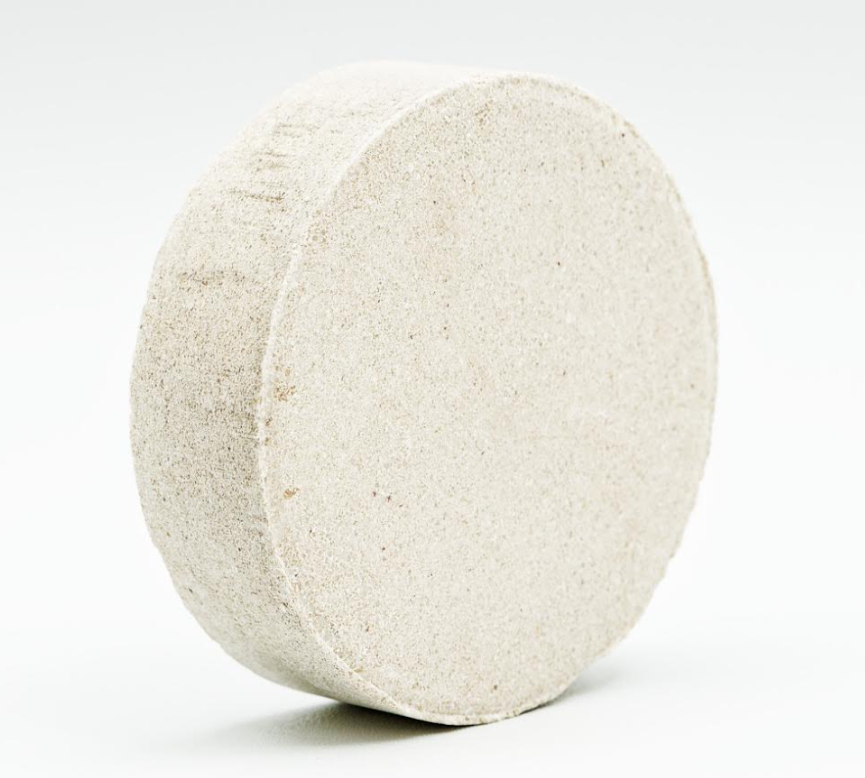
Pit Puck® is a drop-in manure pit additive: a 130 gram tablet at 10 billion CFU per gram that sinks into a manure pit, storage tank or lagoon and dissolves in minutes. There is no weighing, no mixing, no dilution and no dosing equipment. It carries the same Animal Waste Treat bacteria we supply in powder and liquid form, delivered in a slow-release tablet built for operations that dose by head count rather than by volume.
The bacteria digest the fats, proteins and fibrous solids that build into sludge, bottom crust and surface scum. That is what gives a pit back its capacity, lets agitation reach the whole mass instead of churning under a mat, and shortens pump-out.
One tablet per week per 100 cows or 300 finisher hogs. Nothing to calculate against volume, nothing to weigh, and one person can apply it walking past the pit. That is the whole reason an operation buys a tablet instead of a pail of powder, and it is why the product gets used every week rather than sitting in the shop.
Key benefits:
Buying: small operations can buy Pit Puck® on Amazon in jars of 7. For pails of 50 or 100, bulk, wholesale, OEM and private label, request a quote and tell us your herd size and pit or lagoon type.
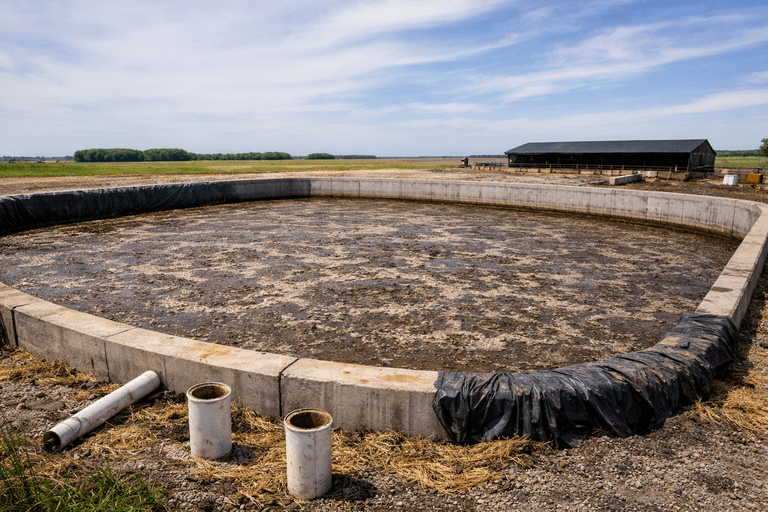
A manure pit additive is a product you add to stored manure so the accumulated solids are digested biologically instead of removed mechanically. Every pit, storage tank and lagoon runs the same losing arithmetic: manure arrives faster than the resident biology can break it down, so fiber and fat settle into bottom sludge, float into surface crust, and quietly eat the structure's usable volume. The mechanical answer is dredging, extra agitation hours and longer pump-out. The biological answer is to put enough of the right bacteria in the manure to keep the solids moving.
Pit Puck® is that second answer in its simplest form. Each 130 gram tablet carries 10 billion CFU per gram of spore-forming Bacillus bacteria selected for manure systems. The tablet sinks, dissolves within minutes, and releases the bacteria into the manure mass rather than leaving them on the surface. Those bacteria produce protease, cellulase and lipase enzymes, which is the specific reason they work on manure: proteins, fibrous plant material and fats are exactly what manure solids are made of, and those three enzyme classes are what cut them apart.
What that buys an operation is measured in four things it feels every week: storage capacity, agitation, pumping hours and odor.
Bottom sludge and surface crust are the same material at two ends of the pit. Fibrous plant matter, undigested feed, fats and proteins either settle or float, and once a mat forms on top it seals the surface, slows gas exchange and makes agitation churn underneath instead of through.
The bacteria in Pit Puck® are facultative, meaning they stay active whether oxygen is present or not. That is not a technical footnote on a manure pit, it is the whole requirement. The sludge layer at the bottom of a deep pit is the most oxygen-starved part of the system and also the part that most needs digesting. Aerobic-only products stall exactly where the problem is. In the swine lagoon trial the dissolved oxygen reading was 0.2 mg/L at both sampling dates, fully anaerobic throughout, and eleven of twelve measured parameters still moved in the intended direction.
Digestion is continuous rather than a one-time clean-out, which is why maintenance dosing matters more than the size of any single application. Manure keeps arriving. The tablet format supports that pattern: a weekly puck per head-count group keeps the bacterial population topped up without anyone having to measure anything.
Every hour of manure agitation and every hour of pumping is diesel, labor and a tractor that is not doing something else. Solids are what make those hours long: a thick, stratified pit resists the impeller, a crust hides the mass from it, and settled sludge raises pumping pressure and plugs injectors and transfer lines.
A digested pit behaves differently. The liquid manure is more homogeneous, so agitation reaches through rather than around, pumping resistance falls, and the load going into the tanker is closer to uniform. Fewer plugging events also means less time spent clearing a line in the middle of a spreading window, which is when it hurts most.
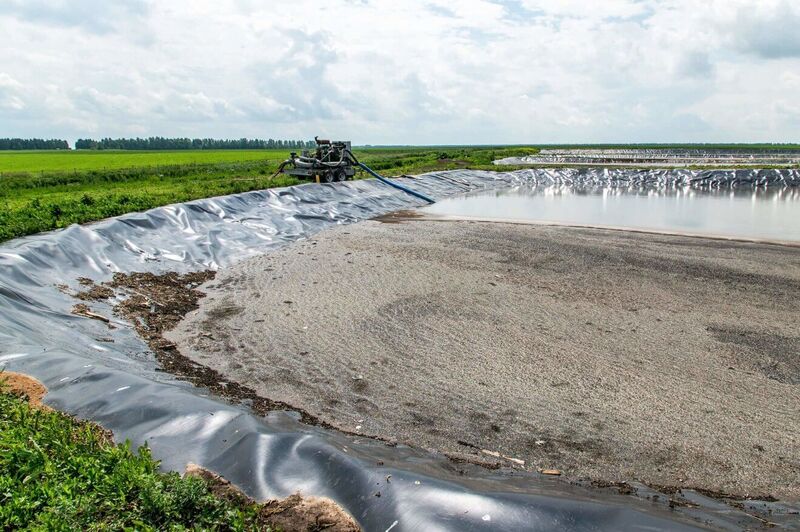
The clearest measured example comes from the same biology in liquid form on a dairy lagoon, where pumping fell from 80 hours to 38 hours per cycle, a 52.5% reduction, and the lagoon returned to 95% open water in 45 days. That trial used the powder and liquid product rather than tablets, so it is quoted here as evidence of what the bacteria do, not as a tablet result.
Odor from a manure pit comes mostly from volatile fatty acids and the sulfur and nitrogen gases released when solids break down without enough biological capacity to finish the job. Agitation day is when it becomes everyone's problem, because the mass that has been sitting still gets stirred back into the air.
Biological treatment works on the source rather than the smell. Digesting the organic solids and the volatile fatty acids removes what the odor is made of, which is a different mechanism from a masking agent or a perfume. Odor is usually the first change an operation reports, ahead of anything measurable in the solids, simply because people notice it daily.
One thing we do not claim: Pit Puck® is not sold as a foam control product for deep pit swine barns. Manure foaming is a real and well-documented hazard, and we have no trial data on it. We would rather say that plainly than let a page imply otherwise.
The dose is set by animals, not by volume, which is what makes the tablet practical for a herdsman rather than an engineer. If you do not know your lagoon's working volume, and plenty of operations do not, it does not matter here.
Startup: 4 tablets to establish activity, per each group below. Maintenance: 1 tablet per week, per each group below.
Application is as simple as it sounds: toss the tablet into the pit or lagoon, near an inlet, agitation point or pump intake where the manure is moving, so the bacteria distribute. It dissolves in minutes and sinks. There is nothing to weigh, dilute or activate, and nobody has to open a pail on a windy day.
The tablet's operating range is wide enough for year-round use: pH 5 to 9.5 with an optimum of 6 to 8, and 45 to 120 °F with an optimum of 59 to 104 °F. Activity slows in a cold pit, as it does with any biological product, so expect longer timelines through winter rather than no result.
Anyone comparing manure pit additives is really comparing three things at once: the biology, the format and the supplier. Most product pages only argue the first, and the first is where the leading commercial products differ least. Nearly all of them are spore-forming Bacillus blends producing the same three enzyme classes. Where they genuinely differ is how the product gets into the manure and what the company will tell you when you ask a hard question.
The format question usually answers itself once you know who applies the product. If that person is a herdsman walking past a pit on the way to something else, a tablet gets used every week and a pail of powder does not.
Cost per pound of product is the wrong comparison, because the formats are not dosed the same way. Run cost per head per week instead, and add the labor of measuring and mixing on the formats that need it. A tablet is more expensive per gram of active material than bulk powder and usually cheaper per head on a deep-pit operation, because the powder rate on a structure of unknown volume tends to get rounded up. On a large lagoon with a pump loop and a scale, that reverses and powder wins outright.
Very large waste lagoons dosed by volume, sites that already own dosing equipment, and operations buying by the tote. All three are better served by the powder or liquid form of the same biology. We would rather sell the right format than the more expensive one, and since both formats are ours, we have no reason not to say so.
Two operations ran this product with laboratory analysis on both ends. They were different species, different countries, different laboratories and different objectives, so they are two case studies rather than a curve. Both are published in full, including what they failed to achieve.
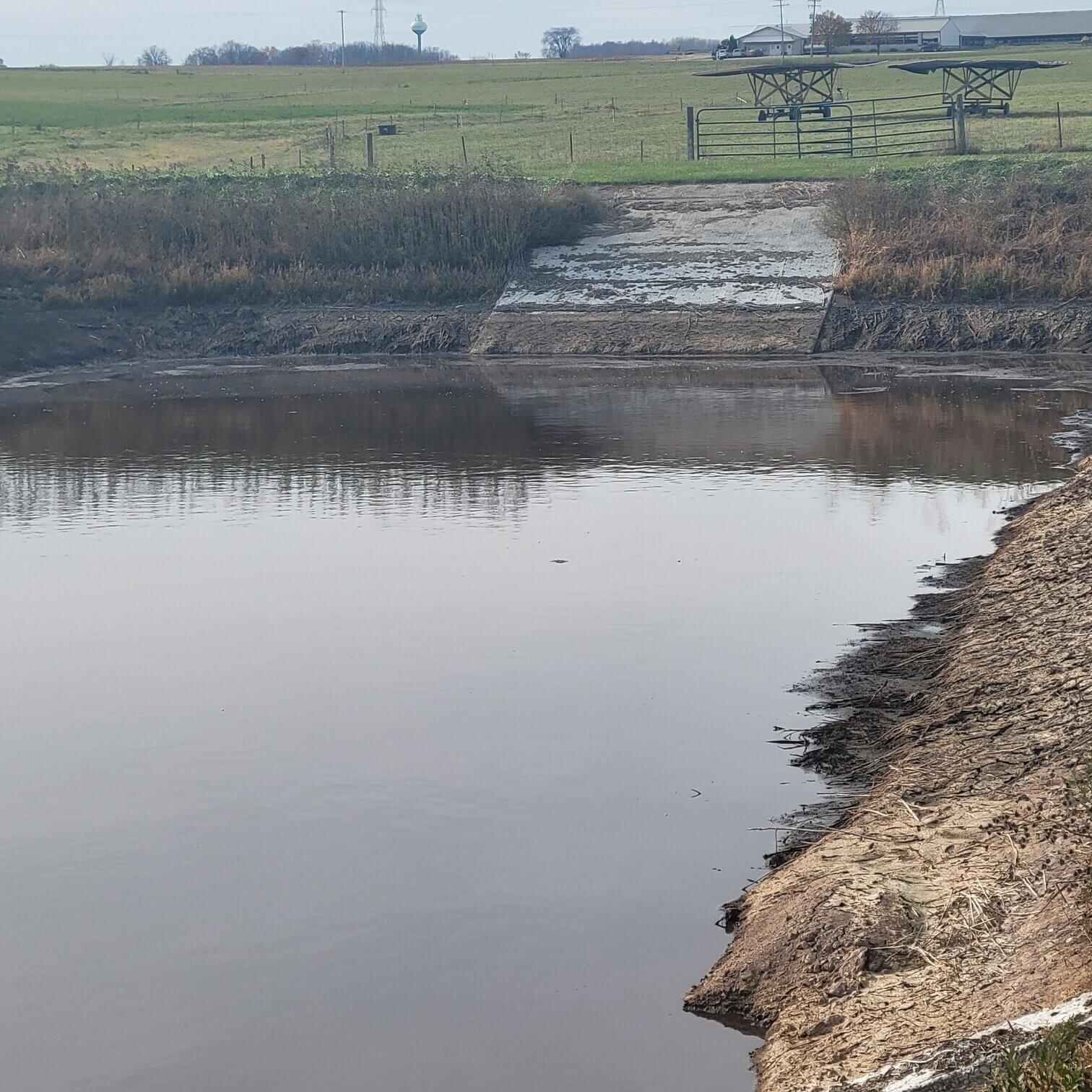
The farm stored liquid dairy manure in a lagoon and spread it on its own ground. Two problems ran together. The lagoon carried heavy bottom sludge and a surface scum layer, which drove odor and made every agitation and pump-out cycle harder. Separately, the manure was not worth much agronomically: lab analysis showed low plant-available nitrogen and potassium, while the phosphorus concentration was high enough to cap how many gallons per acre the farm could apply under its nutrient management plan.
Pit Puck went in as a drop-in tablet with no equipment and no labor change. Manure was sampled and sent for nutrient analysis, then sampled again after treatment, with both results converted to pounds per acre at the farm's working rate of 20,000 gallons per acre.
At this dairy the manure came out carrying more nitrogen and potassium and less phosphorus per acre, which is the direction a nutrient management plan wants, since phosphorus is usually what caps how many acres a lagoon has to cover. That is one lagoon at one rate. How a given structure responds varies with lagoon volume, loading rate and temperature, and we do not offer a nutrient result as something we can set in advance. Full numbers and photos are in the Wisconsin dairy lagoon case study.
A commercial swine operation held raw slurry in an anaerobic lagoon and was being judged on how far it could pull down a full effluent panel. The starting load was heavy, with settleable solids pegged at 1,000 mL/L, the top of the scale on a standard Imhoff cone. Nothing about the site could change: no aeration, no dredging, no new equipment, no interruption to normal loading. Because the objective there was reduction across every component, that operation dosed above the published maintenance rate. A baseline sample was drawn before any product went in and a second sample 41 days later, both analyzed by ANAM, Analisis Ambientales S.A., an environmental laboratory accredited by the American Association for Laboratory Accreditation under A2LA certificates 6134-01 and 6134-02.
Chemical oxygen demand, biochemical oxygen demand, ammonia and total nitrogen fell as well, between 27% and 84%, so eleven of twelve measured parameters moved in the intended direction. The full lab panel is in the swine manure lagoon case study.
Two limits belong here rather than in small print. The swine operation's own targets for total suspended solids and total nitrogen were both 1,500 mg/L, and neither was met, even while nine tenths of the solids load was removed. And in both trials day zero is a baseline, not a control: there was no untreated lagoon running in parallel, so settling, temperature and rainfall over the trial period cannot be separated from the treatment. What the two trials share is a direction, not a dial. Solids fell and phosphorus fell in both, through the same mechanism. Everything else moved differently, which is what you would expect from two lagoons with nothing else in common.
Pit Puck® is the slow-release tablet form of Animal Waste Treat. Same spore-forming Bacillus blend, same facultative strains, same enzyme activity. Animal Waste Treat ships as powder, liquid and slow-release blocks dosed by volume; Pit Puck ships as a 130 gram tablet dosed by head count. For a dealer that is one biology and one supply relationship covering four formats. For a producer already using one, the other is not a new product to evaluate.
Manure management is really two jobs that compete for the same storage. The structure has to hold the manure until you can legally and practically spread it, and the manure has to be worth something when it goes on the ground. Solids accumulation works against both at once: it takes away storage volume and it leaves nutrients locked in undigested organic matter.
Keeping the storage biologically active addresses both. As solids digest, nutrients that were bound in undigested material become available, and the slurry leaving the pump is more consistent from load to load, which is what makes a spreading plan mean anything. An operation applying variable manure has to plan for the worst sample. An operation applying uniform manure can plan for the actual number.
Phosphorus is the constraint worth watching, because nutrient management plans typically cap application on phosphorus rather than nitrogen, which forces you to spread thin across more acres to place the same nitrogen. Both trials moved phosphorus down. For an operation short on spreadable ground, that is the argument.
Some operations run a heavier program when they are working to a reduction target rather than routine maintenance. If that is your situation, talk to us about your system rather than ordering off the standard rate.
Pit Puck® ships direct from the manufacturer in jars of 7 and pails of 50 or 100. Bulk and wholesale quantities are available for farms, cooperatives, integrators and agricultural service providers, and OEM and private label supply is available for qualified partners, including custom CFU concentrations and packaging. We ship across the US and internationally.
Small operations that want a jar without a purchase order can buy Pit Puck® on Amazon.
For a quote, tell us two things: your herd size and your pit or lagoon type. That is enough to set the dose, and the dose sets the price. Shelf life is 2 years at room temperature and 3 years refrigerated, so ordering in pail quantities does not commit you to using it quickly.
Details:
Packaging Options:
Shelf-life:
Storage Recommendations:
Application Guidelines:
Apply 4 Pit Pucks® per the following livestock equivalents to establish active microbial digestion:
This initial application jump-starts biological activity, accelerates solids digestion, and begins liquefying accumulated manure solids and sludge.
Apply 1 Pit Puck® per week per the following livestock equivalents to maintain consistent digestion and manure handling performance:
Weekly maintenance dosing supports continued solids reduction, improved agitation and pumping, odor control, and nutrient stability.
A manure pit is the below-barn or in-ground structure a livestock operation uses to store liquid manure between land applications. Deep pits sit under slatted barn floors, storage tanks and lagoons hold manure outside. All of them accumulate settled solids, bottom sludge and surface crust over time, which is what reduces usable capacity and makes agitation and pump-out slower and more expensive.
A manure pit additive is a product added to stored manure to digest the accumulated solids biologically rather than removing them mechanically. Microbial additives deliver bacteria that produce protease, cellulase and lipase enzymes, breaking down the proteins, fibers and fats that form sludge and crust. Pit Puck delivers those bacteria in a 10 billion CFU tablet you drop straight into the pit, with no mixing or equipment.
The biology can be identical; the delivery is not. Liquids and powders have to be measured, sometimes diluted, and often applied with equipment, and they can stay near the surface instead of reaching the solids below. A tablet sinks and dissolves in minutes, putting the bacteria into the manure mass where the sludge actually is, and it is dosed by head count instead of by volume. For pits and tanks that are awkward to reach or dose by hand, that difference is the whole reason producers choose tablets.
In our case, yes. Pit Puck is the slow-release tablet form of Animal Waste Treat, the same spore-forming Bacillus blend supplied as powder, liquid and blocks. The strains and the biology are the same. Tablets suit deep pits, storage tanks and operations dosing by head count; powder and liquid suit larger lagoons and volume-based dosing. Dealers who already stock Animal Waste Treat can carry both without adding a second biology.
The only honest test is whether something measurable changes, verified by someone who is not selling it. Two trials on this product were lab-analyzed. A Wisconsin dairy lagoon showed plant-available nitrogen rise from 172.4 to 237.0 lbs per acre, a 37% gain at the same 20,000 gallon rate. A commercial swine lagoon, analyzed by an A2LA-accredited laboratory, showed total suspended solids fall 91% and phosphorus 85% in 41 days. Both trials also missed some of the operation's own targets, and both are published with those misses intact.
Settled manure solids are undigested organic matter, so the biological route is to give the pit enough of the right bacteria to keep breaking them down instead of letting them settle and mat. The enzymes cut fibers, fats and proteins into material that stays in suspension, which converts thick or settled manure into a more uniform, pumpable slurry. In the swine lagoon trial, settleable solids went from 1,000 mL/L to 3 mL/L over 41 days.
Sludge on the bottom and crust on top are the same problem at two ends of the pit, and both are undigested solids. Adding bacteria that digest fibrous material breaks the mat apart and thins the sludge layer so the pit recovers capacity. Doing it biologically avoids dredging and the equipment time that goes with it. Continuous dosing matters more than a single large application, because manure keeps arriving.
Most of the gain comes from getting the storage biologically active, so solids break down and the slurry leaving the pump is more consistent. In the Wisconsin dairy trial, adding a microbial tablet lifted plant-available nitrogen 37% and potassium 20% per acre while dropping phosphorus 13.4 lbs per acre, without any change to the herd, the ration or the spreading rate. The phosphorus drop matters as much as the nitrogen gain, because phosphorus is usually what caps how many gallons per acre a nutrient management plan allows.
Sometimes, but it is not something we can promise in advance. At the standard weekly maintenance rate the program is set up to retain nitrogen, which is what a farm spreading its own manure wants. In one commercial swine lagoon dosed above the label rate, total nitrogen fell 27% and ammonia 28% over 41 days. That is a single lagoon with its own volume, loading and climate, and how nitrogen behaves in stored manure depends on far more than the additive. If you are working to a nutrient management plan or an internal reduction target, tell us the target and the system and we will size a program with you rather than quoting a rate off a table.
Storage and agitation odor comes mostly from volatile fatty acids and the gases released as undigested solids break down uncontrolled. Digesting those solids removes the source instead of covering it, which is why biological treatment behaves differently from a masking agent. Odor is usually the first change an operation notices, ahead of any measurable solids reduction. Pit Puck is not sold as a foam control product and we make no claim there.
Most operations notice the odor change first, generally within the first couple of weeks, with solids reduction and easier pumping developing over the following one to two months. The swine lagoon trial ran 41 days, just under six weeks, between the baseline sample and the follow-up. Results vary with pit volume, loading rate, temperature and how much sludge has already accumulated, so a cold pit or a lightly dosed one will take longer.
Yes. The tablet is designed for deep pits, storage tanks, holding structures and waste lagoons. Both published trials on this product were run in lagoons. For very large lagoons, the powder and liquid forms of the same biology are usually the more economical way to dose by volume, and we will say so rather than sell you tablets you do not need.
Yes. The strains are facultative, so they stay active across the aerobic, facultative and low-oxygen zones found in a deep pit or a crusted lagoon. That matters because the sludge layer is the most oxygen-starved part of the system and also the part that needs digesting. The swine lagoon in the trial ran at 0.2 mg/L dissolved oxygen throughout, which is fully anaerobic, and still moved eleven of twelve measured parameters.
Yes, and the dose table covers both, along with heifers, dry cows, feeder calves, sows and finisher hogs. The two published trials cover both species: a Wisconsin dairy lagoon and a commercial swine lagoon. Feedlots and mixed livestock operations use the same head-count dosing.
Yes, and for most operations this is the change that pays for the program. Digesting settled solids produces a more uniform slurry, which lowers pumping resistance, shortens pump-out and reduces plugging in pumps, transfer lines and injectors. On the lagoon side, the same biology in liquid form cut pumping at one dairy from 80 hours to 38 hours per cycle, a 52.5% reduction.
You drop it in. Toss the tablet directly into the pit or lagoon and it sinks and dissolves within minutes, delivering the bacteria into the manure mass. No mixing, dilution, activation or equipment is required. For best distribution, apply near inlets, agitation points or pump intakes where the manure is moving.
One tablet per week per 100 cows for ongoing maintenance, after a startup dose of four tablets to establish activity. The same weekly rate covers 200 heifers or dry cows, 400 feeder calves, 100 sows or 300 finisher hogs. If your objective is nutrient reduction rather than routine maintenance, the rate goes up, so tell us the target before you order.
Pit Puck contains naturally occurring beneficial bacteria and no harsh chemicals or oxidizing agents. Used as directed it is safe for manure storage infrastructure, livestock, soils and crops. Standard handling guidance is in the SDS and tech sheet on this page. Normal pit gas safety rules still apply to any confined manure storage and are unaffected by biological treatment: never enter a pit and always ventilate before and during agitation.
Store in a cool, dry place away from direct sunlight and reseal the container after each use. Shelf life is 2 years at room temperature and 3 years refrigerated. The tablet format is stable in a barn or shop where powders can cake and liquids can freeze.
Pit Puck ships direct from the manufacturer in jars of 7 and pails of 50 or 100, with bulk, wholesale, OEM and private label available for distributors, integrators and agricultural service providers. Small operations that want a jar without a purchase order can buy it on Amazon. We ship across the US and internationally.
Yes. Pit Puck is available in bulk and wholesale quantities, and under private label or OEM supply with custom CFU concentrations and packaging for qualified partners. Because it is the tablet form of Animal Waste Treat, a distributor can carry powder, liquid, block and tablet on one biology and one supply relationship.
Contact our sales team with your herd size, pit or lagoon volume and what you are trying to achieve, whether that is easier pump-out, more fertilizer value in the slurry, or a reduction target you are being measured against. Those three answers set the dose, and the dose sets the price. We supply farms, dairies, swine operations and distributors directly.