- Products
- Overview
- Product Forms / Packaging
- Plant Health
- Wastewater
- Livestock Waste
- Aquaculture & Ponds
- Petroleum & Grease
- Case Studies
- Buy
- About
- Contact

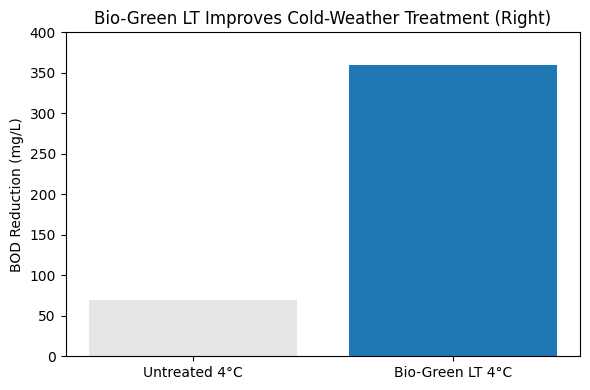
Low Temperature (LT) is a blend of cold-weather Bacillus bacteria built to keep biological treatment running when water drops below 15°C/60°F. While standard bacteria stall in the cold, LT strains retain about 92% of their biological activity at 4°C/39°F, versus 1 to 5% for conventional bacteria, so wastewater plants, lagoons, and cold-water ponds hold their BOD, COD, TSS, and sludge reduction straight through winter. In a controlled cold-weather trial on dairy and pulp and paper wastewater, LT delivered measurable BOD reduction in three days at 4°C. By keeping the biomass active and limiting winter sludge and nutrient release, LT helps operators avoid seasonal upsets and hand off cleanly into spring.
Key Benefits:
Cold weather is hard on every kind of biological system, from municipal and industrial wastewater plants to lagoons and cold-water ponds. As water cools, biological conversion slows and solids stop digesting, so sludge builds, effluent slips, and odor climbs. Low Temperature (LT) is a consortium of cold-active, psychrotolerant Bacillus bacteria that stays active when conventional microbes turn sluggish, holding BOD, COD, TSS, and sludge reduction through the winter.
Standard wastewater bacteria lose roughly half of their activity for every 10°C drop in temperature, and most slow sharply below 10°C/50°F. That is when facilities see BOD and COD creep up, ammonia and nitrogen cycles wobble, sludge accumulate, and the risk of process upsets and compliance misses rise, right when stability matters most. This is the low temperature that slows biological wastewater treatment, and LT is formulated to hold performance through that window instead of losing it.
LT supplies cold-active Bacillus strains that keep producing the enzymes that drive treatment at low temperature. In cold-weather testing, LT retained about 92% of its biological activity at 4°C/39°F relative to 25°C/77°F, compared with just 1 to 5% for conventional bacteria. That translates to consistent BOD reduction at low temperature, reliable COD reduction in cold wastewater, and more stable ammonia removal and denitrification, while keeping effluent clearer, reducing odor, and limiting the seasonal sludge that disrupts operations in spring.
In a controlled cold-weather trial on dairy and pulp and paper wastewater, LT held about 92% of its 25°C biological activity at 4°C, against 1 to 5% for two conventional competitor products, and produced measurable BOD reduction within three days at 4°C. This was a controlled lab bench comparison rather than a full-scale plant install, and both tests point the same way: LT keeps biological treatment working near freezing, so winter sludge and odor stay controlled and no seasonal shutdown is required.
In ponds and lagoons, the same cold that slows a treatment plant slows the natural biology that keeps water clear and sludge digested. LT works as a cold water beneficial bacteria that stays active near freezing, digesting the bottom sludge, leaves, and organic muck that pile up over winter and limiting the nutrient conditions that favor algae as the water warms. It is safe for fish, aquatic plants, pets, and wildlife, and treated water is safe for recreation.
LT ships as a slow-release block that steadily releases cold-water pond and lagoon bacteria for consistent activity through the coldest months. For heavy winter muck, pair LT with Muck Fighter slow-release blocks, and for ongoing clarity through the warm season, hand off to Pond Treat. Operators running full treatment systems can also combine LT with Wastewater Treat as temperatures recover.
LT keeps the biological functions that normally stall in the cold running: BOD reduction at low temperature for cleaner effluent, COD reduction in cold wastewater for consistent organic breakdown, low temperature denitrification for nutrient compliance, and sludge digestion at low temperatures to cut hauling and springtime surges. Holding these functions through winter is what keeps a system in compliance when native biology slows.
By limiting excess solids buildup during winter, LT helps prevent the nutrient surges that cause springtime process problems. It curbs the nitrogen and phosphorus release that drives odors and algae blooms, reduces sludge handling and hauling costs, and limits the effluent upsets tied to seasonal load changes.
LT strengthens cold-weather process resilience, keeping operations stable and helping facilities recover from upsets up to 2 to 3 times faster. It reduces vulnerability to hydraulic washout during storms and variable flows, and works alongside existing biomass for a balanced microbial community that carries cleanly from winter operation into spring startup.
LT ships in powder, liquid, slow-release block, and tablet forms, from sample through bulk quantities, with private label and OEM options for distributors.
A typical wastewater starting dose is 40 grams of 50-billion CFU/g powder per million liters per day, or 150 grams per million gallons per day, doubled after two weeks. In ponds and lagoons, one slow-release block covers about one acre for roughly 30 days. Tell us your system type and your winter low temperatures, and we will recommend a starting dose and send a quote. LT is available in bulk and wholesale supply for plants, lagoons, and pond managers, with custom CFU concentrations and packaging on request.
Concentration (CFU):
Custom concentrations available upon request
Packaging Options:
Smaller packaging available upon request
Shelf-life:
Storage Recommendations:
Blocks
Fast-Dissolve Tabs
Yes. Low Temperature (LT) is a blend of cold-active, psychrotolerant Bacillus bacteria that keeps working when water turns cold. Its strains retain about 92% of their biological activity at 4°C/39°F, versus 1 to 5% for conventional bacteria, so wastewater plants, lagoons, and ponds hold their BOD, COD, TSS, and sludge reduction through winter.
Standard microbial products lose roughly half their activity for every 10°C temperature drop, so treatment slows and sludge, odor, and compliance problems follow. Low Temperature (LT) is engineered for winter wastewater treatment: its cold-weather microbes stay active near freezing and keep systems stable through the season.
Low Temperature (LT) keeps the biological functions that normally stall at low temperatures running:
Yes. Low Temperature (LT) uses cold-active microbes that speed sludge digestion at low temperatures, limiting the solids buildup behind winter odor. Keeping solids in check also limits the nitrogen and phosphorus release that drives odor, TSS spikes, and the nutrient conditions that favor spring algae.
Yes. By keeping the biomass active and efficient in winter, Low Temperature (LT) reduces sludge hauling, dredging, and chemical costs, and can lower aeration energy demand by keeping the biology stable in cold conditions.
Low Temperature (LT) is formulated for activated sludge cold-weather performance and works in SBR and MBBR systems at low temperatures. It also stabilizes lagoons and ponds where operators need reliable microbial activity through winter.
Low Temperature (LT) is a cold-water pond bacteria that stays active near freezing, when the natural biology that keeps a pond clear slows down. It digests the bottom sludge and muck that build up over winter and limits the nutrient conditions that favor algae as the water warms, for smoother pond recovery in spring. It is safe for fish, aquatic plants, and wildlife.
Low Temperature (LT) ships in multiple dosing formats:
Yes. Low Temperature (LT) comes as a slow-release block for easy dosing in ponds, lagoons, and wastewater systems. The block steadily releases cold-water pond and lagoon bacteria into the water for consistent activity through the winter months.
Yes. Low Temperature (LT) blocks are all-natural and non-GMO, and are safe for fish, aquatic plants, pets, and wildlife. Treated water is safe for recreation and can be used right after application.
Yes. Low Temperature (LT) is available in bulk and wholesale supply for municipal and industrial wastewater facilities, pond managers, and lagoon operators. Custom CFU concentrations and packaging sizes are available on request.
Yes. Low Temperature (LT) is offered in private label, OEM, and distributor-ready formats, in powder, liquid, block, or tablet form, to fit B2B buyers across different markets.
You can buy Low Temperature (LT) directly from the manufacturer in bulk, wholesale, private label, OEM, and distributor formats, with domestic and international shipping.
Contact our sales team for pricing and dosing guidance. We supply WWTP operators, pond and lagoon managers, industrial users, OEMs, and distributors directly, and we will recommend a starting dose for your system and winter temperatures.