- Products
- Overview
- Product Forms / Packaging
- Plant Health
- Wastewater
- Livestock Waste
- Aquaculture & Ponds
- Petroleum & Grease
- Case Studies
- Buy
- About
- Contact

Multi-Tricho is an OMRI Listed multi-strain Trichoderma inoculant built on three complementary strains: Trichoderma harzianum, Trichoderma asperellum, and Trichoderma longibrachiatum. They colonize the root zone, release enzymes that free up nutrients and break down crop residue, and crowd out the space where root pathogens would otherwise take hold. In independent and field trials, that has meant stronger roots, better transplant survival, and more fruit, even on poor soil.
Multi-Tricho is a high-CFU, OMRI Listed Trichoderma inoculant: a living powder of beneficial soil fungi you dissolve in water and apply to the root zone. Once it is down, the fungi colonize root surfaces and the surrounding rhizosphere and work on two fronts. They release cellulase, amylase, protease and related enzymes that break down crop residue and free up nitrogen, phosphorus and micronutrients the crop can take back up. And as living fungi they colonize aggressively and compete for the space and food in the root zone, establishing first so the crop grows into an occupied, biologically active root zone instead of a bare one. That head start is what shows up later as stronger roots, better establishment and more yield.
Multi-Tricho is built on three complementary species rather than one: Trichoderma harzianum, Trichoderma asperellum and Trichoderma longibrachiatum. Trichoderma harzianum is the most studied of the beneficial Trichoderma fungi, valued for aggressive root colonization and strong residue breakdown. Pairing it with asperellum and longibrachiatum widens the range of crops, soil types and temperatures the blend performs in, because each species occupies a slightly different niche in the root zone. That is what lets one Trichoderma for plants deliver on hydroponic transplants, marginal field soil and turf alike, and in a side-by-side trial it is what put Multi-Tricho ahead of a leading single-strain commercial product.
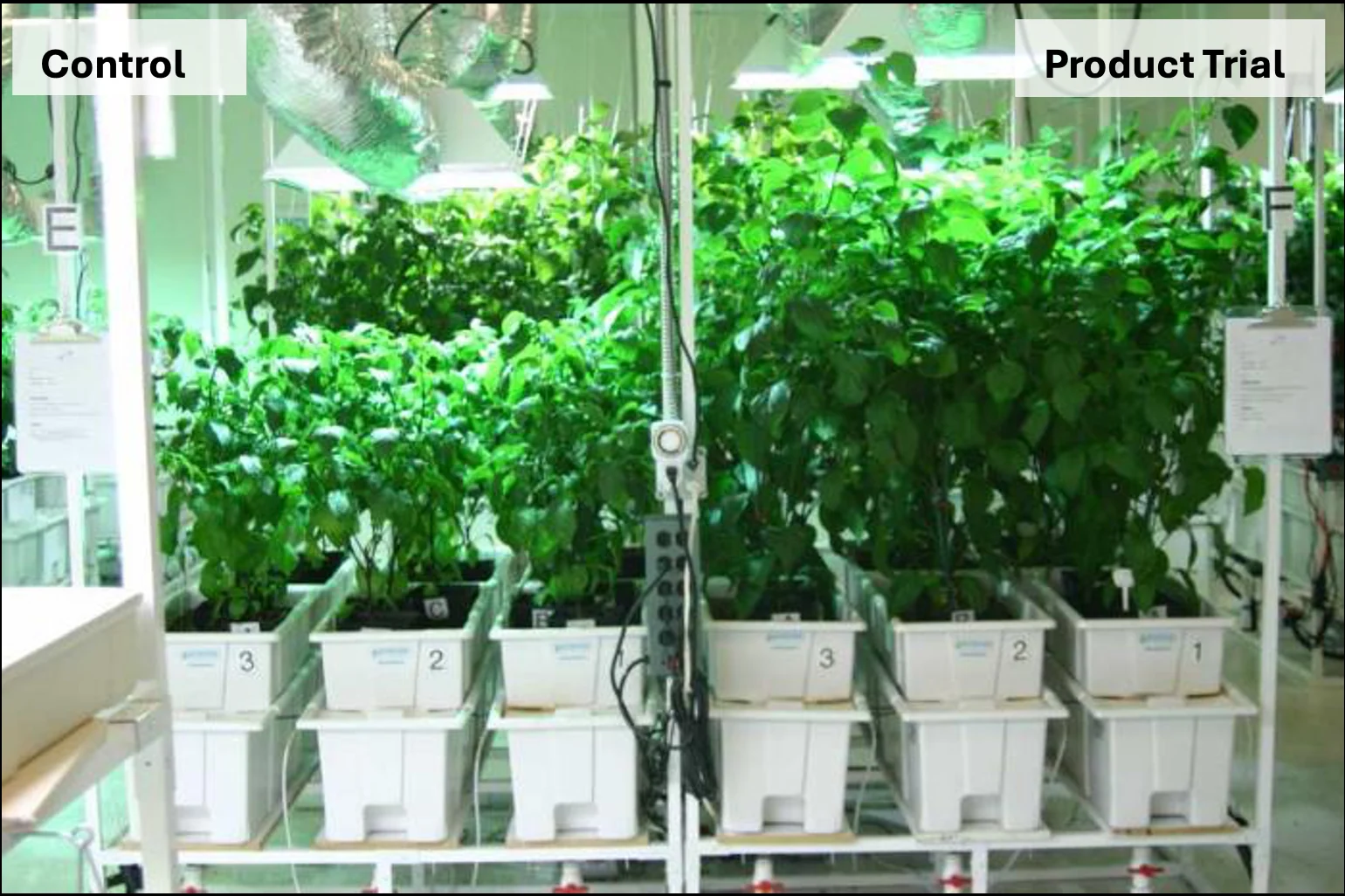
The proof is measured, not asserted, and it comes from separate trials rather than one flattering test. In an independent Arizona laboratory, peppers grown in a standing hydroponic lot reached 100% transplant survival, 24 of 24 plants, against 71% for the untreated control on the same nutrient solution, and built about 39% more wet root mass, 126.4 grams versus 91.1 grams, with roots nearly twice as long. In a separate drip lot run out to fruiting, treated plants set about 18% more peppers per plant, 42.6 versus 36.2, and stood roughly 35 centimeters taller. In a third soil lot, Multi-Tricho also finished ahead of a leading commercial Trichoderma product on height and leaf mass. These are three separate lots in separate systems, not one experiment measured three ways, and the trial did not run replication statistics, which is exactly why we show the plant counts.
No. Multi-Tricho is a soil and root inoculant and biostimulant, not a registered fungicide, and it makes no disease-control claims. What it does is colonize the root zone aggressively and compete for space and resources, which helps crowd out less desirable organisms and keeps roots vigorous. Growers searching for a biofungicide are usually after that competitive, root-zone effect, and that is what a multi-strain Trichoderma inoculant delivers, through ecology rather than chemistry.
A crop is decided early. Every transplant lost in the first weeks is a hole in the stand that produces nothing for the rest of the season, and root establishment sets the ceiling on everything after it. By colonizing the root zone the moment it goes in, Multi-Tricho drives root elongation and branching for better anchorage and nutrient uptake, which is what carried the Arizona peppers from 71% survival to 100% and from 91.1 to 126.4 grams of root mass. Stronger, longer roots reach water and nutrient a stressed seedling otherwise cannot, and that early advantage is what turned into more fruit per plant at harvest.
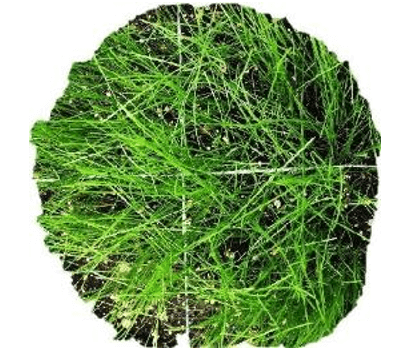
Turf is judged on how fast and how evenly it comes in. In a Mustang III turfgrass trial in Colombia, plots treated weekly with Multi-Tricho reached 100% germination by day 9, against 22% for the untreated control on the same nutrient solution, and grew 30% taller by day 24, 9.2 centimeters versus 7.1. The response tracked the rate at every reading: more inoculant, faster and more even establishment. For sod producers, golf course superintendents and anyone overseeding into a thin stand, that shorter, more uniform establishment window is where a turf inoculant pays.
As a microbial soil amendment, Multi-Tricho rebuilds root-zone biology rather than feeding the crop once. Its cellulase, amylase and protease activity breaks down crop residue and organic matter, which is the same enzyme work that makes it an effective Trichoderma compost inoculant: dissolve the powder, spray the piles and turn them to distribute it through the windrow. In the field, that residue turnover returns nutrients to the root zone and supports soil aggregation for better aeration and water movement, so fertility builds over repeat applications instead of fading like a one-time input.
Multi-Tricho is a broad-acre and specialty-crop inoculant that fits most soil, greenhouse and hydroponic systems:
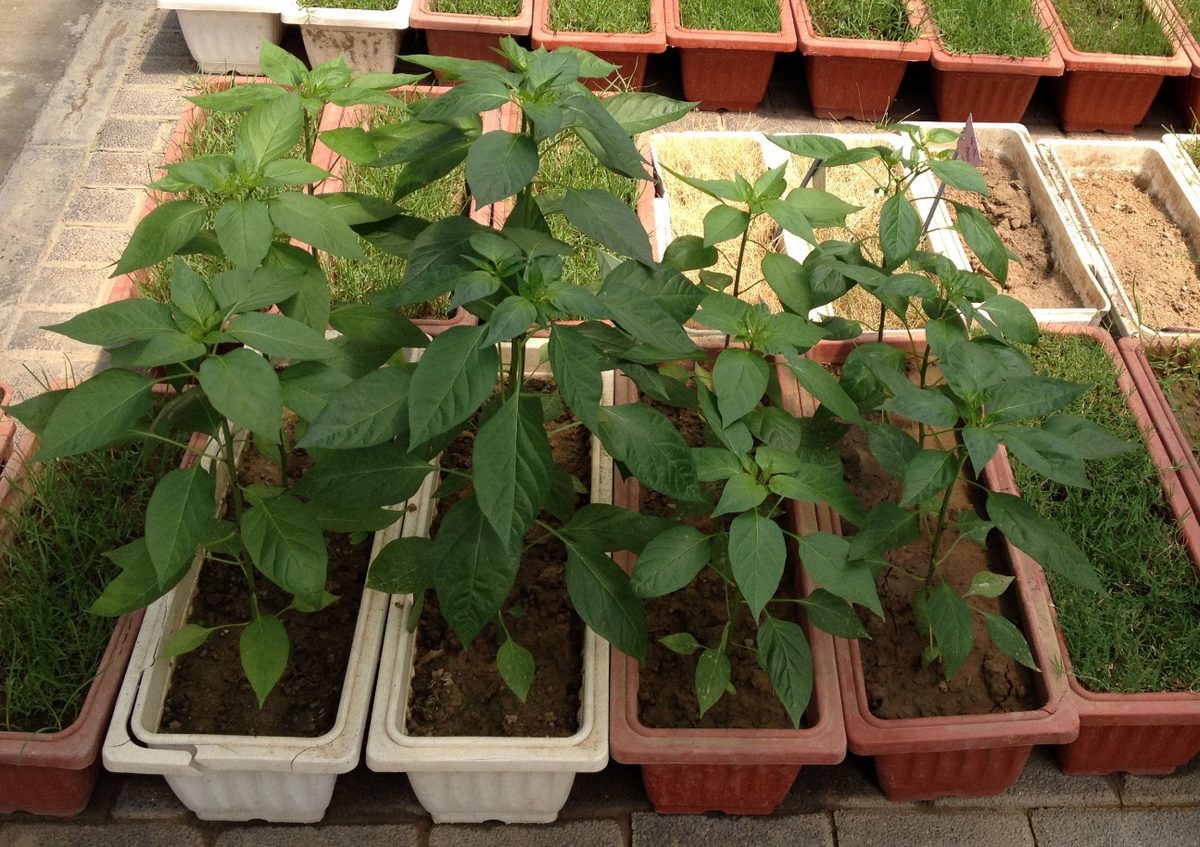
The clearest test of a soil biology input is what happens on poor ground. In a China green pepper trial on deliberately poor soil with no fertilizer applied at all, treated plants produced 156 grams of fruit per plant against 63 grams for the untreated control, more than double the yield from soil biology alone. By colonizing and stabilizing the root zone, Multi-Tricho helps crops hold up through drought, salinity and compacted or degraded soils, and it helps rebuild that ground over time by restoring biological activity and root regeneration. For a grower on marginal or organic land, that is the point: the yield came from biology, not a bigger fertilizer bill.
Multi-Tricho is a water-soluble powder. Dissolve it fully in non-chlorinated water and apply to the root zone through drip, drench or fertigation at 100 to 200 grams per acre, in-furrow at 25 to 50 grams per acre at planting, or as a foliar spray at 50 to 100 grams per acre during vegetative growth. Keep the solution agitated, apply as close to the roots as possible, and flush the lines afterward. Full rates, timing and the seed-treatment and composting doses are in the application section below.
Multi-Tricho integrates with compost, organic inputs and conventional fertilizer programs, and it can go out with water or compost teas. Dilute fertilizer fully in water before adding the microbes. Do not tank-mix it with fungicides, chlorinated water or other pesticides, which reduce microbial viability; where a chemical program is required, separate the applications rather than mixing them in the same tank.
Multi-Tricho is OMRI Listed for use in certified organic systems and meets the USDA National Organic Program requirements for microbial soil amendments, so it drops into organic and regenerative programs without a paperwork problem. It contains only naturally occurring, non-pathogenic Trichoderma fungi and is safe for organic, regenerative and conventional systems when applied as directed.
Multi-Tricho is a high-CFU powder at 15 billion CFU per gram, built on Trichoderma harzianum, Trichoderma asperellum and Trichoderma longibrachiatum, and it passes a 100-mesh sieve so it moves through drip and fertigation lines without clogging. It ships in 22 lb (10 kg) and 44 lb (20 kg) pails and 340 lb (155 kg) drums, with custom concentrations and packaging available. Store it cool, dry and out of direct sunlight, and reseal the container after each use. Full specifications and shelf life are in the technical data below.
The three biologicals do different jobs and are often run together. Multi-Tricho is the Trichoderma play for root colonization, residue breakdown and fast establishment. Mycorrhizae builds a longer-term symbiosis that extends the root system's reach for phosphorus and water. Sunrise is the broad multi-strain biofertilizer that pairs bacteria and fungi to unlock nutrients across the program. If you are choosing one to start, match it to the problem: establishment and residue, Trichoderma; nutrient and water reach, Mycorrhizae; overall soil fertility, Sunrise.
Multi-Tricho is produced in the United States and sold direct by the manufacturer, with verified CFU counts and lot traceability. If you are looking for where to buy Trichoderma for plants, it is for sale in bulk and wholesale, plus OEM and private-label formats for distributors, integrators and agricultural input companies. Tell us your crop and acreage through the form on this page and we will recommend a rate and send a quote or a sample.
Concentration (CFU/g):
Organisms:
Particle Size (Mesh):
Packaging Options:
Shelf-life:
Storage Recommendations:
Regulatory:
Dosage:
Frequency:
Application Method:
Dosage:
Frequency:
Application Method:
When tank-mixing with fertilizers:
Dosage:
Frequency:
Application Method:
Dosage:
Frequency:
Application Method:
Dosage:
Frequency:
Application Method:
Multi-Tricho is a multi-strain Trichoderma inoculant with Trichoderma harzianum, asperellum, and longibrachiatum. The living fungi colonize the root surface and rhizosphere, release cellulase, amylase, and protease enzymes that break down crop residue and free up nutrients, and compete for space in the root zone so the crop establishes with stronger roots.
Yes. Multi-Tricho is OMRI Listed for use in certified organic systems and meets the USDA National Organic Program (NOP) requirements for microbial soil amendments, so it fits organic and regenerative programs.
No. Multi-Tricho is a soil and root inoculant and biostimulant, not a registered fungicide, and it makes no disease-control claims. What it does is colonize the root zone aggressively and compete for space and resources, which helps crowd out less desirable organisms and keeps roots vigorous.
Yes. Multi-Tricho contains only naturally occurring, non-pathogenic Trichoderma fungi. It is OMRI Listed and safe for use in organic, regenerative, and conventional systems when applied as directed.
Trichoderma harzianum is the most studied beneficial Trichoderma, known for aggressive root colonization and strong residue breakdown. It is one of three strains in Multi-Tricho, paired with Trichoderma asperellum and longibrachiatum so the blend performs across more crops and soil conditions than a single strain.
Yes, and it is measured. In an independent U.S. lab trial, Multi-Tricho reached 100% transplant survival versus 71% untreated, built about 39% more root mass, and produced about 18% more peppers per plant. In a separate no-fertilizer field trial on poor soil, treated pepper yield more than doubled.
Yes. By colonizing and stabilizing the root zone, Multi-Tricho supports crops through drought, salinity, and compacted or degraded soils. In a field trial on deliberately poor soil with no fertilizer, treated pepper plants still produced more than double the yield of the untreated control.
Multi-Tricho works across row crops and cereals, vegetables and horticulture such as peppers and tomatoes, orchards and vineyards, greenhouse and hydroponic crops, and turf and forage. It fits soil, greenhouse, and hydroponic systems, organic or conventional.
Yes. Multi-Tricho integrates with compost, organic inputs, and conventional fertilizer programs, and it can be applied with water or compost teas. Dilute fertilizer fully before adding the microbes, and do not mix it with fungicides, chlorinated water, or other pesticides.
Dissolve the powder in water and apply to the root zone. Typical rates are 100 to 200 grams per acre by drip, drench, or fertigation, 25 to 50 grams per acre in-furrow at planting, and 50 to 100 grams per acre as a foliar spray. Keep the solution agitated, apply close to the roots, and do not tank-mix with fungicides or pesticides. Full rates are in the application section on this page.
Yes. Multi-Tricho works as a Trichoderma compost inoculant. Its cellulase, amylase, and protease enzymes speed up the breakdown of crop residue and organic matter. For composting, dissolve the powder in water, spray the piles, and turn them to distribute it through the windrow.
Yes. Multi-Tricho helps rebuild degraded soils by boosting biological activity, promoting soil aggregation, and supporting root regeneration. It is OMRI Listed and fits regenerative and microbiome-focused programs that rely on living soil biology rather than synthetic inputs.
Multi-Tricho is a high-CFU powder at 15 billion CFU per gram. It ships in 22 lb (10 kg) and 44 lb (20 kg) pails and 340 lb (155 kg) drums, with custom concentrations and packaging available. OEM and private-label formulations are available for distributors.
Yes. Multi-Tricho is available in bulk and wholesale, plus OEM and private-label formats for distributors, integrators, and agricultural input companies. You buy direct from the manufacturer, with verified CFU counts and lot traceability.
Multi-Tricho is for sale directly from us, the manufacturer, in bulk, wholesale, OEM, and private-label formats. Tell us your crop and acreage and we will recommend a rate and send a quote. Use the form on this page to get started.
We manufacture Multi-Tricho in the United States under strict quality control, with verified CFU counts and lot traceability. Buying direct from the producer means reliable bulk, wholesale, OEM, and private-label supply without middle layers.
Contact us through the form on this page for a quote or a sample. Tell us your crop, acreage, and whether you need bulk, OEM, or private label, and we will send pricing and a recommended application rate.