- Products
- Overview
- Product Forms / Packaging
- Plant Health
- Wastewater
- Livestock Waste
- Aquaculture & Ponds
- Petroleum & Grease
- Case Studies
- Buy
- About
- Contact

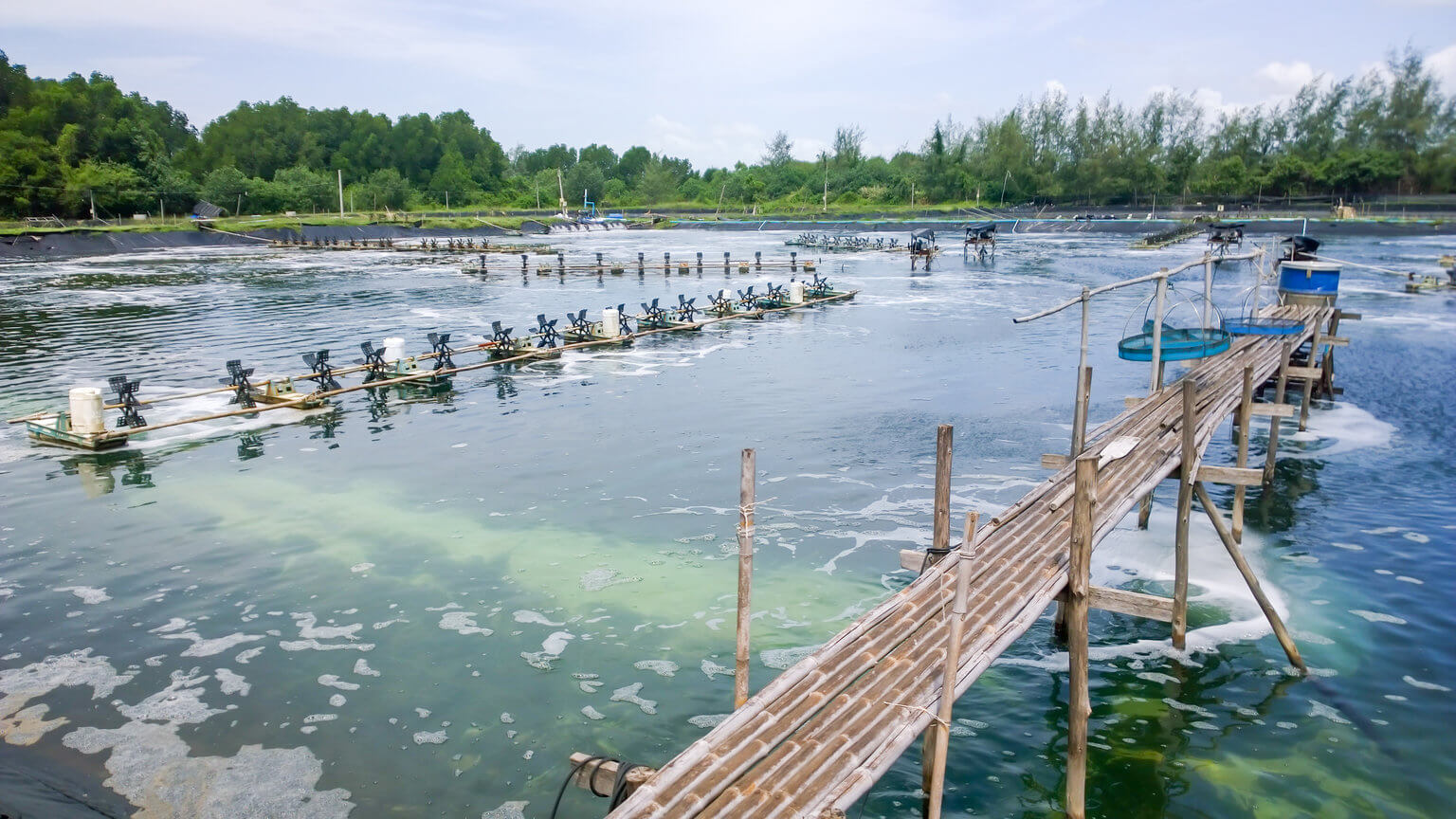
Aquaculture Treat (AQ) is a high-CFU, spore-forming Bacillus probiotic for shrimp ponds and aquaculture water treatment. Its facultative and aerobic strains colonize the water column and the pond bottom, releasing protease, lipase, amylase, and cellulase to break down uneaten feed, feces, and other organics. That lowers BOD, clears suspended solids, feeds the uptake of ammonia and nitrite, cuts sludge and odor, and holds daily pH and dissolved oxygen steady, so ponds run cleaner and shrimp perform more evenly through the cycle.
The numbers above are real field results. On a 7,000 m² Pacific whiteleg pond in Colima, Mexico, AQ raised survival from 69% to 77%, brought feed conversion from 1.79 to 1.37, lifted harvest 17%, and held the pond bottom firm and aerobic with zero water exchange for the entire cycle.
Key Benefits:
Aquaculture Treat (AQ) is a high-CFU, spore-forming Bacillus probiotic for shrimp and aquaculture ponds. Its facultative and aerobic strains stay active in both the oxygen-rich water column and the low-oxygen pond bottom, so the treatment keeps working where a single-strain product would stall. The strains secrete protease, lipase, amylase, and cellulase, the enzymes that break down uneaten feed, feces, and dead plankton before that waste decays. Digesting the organic load lowers BOD and COD, clears suspended solids, and feeds the microbial uptake of ammonia and nitrite, so the pond holds cleaner water and steadier pH and dissolved oxygen across the whole cycle.
On a 7,000 m² Pacific whiteleg (Litopenaeus vannamei) grow-out pond in Colima, Mexico, one crop was dosed with AQ on a routine schedule while a second pond of the same size and stocking was left untreated as the control. Feed, aeration, and day-to-day management were kept the same on both.
| Metric | Without AQ | With AQ |
|---|---|---|
| Survival, larva to harvest | 69% | 77% |
| Feed conversion ratio | 1.79 | 1.37 |
| Harvest (7,000 m² pond) | 3,650 kg | 4,268 kg (+17%) |
| Size dispersion | 17% | 8% |
| Water exchanges per cycle | 8 to 10 | 0 |
| Pond bottom and odor | Black, anaerobic, sulfur | Firm, aerobic, no odor |
Every measure moved in the treated pond. Survival rose from 69% to 77%, feed conversion fell from 1.79 to 1.37, and harvest came in at 4,268 kg against 3,650 kg, about 618 kg more shrimp from the same water. The crop also graded tighter: size dispersion dropped from 17% to 8%, so fewer undersized animals pulled down the average. The operator put operating profit at $6,822 for the treated pond against $4,344 for the control. AQ cost $181 for the cycle and added about $2,478, a return the farm recorded near 1,270%. Those figures come from one commercial operation with a single treated and control pond, not a replicated study, so read them as this farm's result. See the full Colima shrimp farm case study.
AQ is used as a probiotic for whiteleg shrimp (Litopenaeus vannamei) and tiger shrimp (Penaeus monodon), the two species that carry most of the world's production, and it suits other farmed species, including freshwater prawns such as Macrobrachium rosenbergii. The strains adapt across a wide salinity range, from low-salinity inland ponds to full-strength coastal water, so the same product covers a farm's whole operation instead of one pond type.
Poor water quality in a shrimp pond almost always traces back to organic load: feed and waste that settle and decay, drive up ammonia, and pull oxygen out of the sediment. AQ digests that material before it turns, which lowers BOD, COD, and total suspended solids and holds dissolved oxygen steadier day to night. Clearer, more stable water leaves less room for the sudden crashes that cost a crop.
Ammonia and nitrite are among the most common causes of stress and loss in shrimp culture, and both climb when feed and waste break down faster than the pond can process them. AQ works on both ends of that problem. It digests the waste that would release ammonia, and it feeds the microbial uptake of ammonia, nitrite, and nitrate, which lowers total ammonia nitrogen and blunts the toxic spikes that force emergency water changes.
When settled waste outpaces what the pond can break down, the bottom goes black and anaerobic and gives off the sulfur smell that tells an operator the sediment has gone sour. The enzyme activity in AQ digests proteins, fats, starches, and fibrous residue at the bottom, so it never builds into that anaerobic layer. Pond bottoms stay firmer and aerobic, hydrogen sulfide and volatile fatty acids stay low, and cleanout between crops takes less work.
AQ carries across the main production systems. In biofloc culture, its Bacillus strains add to the microbial community that builds and holds floc, which recycles nitrogen and feeds the shrimp. In recirculating aquaculture systems (RAS), it works as a side-stream treatment that keeps the organic and nitrogen load in check between filter cycles. In earthen and lined ponds, it manages the sediment and the water column together. Because the strains are facultative, they stay active through the swings in oxygen, salinity, and temperature that these systems run through.
Water quality matters at every stage, and AQ covers all of them. In hatchery tanks and nursery systems it helps hold conditions steady for post-larvae, when animals are smallest and least tolerant of a swing. In grow-out ponds it manages the heavy load that comes with full biomass and heavy feeding. Running the same probiotic from hatchery through harvest keeps the microbial baseline consistent across the operation.
AQ works by competition and stability, not by treating disease. Its Bacillus colonize the water column and pond bottom quickly, take up the available space and nutrients, and leave less room for less desirable organisms to build up. Firmer aerobic bottoms, lower ammonia and nitrite, and steadier water chemistry keep stress down, and shrimp under less stress hold their own condition better through the cycle. AQ is a pond and water-quality product; it is not an animal-health product, and we make no disease or treatment claims for it.
AQ combines complementary Bacillus strains rather than leaning on a single organism. That widens the range of enzymes at work and keeps the pond stable as conditions shift, where a one-strain product tends to fall behind. Dosed on a routine, it does the everyday job of aquaculture water treatment across shrimp and fish systems, whether earthen ponds, intensive grow-out, or biofloc operations.
Managing the waste load biologically changes the economics of a pond. When ammonia and sludge stay in check, farms exchange and pump far less water, which cuts fuel and labor and tightens biosecurity by keeping outside water out. On top of that, better survival and feed conversion, larger and more uniform shrimp, and less spending on aeration, dredging, and corrective chemicals all add up to a stronger margin per crop. In the Colima pond, water exchange went from 8 to 10 per cycle down to none.
AQ is dosed by pond volume and stocking density, starting during pond preparation before stocking and continuing on a schedule through grow-out. The dosing tables on this page give powder and liquid rates by farming intensity, from semi-intensive ponds up to super-intensive systems. It ships as powder and liquid, from samples through bulk, wholesale, OEM, and private-label quantities, with domestic and international shipping to farms, hatcheries, integrators, and distributors. Tell us your pond size, system, and stocking density, and we will recommend a starting dose and send a quote.
Concentration (CFU/g):
Custom concentrations available upon request
Packaging Options:
Shelf-life:
Storage Recommendations:
Aquaculture Treat (AQ) is a high-CFU shrimp pond probiotic built on facultative and aerobic Bacillus strains that colonize both the water column and the pond bottom. They secrete protease, lipase, amylase, and cellulase to digest uneaten feed, feces, and plankton waste, which lowers BOD, clears the water, feeds ammonia and nitrite uptake, and holds pH and dissolved oxygen steady through the cycle.
Standard pond bacteria are not built for the heavy organic load and the ammonia and nitrite spikes of shrimp culture. AQ is a multi-strain Bacillus probiotic selected for shrimp systems, so it digests sludge faster, feeds ammonia and nitrite control, cuts odor, and holds pH and dissolved oxygen steadier under high stocking densities and heavy feeding.
AQ lifts the two numbers that decide a crop: survival and feed conversion. In a commercial Colima, Mexico trial, survival rose from 69% to 77%, feed conversion improved from 1.79 to 1.37, and harvest climbed 17%, while water exchange dropped to zero for the cycle. The farm recorded a return near 1,270% on the cost of AQ. It ships in bulk, wholesale, and private label for farms and distributors.
The best aquaculture probiotic is a multi-strain Bacillus product matched to your system rather than a single-organism blend. AQ combines complementary strains that digest the organic load and feed nitrogen uptake across shrimp and fish systems, including earthen ponds, biofloc, and RAS, so one product covers pond preparation, grow-out, and side-stream treatment.
AQ works by competition and stability, not by treating disease. Its beneficial Bacillus colonize the water column and pond bottom quickly and take up the space and nutrients that less desirable organisms would otherwise use. Firmer aerobic pond bottoms, lower ammonia and nitrite, and steadier water chemistry keep stress down and leave conditions less favorable to imbalance through the cycle.
AQ feeds the microbial uptake of ammonia, nitrite, and nitrate, which lowers total ammonia nitrogen and blunts the toxic spikes that stress shrimp. By digesting the organic load it also lowers BOD and COD, which helps hold dissolved oxygen steady and reduces the need for emergency water exchange.
Yes. When the water stays stable and the pond bottom stays clean, shrimp feed and grow more efficiently. In the Colima, Mexico trial, feed conversion improved from 1.79 to 1.37 and harvest rose 17%, with a more uniform shrimp size at harvest.
Yes. AQ is an all-natural, non-GMO, antibiotic-free shrimp probiotic, safe for shrimp, fish, hatcheries, ponds, and the surrounding water when used as directed.
Many farms see clearer water and less odor within one to two weeks of dosing. Lower sludge, stronger biofloc, and steadier ammonia and nitrite tend to follow over one to two months, depending on feeding rates, biomass, and pond conditions.
Most shrimp pond water-quality problems come from organic load: uneaten feed, feces, and dead plankton that settle and decay, driving up ammonia and pulling oxygen out of the bottom. Probiotic Bacillus digest that waste before it turns anaerobic, which lowers BOD, clears the water, and holds pH and dissolved oxygen steady. In the Colima trial, the treated pond stayed clear and odor-free while the untreated control went black and anaerobic.
Yes. AQ is used in hatchery tanks, in nursery systems for post-larvae, and in grow-out ponds, so water quality stays steady at every life stage of the crop.
AQ is used as a probiotic for whiteleg shrimp (Litopenaeus vannamei) and tiger shrimp (Penaeus monodon), and it suits other farmed species, including freshwater prawns such as Macrobrachium rosenbergii.
Yes. AQ is used in biofloc systems, in RAS side-stream treatment, and in earthen ponds. Its facultative Bacillus strains stay active across salinity, temperature, and oxygen swings, and they add to the microbial community that builds floc in biofloc culture.
Yes. By digesting the organic load and holding ammonia and nitrite in check, AQ lets many farms cut water exchange, which lowers pumping costs and tightens biosecurity. In the Colima, Mexico trial, water exchange went from 8 to 10 per cycle down to zero.
AQ is dosed by pond volume and stocking density, starting before stocking as part of pond preparation and continuing on a schedule through grow-out. The dosing tables on this page give the powder and liquid rates by farming intensity. Contact our team and we will recommend a starting dose for your pond size and system.
Yes. Biofloc culture runs on a managed microbial community, and AQ adds Bacillus strains that strengthen floc formation and hold the carbon-to-nitrogen balance. That gives shrimp a steadier food source from the floc and keeps ammonia and nitrite in check between feeds, which is what lets biofloc shrimp farming run at higher stocking densities.
AQ ships as powder in 22 lb (10 kg) and 44 lb (20 kg) pails and 340 lb (155 kg) drums, and as liquid in liters, gallons, and 55-gallon (208 L) drums. High-CFU 50B and 100B concentrations and custom packaging are available.
Yes. AQ comes in bulk, wholesale, OEM, and private-label formats for farms, hatcheries, integrators, and distributors, with domestic and international shipping.
You can buy AQ directly from us in bulk, wholesale, OEM, and private-label formats, with domestic and international shipping. We supply farms, hatcheries, integrators, and distributors for domestic and export markets.
Contact our sales team to request a quote or a sample. AQ comes in standard, 50B, and 100B concentrations in both powder and liquid, with bulk, wholesale, and private-label options.