- Products
- Overview
- Product Forms / Packaging
- Plant Health
- Wastewater
- Livestock Waste
- Aquaculture & Ponds
- Petroleum & Grease
- Case Studies
- Buy
- About
- Contact

Ammonia Treat for Poultry (ATp) is a biological poultry litter treatment. It is a high-CFU blend of bacteria and fungi that goes into the litter or the manure pit and takes ammonia out of the house air by consuming the nitrogen that makes it, rather than by acidifying the litter to hold ammonia down temporarily.
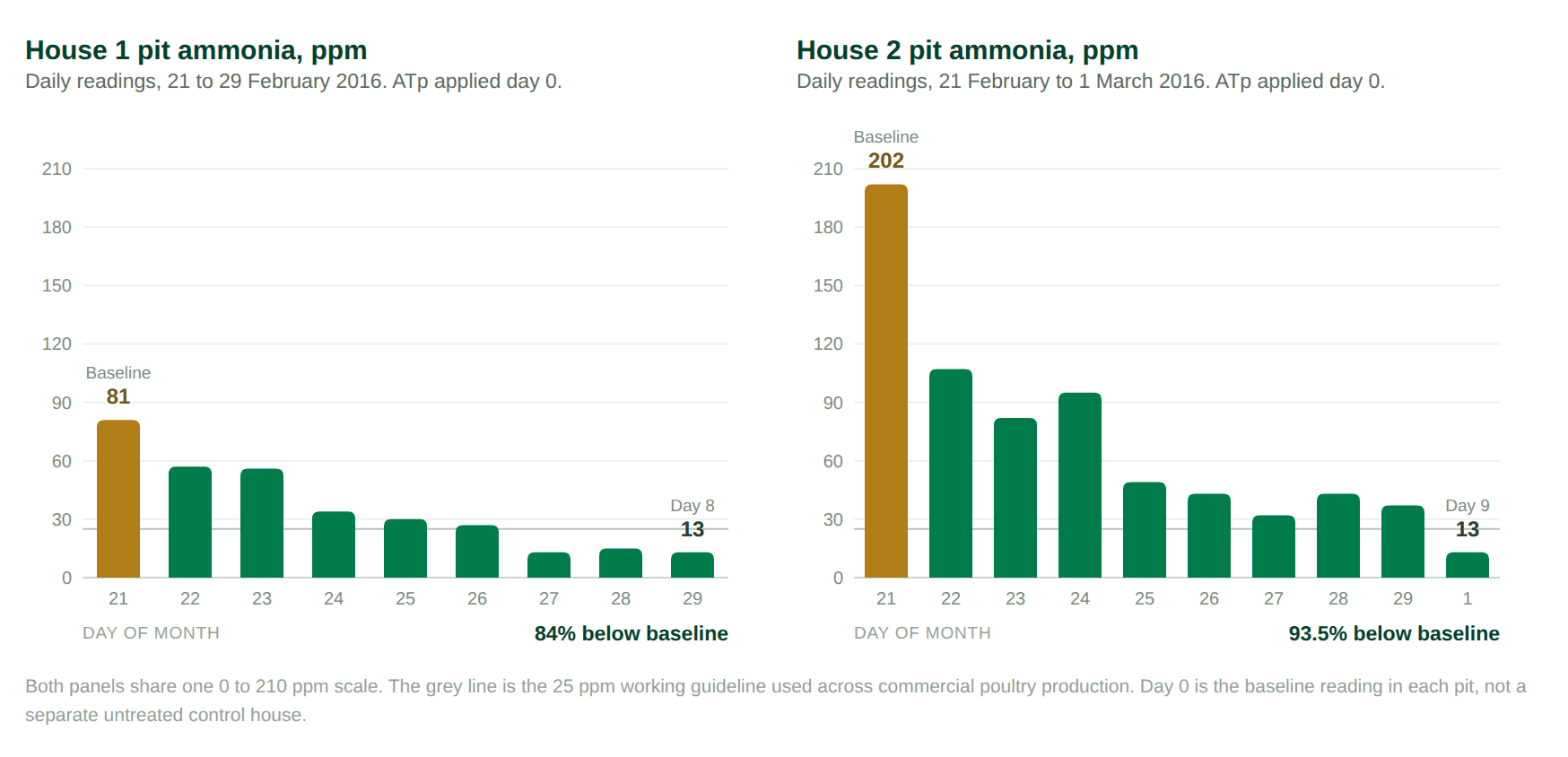
The numbers above are from two high-rise layer houses on one Ohio egg operation, measured daily over nine days of winter operation while ventilation was restricted to hold barn temperature. That is the hardest season to control ammonia, because the usual remedy, more air, is the thing being given up to stay warm. Litter moisture, house type, bird density and pack age all move the result.
Key Benefits
Poultry litter treatment is the practice of amending the bedding and manure pack in a poultry house so that the nitrogen in it stays put instead of leaving as ammonia gas. Birds excrete nitrogen mainly as uric acid and urea. Microbial urease in the pack breaks those down, and the free ammonia that results volatilizes into the air the birds and the people breathe. Everything a litter treatment does comes back to interrupting that one pathway.
Poultry litter is the bedding material on a house floor, typically pine shavings, sawdust, rice hulls, peanut hulls or chopped straw, combined with accumulated manure, spilled feed and feathers. In a high-rise layer barn there is no floor bedding in the same sense, and the equivalent material is the manure pack accumulating in the pit below the birds. Many houses run the same litter for multiple flocks, which is why the condition of that pack, and how you manage it between flocks, drives ammonia more than almost anything else.
Wet litter is the root of most ammonia problems. Leaking or badly adjusted drinker lines, condensation, a high water table, poor floor drainage and reduced winter ventilation all raise moisture, and moisture is what urease-producing microbes need to run. Add a heavy bird density and a pack carried over from previous flocks and ammonia climbs quickly, usually just as cold weather makes it hardest to ventilate the problem away.
Most litter treatment sold in the United States is chemical acidification. Sodium bisulfate and aluminum sulfate, better known as alum, lower litter pH so that the ammonia and ammonium equilibrium sits on the ammonium side. Ammonium is not volatile, so nitrogen that would have gassed off stays in the litter. It is well documented and it works. Published figures put ammonia reduction in the range of 50 to 85 percent depending on the pH actually reached.
The limitation is duration. An acidifier is consumed as it neutralizes, and litter pH climbs back over the flock. This is why acidifier programs are built around reapplication between every flock, and why the standard alum rate is a bulk one, commonly cited at 5 to 10 percent of litter weight, on the order of 1 to 2 tons per house per flock. There are secondary considerations too. Acid salts are corrosive enough to require handling care, and lowering pH can increase hydrogen sulfide volatilization even as it reduces ammonia.
A biological litter treatment attacks the same problem from the other end. Rather than making the litter inhospitable to ammonia release, ATp adds organisms that consume the free ammonia and convert nitrogen into stable microbial and organic forms, plus denitrifiers that move surplus nitrate out as inert nitrogen gas. Because that activity is biological, it continues as long as the pack conditions suit the organisms instead of being spent on contact.
| Biological litter treatment (ATp) | Acidifier litter treatments (sodium bisulfate, alum) | |
|---|---|---|
| What it acts on | The nitrogen. Microbes consume free ammonia and convert nitrogen into stable forms. | The pH. Acid shifts the ammonia and ammonium equilibrium toward non-volatile ammonium. |
| How long it holds | Activity continues while conditions suit the organisms, so it is not spent on contact. | Fades as litter pH drifts back up. Normally reapplied between every flock. |
| Effect on litter nitrogen | Holds nitrogen in the pack in stable organic and microbial forms. | Also retains nitrogen while the pH stays low. Published work reports roughly 50 percent lower ammonia loss from alum-treated litter. |
| Equipment and handling | Non-corrosive. No acid handling precautions. | Acid salts can be corrosive and require care in handling and storage. |
| Rate | Grams per gallon of spray solution, by ammonia severity. | Bulk. Alum is commonly cited at 5 to 10 percent of litter weight, on the order of 1 to 2 tons per house per flock. |
Neither approach is a substitute for fixing wet litter. If a drinker line is leaking, correct the leak. A litter treatment of either kind manages the nitrogen chemistry, it does not manage your water.
The working guideline across commercial poultry production is to hold houses at or below 25 ppm, and many integrators write tighter targets into their grower contracts. Ammonia is an irritant gas, and above that level growers commonly report birds spending less time at the feeder and more variation across the house.
The cost most growers feel is on the fuel bill. Ventilation is the standard tool for pulling ammonia out of a house, but in winter every cubic foot of air exhausted is heated air, and it has to be replaced by cold air that has to be heated again. That puts a grower in a bind: ventilate for air quality and burn propane, or hold the heat and let ammonia climb. A litter treatment that keeps ammonia generation down gives back some of that room, because ventilation can be set for moisture and temperature rather than being driven by ammonia.
We do not have customer-verified propane figures to publish, so we are not going to put a dollar number on this. What we can point to is the Ohio trial, where two layer houses were brought from 81 and 202 ppm down to 13 ppm during the season when ventilation was deliberately being held back.
Nitrogen that leaves the house as ammonia is fertilizer value you paid for in feed and will not get back when the litter goes to the field. That loss is invisible on a day-to-day basis and substantial over a flock.
The window between flocks is where litter management is actually done. Cake-out, the removal of the hard crusted cake that forms under drinker lines and in high-traffic areas, takes out the wettest and most ammonia-productive material in the house. What remains is usually decaked, tilled and conditioned before the next placement.
Windrowing poultry litter means piling the in-house litter into long rows between flocks so it heats. The practice is used to condition the pack in place rather than replace it, and it has become common where full clean-out every flock is not practical. It also drives off a large amount of nitrogen as ammonia precisely because the pile heats and the biology accelerates.
That makes windrowing and cake-out natural points to apply a biological treatment. Treating the pack while it is being turned puts the organisms through the material rather than only on its surface, and stabilizing nitrogen during that heating phase keeps more of it in the litter you are about to spread or reuse.
ATp is supplied as a 50 billion CFU/g dry powder, mixed with a small amount of water and sprayed across the litter. Rate is set by how severe the ammonia problem already is, not by house size alone, with coverage of 1 gallon of solution per 2,250 square feet. Keep the solution agitated while spraying. Full rate tables in US and metric units are in the specifications tab on this page.
As a worked example, a 20,000 square foot house takes about 9 gallons of solution, so a medium-severity treatment uses roughly 0.6 lb of ATp for the house. Tell us your house dimensions and current ammonia reading and we will size it for you.
Litter behaves differently depending on how the house is built, and the treatment should follow the house.
If you are evaluating litter treatments, the products fall into a small number of groups and it is worth knowing which one you are being sold.
These are not mutually exclusive categories in practice, and an operation with a serious moisture problem should fix moisture first regardless of which product it buys. The honest summary is that acidifiers give a fast, well-documented knockdown that has to be repurchased and reapplied every flock, and a biological treatment works on the nitrogen itself so its activity is not spent on contact. Which is the better fit depends on your house type, your flock schedule and what you do with the litter afterward.
A commercial egg producer running high-rise layer barns in Ohio had ammonia climbing in the manure pits through the colder months, when ventilation was being restricted to hold barn temperature. That is the hardest version of this problem, because the usual remedy, more air, is the thing being given up to stay warm. Two houses were treated, and pit ammonia was measured daily in each.
ATp was applied directly onto the manure surface in the high-rise pits. Both houses came down, from very different starting points.
| Ohio layer pit | House 1 | House 2 |
|---|---|---|
| Ammonia at application | 81 ppm | 202 ppm |
| Ammonia at end of trial | 13 ppm | 13 ppm |
| Reduction | 84% | 93.5% |
| Days to below 50 ppm | 3 | 4 |
| Days to below 20 ppm | 6 | 9 |
| Trial length | 8 days | 9 days |
House 2 is the more useful number for anyone with a serious problem. At 202 ppm it sat well into what our own rate table calls high severity, and it still finished at 13 ppm. House 1, starting at a more ordinary 81 ppm, also reached 13 ppm.
Worth saying plainly: neither curve fell in a straight line. House 2 read 82 ppm on day 2 and then bounced back to 95 ppm on day 3 before resuming its drop, and both houses ticked up slightly near the end. That is what real daily readings in a working barn look like, and any supplier showing you a perfectly smooth decline is showing you a drawing rather than data.
The producer reported that the eye and skin irritation seen in the barns beforehand stopped, adopted once-monthly application as standard practice, and discontinued several other products that had not held. One caveat that matters: this is two houses on one operation, in one climate, in one house type, over about nine days in winter. Litter moisture, house type, bird density and pack age all move the outcome. The full record, including the daily charts, is in the case studies tab on this page.
Poultry litter is a genuine fertilizer, carrying nitrogen, phosphorus, potassium and organic matter, and for many operations it is a revenue line rather than a disposal cost. How much it is worth depends directly on how much nitrogen is still in it when it leaves the house.
This is where ammonia control and fertilizer value are the same conversation. Every pound of nitrogen volatilized in the house is a pound not sold or spread. By holding nitrogen in stable forms in the pack, a biological litter treatment protects the value of the material through the flock, through cake-out and through storage or composting. Litter testing before land application is worth doing regardless, because nutrient content varies widely with bedding type, flock count and how the litter has been stored, and nutrient-management planning depends on knowing the real numbers rather than a book value.
Litter treatment is not a single event. It works best as a set of habits across the cycle.
Deep litter systems, where litter is built up and reused over long periods rather than removed, depend on this even more, since the pack is intended to stay in place and stay biologically stable.
ATp is manufactured with lot traceability and verified CFU counts, and supplied in 22 lb (10 kg) pails, 44 lb (20 kg) pails and 340 lb (155 kg) drums, with custom pack sizes and CFU concentrations available. It ships in bulk and wholesale quantities and is available for OEM and private-label supply to integrators, distributors and farm suppliers, domestically and internationally.
Send us your house type, your house dimensions and roughly where your ammonia sits now, and we will come back with a starting rate and a price.
Concentration (CFU/g):
Custom concentrations available upon request
Packaging Options:
Shelf-life:
Storage Recommendations:
Application Guidelines
Coverage Rule: 1 gallon of solution mists 2,250 ft² (0.5 gal per 1,125 ft²). Always keep the solution agitated during spraying.
Coverage Rule: 1.8 L solution mists 100 m² (1 L per 55 m²). Always keep the solution agitated during spraying.
Poultry litter treatment is any amendment worked into the litter or manure pack to keep ammonia out of the house air. Ammonia Treat for Poultry (ATp) is the biological kind. Instead of acidifying the litter, it adds bacteria and fungi that consume free ammonia, lock organic nitrogen into microbial biomass, and denitrify nitrates to harmless nitrogen gas. Because the organisms keep working as long as conditions suit them, the effect builds through the flock rather than fading as an acid is spent.
Acidifier litter treatments such as sodium bisulfate and alum drop litter pH so ammonia stays in its non-volatile ammonium form. That works, and published figures put ammonia reductions in the 50 to 85 percent range depending on the pH reached, but it is a holding action. As the litter pH drifts back up the effect fades, which is why acidifiers are normally reapplied between every flock. ATp works on the nitrogen itself rather than on pH, so it does not depend on holding an acidic litter, it is not corrosive to equipment, and it does not need the handling precautions concentrated acid salts require.
Ammonia is the sharp odor most people notice first walking into a house, so cutting it changes how the building smells. In the two Ohio layer houses the producer measured ammonia below 50 ppm within 3 to 4 days and below 20 ppm within 6 to 9 days. Note that ammonia is only one of the compounds behind manure odor, so treat this as ammonia control rather than a promise about every odor in the building.
Ammonia is an irritant gas, and the standard working guideline in commercial poultry production is to keep houses at or below 25 ppm, with many integrators targeting lower. Above that, growers commonly report birds spending less time at the feeder and uneven performance across the house. Keeping ammonia down is about air quality and bird comfort. ATp is a litter amendment, not an animal health product, and we make no disease or treatment claims for it.
Faster than most people expect, though it depends on litter moisture, temperature, and how loaded the pack already is. The commercial figures we can point to are the two Ohio high-rise layer houses: both dropped below 50 ppm in 3 to 4 days and below 20 ppm in 6 to 9 days, achieved in winter while ventilation was being held back to conserve heat. That is two houses on one operation under one set of conditions, not a rate we can set for yours.
Yes. ATp is used across broiler grow-out houses, layer and breeder barns, pullet houses, turkey barns and specialty poultry operations. The documented commercial result on this page comes from a high-rise layer barn with deep manure pits. Broiler house floor litter behaves differently from a high-rise pit, so tell us the house type and we will give a starting rate for it rather than assume the layer result transfers.
Yes. A litter pack is not uniform. The cake under the drinker lines and the lower pit layers go low-oxygen or fully anaerobic while the surface stays aerobic. ATp carries facultative strains that stay active across all of those microzones, which matters because the wettest, most anaerobic spots are where ammonia generation is worst.
Yes. Windrowing between flocks and stacking or composting litter after cake-out are both points where large amounts of nitrogen escape as ammonia. By stabilizing nitrogen and slowing urease-driven ammonia release, ATp keeps more of that nitrogen in the material, which matters both for house air and for the fertilizer value of the litter you eventually spread.
ATp uses all-natural, non-GMO microbial strains and is non-corrosive, so it does not attack fans, feeder lines, cool cells or concrete the way acid salts can, and it needs no acid handling precautions. Read the SDS and the tech sheet linked on this page before use and follow the label.
ATp is supplied as a 50 billion CFU/g dry powder that is mixed with a small amount of water and sprayed over the litter. Pack sizes are 22 lb (10 kg) pails, 44 lb (20 kg) pails and 340 lb (155 kg) drums, with custom pack sizes and CFU concentrations available. Ask us about the format best suited to your house type and application equipment.
Yes. ATp ships in bulk and wholesale quantities and is available for OEM and private-label supply to integrators, distributors and farm suppliers. We support custom CFU concentrations and custom packaging for qualified partners.
You can buy ATp directly from the manufacturer in bulk, wholesale, OEM and private-label formats, with domestic and international shipping. Buying direct means you get lot traceability and verified CFU counts rather than a repackaged blend.
Send us your house type, house dimensions and roughly where your ammonia sits now, and we will come back with a starting rate and a price. We supply poultry producers, integrators and agricultural distributors directly.