
- Products
- Overview
- Product Forms / Packaging
- Plant Health
- Wastewater
- Livestock Waste
- Aquaculture & Ponds
- Petroleum & Grease
- Case Studies
- Buy
- About
- Contact

Two Ohio high-rise layer houses cut pit ammonia 84% and 93.5%, from 81 and 202 ppm down to 13 ppm, in 8 to 9 days of winter operation.
| Metric | House 1 | House 2 |
|---|---|---|
| Pit ammonia at application | 81 ppm | 202 ppm |
| Pit ammonia at end of trial | 13 ppm | 13 ppm |
| Reduction | 84% | 93.5% |
| Days to below 50 ppm | 3 | 4 |
| Days to below 20 ppm | 6 | 9 |
| Trial length | 8 days | 9 days |
Day-0 figures are the baseline reading in each house, not a separate untreated control house. All values are on-farm measurements taken by the operation's staff between 21 February and 1 March 2016.
Winter is when ammonia gets away from a high-rise layer house. The pit sits under the birds collecting manure all season, and the main lever on pit ammonia is air movement. At an Ohio commercial egg operation, outside temperatures made that lever unusable. Ventilating hard enough to clear the pits meant giving away house temperature the operation could not afford to lose.
By the third week of February one house measured 81 ppm at the pit. A second measured 202 ppm. The working guideline across commercial poultry production is 25 ppm, and many integrators write tighter targets into grower contracts, so both houses were outside normal operating range and one of them by a factor of eight.
Staff reported eye and skin irritation working in the barns, and the producer reported reduced feed conversion over the period. The operation had already worked through several ammonia products without getting a result worth continuing to pay for.
It needed a treatment that worked inside the ventilation constraint. Applied to the pit itself, no corrosive chemistry added to a building full of birds and steel, and no opening the house up in February.
Ammonia Treat for Poultry (ATp) was applied on 21 February 2016 to the high-rise pits of both houses, onto the manure surface rather than onto floor litter. Nothing was added to feed or water.
ATp is a dry powder that is mixed with a small amount of water and sprayed. It carries a microbial consortium selected for hyper-ammonia accumulation and denitrification. The organisms use the nitrogen compounds in the manure as a substrate, so nitrogen ends up in microbial biomass and stabilized in the pack rather than volatilizing into the house as NH3. That is a different mechanism from a litter acidifier, which does not remove nitrogen at all. An acidifier drops litter pH so that more of the nitrogen stays in the non-volatile ammonium form, and the effect fades as pH drifts back up.
Pit ammonia was then measured daily by farm staff, House 1 for eight days and House 2 for nine. Ventilation stayed restricted for the whole period, and no other change was made to either house.
The day-0 figure is a baseline, not a separate untreated control house, so it establishes where each pit started rather than what would have happened without treatment. These are on-farm measurements taken by the operation's own staff, not third-party laboratory work.
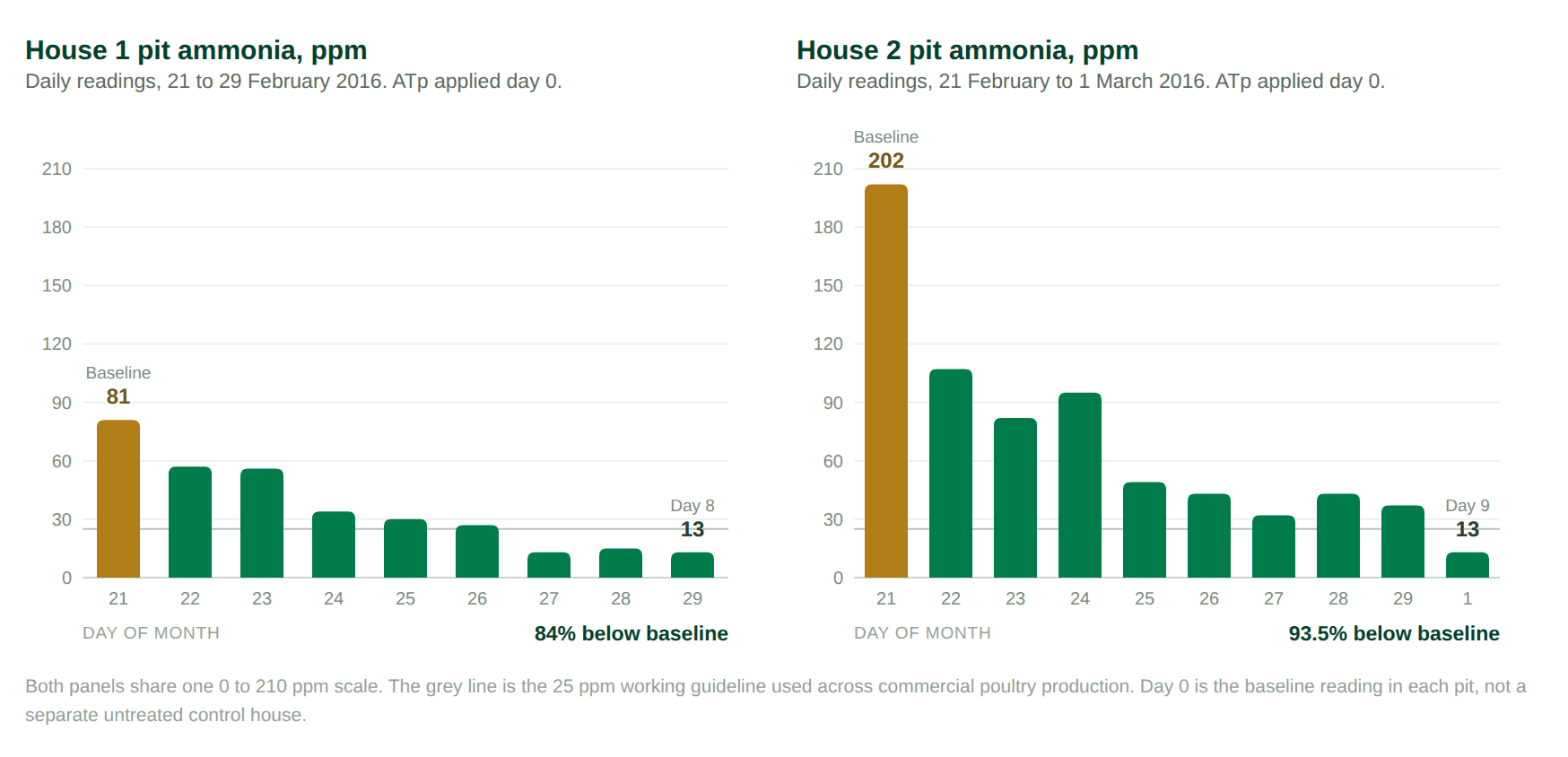
Daily pit ammonia in both Ohio layer houses from application on 21 February 2016. Both panels share one 0 to 210 ppm scale.
House 1 went from 81 ppm at application to 13 ppm on day 8, an 84% reduction. It crossed below 50 ppm on day 3 and below 20 ppm on day 6.
House 2 started at 202 ppm, well into what our own rate table calls high severity, and finished at 13 ppm on day 9, a 93.5% reduction. It crossed below 50 ppm on day 4 and below 20 ppm on day 9. The two panels share one 0 to 210 ppm scale, so the houses can be read against each other.
Neither curve fell in a straight line. House 2 read 82 ppm on day 2, rebounded to 95 ppm on day 3, then resumed dropping, and rose again from 32 to 43 ppm on day 7. House 1 ticked up from 13 to 15 ppm on day 7. A pit is a live system with fresh manure landing on it every day, so daily readings move. Both houses settled at or below the 25 ppm working guideline.
The producer reported that the eye and skin irritation in the barns stopped, that beneficial organisms returned to the pits, and that bird stress and feed conversion improved over the period. Those are the operation's own observations from these two houses.
The operation adopted once-monthly ATp application as standing practice and has continued it since, citing effectiveness, ease of application, lower labor cost, and dropping several alternative products it had been buying.
This is two houses on one operation in one winter. There was no parallel untreated control house, no third-party laboratory, and the source record does not give house dimensions, bird numbers or dose rate. Litter moisture, house type, bird density and pack age all move ammonia, so treat the speed and the direction as the transferable part of this result rather than the exact percentages.
In these two Ohio high-rise layer houses, pit ammonia fell below 50 ppm within 3 to 4 days of a single application and below 20 ppm within 6 to 9 days. The faster house started lower, at 81 ppm, and the slower one started at 202 ppm. A biological works by consuming the nitrogen compounds that produce ammonia, so it builds over days rather than switching off overnight, and it keeps working as long as the population is active.
Yes. Both Ohio houses were under restricted winter ventilation the entire time, because opening them up would have cost house temperature. Treating the manure in the pit works inside that constraint rather than against it, since it reduces the ammonia being produced instead of relying on air exchange to remove it.
A high-rise layer house keeps birds on an upper level with manure collecting in a pit below, sometimes for a full season. That pack is a continuous source of ammonia. In cold weather, when ventilation rates are cut to hold house temperature, the ammonia has nowhere to go and pit readings climb, which is what the Ohio operation was seeing at 81 and 202 ppm.
No. A baseline is the reading taken in the same house before treatment, which is what these charts show on day 0. A control is a separate untreated house measured in parallel over the same period. This trial has a baseline, not a control, so it shows how far each pit moved after treatment rather than proving what would have happened without it.
An acidifier lowers litter pH so that more nitrogen stays in the non-volatile ammonium form. It suppresses ammonia release without removing nitrogen, and the effect fades as pH drifts back up, which is why acidifiers are typically reapplied every flock. A biological such as ATp instead puts organisms into the pack that use those nitrogen compounds as a substrate, so the nitrogen is tied up in biomass and stays with the manure as fertilizer value rather than leaving as gas.
The working guideline used across commercial poultry production is 25 ppm or lower, and many integrators write tighter targets into grower contracts. Both Ohio houses started well above it and finished at 13 ppm, at or below the guideline, while ventilation was still restricted.
The Ohio operation settled on once-monthly application and has continued it as standing practice. Reapplication interval depends on how much fresh manure is landing on the pack, litter moisture and pit temperature, so a house under heavy load or a very wet pack may need a shorter interval.
Yes, though it is a different product and a different measurement. Where a layer barn is judged on air quality in ppm, a liquid system is judged on what is in the effluent, so trials there report solids, sludge depth and nutrient numbers instead. Our swine manure lagoon trial is the closest comparison. For liquid ammonia loads specifically, Ammonia Treat (AM) is the sibling product.
Direct from Bio-Green Planet, in pack sizes through to bulk, wholesale and private label. Full specifications, severity-based application rates and pricing are on the poultry litter treatment product page. Tell us your house type and current ppm readings and we will recommend a starting rate.
This is the product behind these results. Open its page for full specifications, packaging, and dosing rates.
Tell us your system size and current numbers. We will recommend a starting dose and send a quote.
Request a Quote


