- Products
- Overview
- Product Forms / Packaging
- Plant Health
- Wastewater
- Livestock Waste
- Aquaculture & Ponds
- Petroleum & Grease
- Case Studies
- Buy
- About
- Contact

Ammonia Treat (AM) is a high-CFU Bacillus blend built for fast, biological ammonia removal from wastewater. Instead of relying on slow autotrophic nitrifiers, AM uses hyper-ammonia-utilizing strains that take up ammonia (NH₃/NH₄⁺) directly, paired with denitrifying strains that convert nitrite and nitrate to nitrogen gas. That heterotrophic, denitrification-based route is why AM holds effluent ammonia within permit even when conventional nitrifying bacteria stall under load, temperature swings, or high-strength influent.
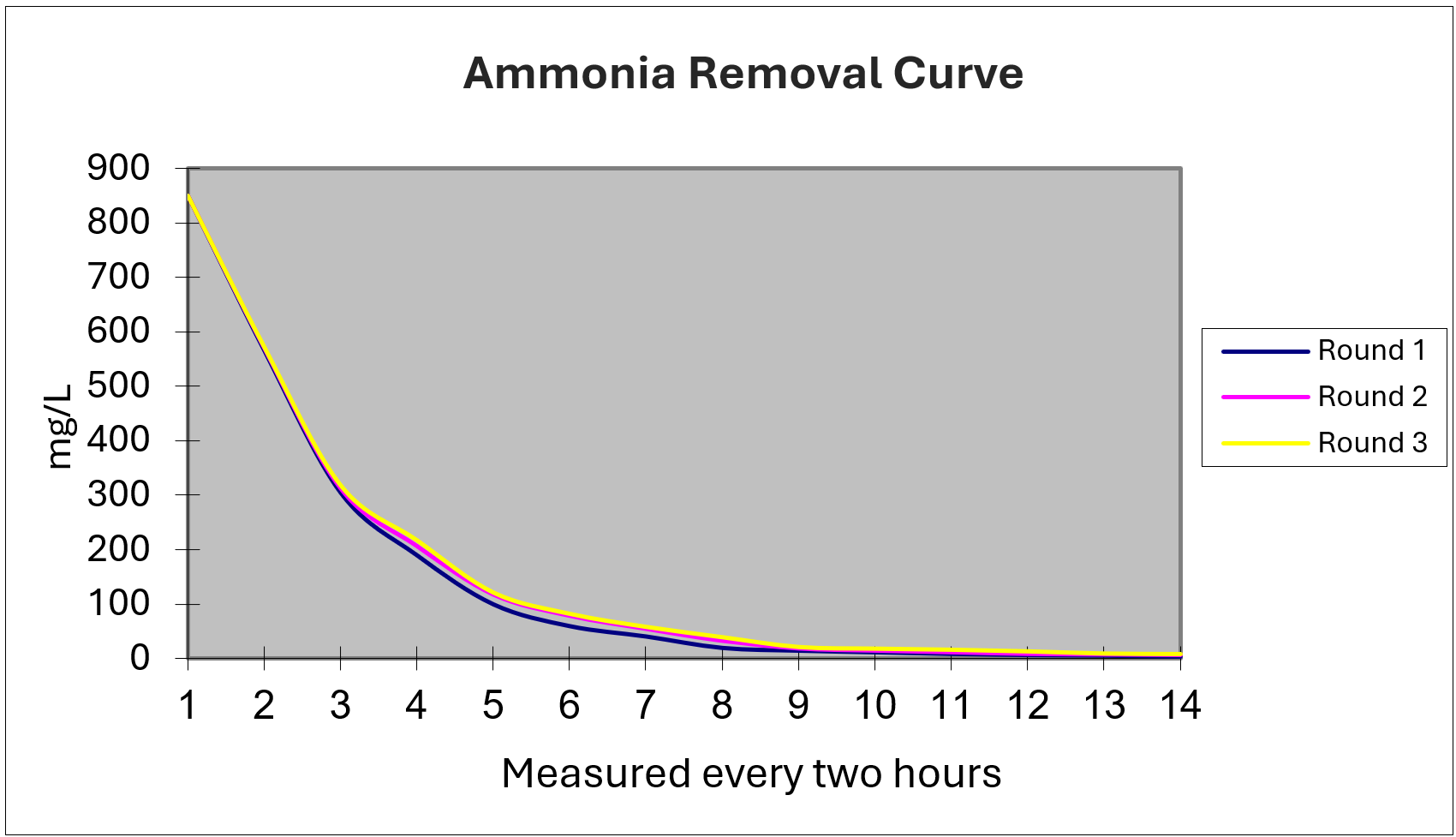
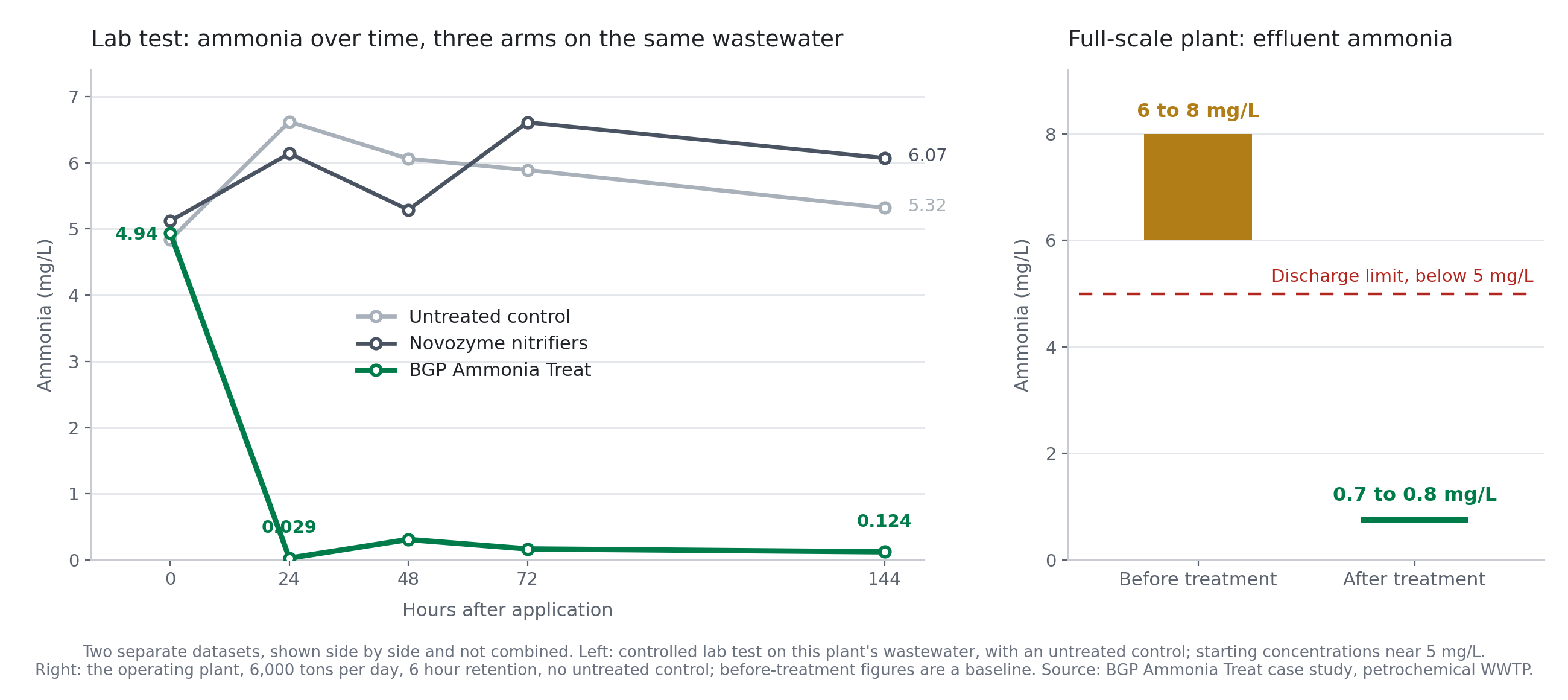
The numbers above are real trial results. At a petrochemical wastewater plant that had failed with multiple domestic and imported nitrifier products, AM brought effluent ammonia from the 6 to 8 mg/L range under the new 5 mg/L discharge limit within 3 days and then down to below 1 mg/L. In high-strength landfill leachate, AM drove ammonia from 850 to 4 mg/L, over 99%, in 26 hours.
Key benefits:
Ammonia is one of the hardest loads for a wastewater plant to hold within permit. It drives compliance risk, odor complaints, and higher aeration and chemical costs, and a spike from variable flow, a shock load, or a seasonal temperature drop can push effluent out of spec. Ammonia Treat (AM) is a high-CFU Bacillus blend that removes ammonia biologically and holds effluent stable across those swings, without waiting on slow nitrifiers to recover.
Most products lean on nitrification, where slow-growing autotrophic nitrifiers oxidize ammonia to nitrite and nitrate. Those organisms are sensitive: they need steady oxygen and alkalinity, grow slowly, and stall under cold, shock loads, or high-strength influent. AM works a different way. Its hyper-ammonia-utilizing strains are heterotrophs that take up ammonia (NH₃/NH₄⁺) directly for growth, and its denitrifying strains convert nitrite and nitrate to nitrogen gas, lowering total nitrogen. Because these strains are heterotrophic, they also consume carbon, so COD falls alongside ammonia, and they keep reducing ammonia in conditions where a conventional nitrifier blend would stall.
At a petrochemical wastewater plant treating 6,000 tons per day on a 6 hour retention time, effluent ammonia sat in the 6 to 8 mg/L range while a new standard required it below 5 mg/L, and the plant had tried multiple domestic and imported nitrifying bacteria products without success. Dosing about 1.06 kg of AM per day, effluent ammonia dropped to 2 mg/L within 3 days and then held below 1 mg/L, meeting the new limit, and COD fell as well. In a side-by-side lab test from the same trial, AM lowered ammonia to 0.029 mg/L at 24 hours while a conventional nitrifier product and the untreated control both stayed above 5 mg/L.
In a separate high-strength case, a rural landfill leachate near Chengdu, China started at 850 mg/L ammonia. After AM was applied with aeration, ammonia fell 93% to 60 mg/L within 10 hours and reached 4 mg/L, a reduction of more than 99%, in 26 hours, while leachate odor dropped sharply.
Meeting an ammonia limit is only part of a nitrogen permit. AM carries denitrifying bacteria that convert nitrite and nitrate to nitrogen gas, so nitrogen leaves the water instead of building up as nitrate carryover. Pairing hyper-ammonia-utilizing strains with denitrifiers means removal across the whole nitrogen chain, which helps plants under a total nitrogen (TN) or nitrate cap, not just an ammonia number.
AM is built for high-ammonia, high-strength streams that overwhelm conventional biology. In rural landfill leachate starting at 850 mg/L ammonia, it cut ammonia more than 99% to 4 mg/L in 26 hours. The same approach applies to petrochemical and refinery effluent, food and protein processing, slaughterhouse and rendering, dairy and beverage, breweries and distilleries, pulp and paper, and pet food production, wherever ammonia and COD run high.
AM performs across the common biological treatment configurations: activated sludge, sequencing batch reactors (SBR), moving bed biofilm reactors (MBBR), oxidation ditches, clarifiers, and aerated or facultative lagoons, in both municipal and industrial plants. It also works in lift stations, collection systems, and headworks for ammonia and odor control.
Because AM's strains are heterotrophic, they consume organic carbon, so BOD and COD fall alongside ammonia and less sludge is produced per unit of load. AM also improves floc formation and settling for clearer effluent, and it works in aerobic and facultative zones across a wide pH and temperature range. That steadies day-to-day operation, shortens recovery after an upset, and lowers the aeration, sludge handling, and chemical costs tied to ammonia control.
AM reduces the ammonia, amines, hydrogen sulfide, and volatile fatty acid odors that draw complaints around headworks, lift stations, collection systems, and lagoons, cutting the nuisance gases at the source rather than masking them.
Beyond municipal and industrial plants, AM lowers total ammonia nitrogen (TAN) in shrimp and fish ponds, hatcheries, and recirculating aquaculture systems (RAS) to protect stock and water quality. The strains are natural, non-GMO Bacillus and are safe for aquatic life when used as directed.
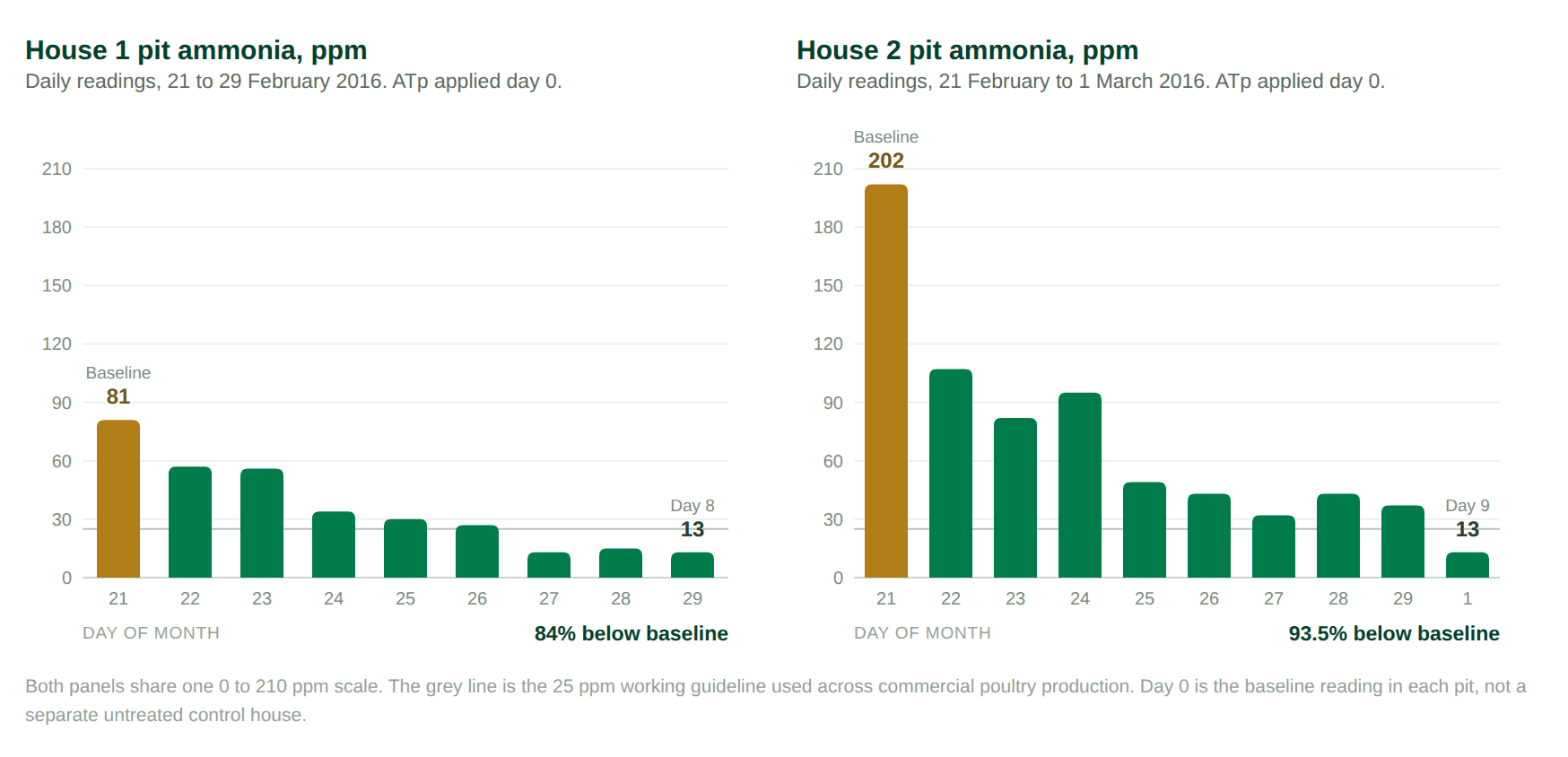
In livestock operations, AM reduces ammonia and odor in manure pits, waste lagoons, and barns, improving air quality and keeping more nitrogen in the manure instead of losing it as ammonia gas.
AM is a high-CFU, spore-forming Bacillus platform made in the USA with lot traceability and verified CFU counts. A typical wastewater starting dose is about 0.04 ppm, roughly 40 g of 50-billion CFU/g powder per million liters per day, or 150 g per million gallons per day, stepped up after two weeks; liquid and custom concentrations are available. AM ships in powder and liquid, from sample through bulk quantities, with wholesale, private label, and OEM options for distributors. Tell us your system, flow, and current ammonia levels, and we will recommend a starting dose and send a quote.
Concentration (CFU/g):
Custom concentrations available upon request
Packaging Options:
Shelf-life:
Storage Recommendations:
Bio-Based Odor Neutralizers
Usage rates vary. Reference dose:
Biological ammonia removal uses bacteria to take ammonia out of the water instead of dosing chemicals. Ammonia Treat (AM) is a high-CFU Bacillus blend whose hyper-ammonia-utilizing strains consume ammonia (NH₃/NH₄⁺) directly, while its denitrifying strains convert nitrite and nitrate to nitrogen gas. At a petrochemical plant, AM brought effluent ammonia from 6 to 8 mg/L under the 5 mg/L limit within 3 days and then below 1 mg/L.
No, they are not the same. AM removes ammonia without nitrification. Conventional nitrifiers are slow autotrophs that need steady oxygen and alkalinity and stall under shock loads or cold water. AM instead uses hyper-ammonia-utilizing heterotrophs that take up ammonia directly, plus denitrifiers that drive nitrite and nitrate to nitrogen gas. In a head-to-head petrochemical trial, AM reached 0.03 mg/L ammonia in 24 hours while a conventional nitrifier product showed no reduction.
Ammonia reducing bacteria lower ammonia in water through biology rather than chemistry. AM's strains metabolize ammonia and related nitrogen compounds directly and denitrify nitrite and nitrate to nitrogen gas, so plants meet effluent limits, cut odor, and lower aeration and chemical costs. They stay active across wide pH, temperature, and load ranges.
Often within days. At a petrochemical wastewater plant, AM brought effluent ammonia from 6 to 8 mg/L under the 5 mg/L discharge limit within 3 days and then below 1 mg/L. In high-strength landfill leachate, AM cut ammonia from 850 to 4 mg/L, over 99%, in 26 hours. Actual timing depends on load, temperature, and dose, and we will size a starting dose for your system.
In many conditions, yes. Because AM's strains are heterotrophic, they resist the cold, low alkalinity, and shock loads that stall autotrophic nitrifiers, and they consume carbon so COD falls too. Its denitrifiers also lower total nitrogen by converting nitrite and nitrate to nitrogen gas. In a side-by-side petrochemical trial where domestic and imported nitrifier products had failed, AM drove ammonia to 0.03 mg/L in 24 hours while the nitrifier product and control stayed above 5 mg/L.
Yes. AM is built for high-ammonia, high-strength streams. In rural landfill leachate starting at 850 mg/L ammonia, AM cut it 93% to 60 mg/L within 10 hours and to 4 mg/L, over 99%, in 26 hours, while sharply reducing odor. It is also used in petrochemical, refinery, food and protein, and other industrial effluents.
AM performs in activated sludge, sequencing batch reactors (SBR), moving bed biofilm reactors (MBBR), oxidation ditches, clarifiers, and aerated or facultative lagoons. It also works in lift stations, headworks, and collection systems for ammonia and odor control, in both municipal and industrial plants.
Dose AM, a high-CFU Bacillus blend, into the pond or system. It lowers total ammonia nitrogen (TAN) in shrimp and fish ponds, hatcheries, and recirculating aquaculture systems (RAS) to improve water quality, and it also reduces ammonia and odor in manure pits, lagoons, and barns. The strains are natural, non-GMO Bacillus and are safe for aquatic life when used as directed.
Municipal wastewater plants, petrochemical and refinery operations, food and protein processing, landfill leachate and waste management, aquaculture, and livestock and animal-waste systems, worldwide.
A typical wastewater starting dose is about 0.04 ppm, roughly 40 g of 50-billion CFU/g powder per million liters per day, or 150 g per million gallons per day, stepped up after two weeks. Liquid and custom concentrations are available, and we tailor the rate to your flow, ammonia load, and system.
AM ships as powder in 22 lb (10 kg) and 44 lb (20 kg) pails and 340 lb (155 kg) drums, and as liquid in quarts through 55 gallon (208 liter) drums, with custom CFU concentrations on request. The powder runs up to 100 billion CFU/g for strong viability and lower shipping cost.
You can buy AM directly from the manufacturer in bulk and wholesale quantities, with domestic and international shipping. Request a sample or a quote and we will size the order and dose to your system.
Yes. AM is available for private label, OEM, and distributor programs, including as a microbial base for bio-based ammonia and odor products, with custom CFU concentrations and packaging for qualified partners.
Send us your system, flow, and current ammonia levels through the form on this page, and our team will recommend a starting dose and send pricing. We supply plants, integrators, and distributors directly.
Yes. AM uses all-natural, non-GMO Bacillus strains and is manufactured in the USA under strict quality control with lot traceability and verified CFU counts, safe for treatment infrastructure, operators, and downstream water when used as directed.