
- Products
- Overview
- Product Forms / Packaging
- Plant Health
- Wastewater
- Livestock Waste
- Aquaculture & Ponds
- Petroleum & Grease
- Case Studies
- Buy
- About
- Contact

New discharge rules put this plant's ammonia limit below 5 mg/L. It was running 6 to 8, and nitrifying bacteria, both domestic and imported, had already failed there. Ammonia Treat uses heterotrophic bacteria that consume carbon rather than the autotrophic nitrifiers those products rely on, and the lab test that preceded the full scale application carried an untreated control.
| Measurement | Before | After Ammonia Treat |
|---|---|---|
| Plant effluent ammonia | 6 to 8 mg/L | 0.7 to 0.8 mg/L |
| Plant timeline | n/a | 2 mg/L at day 3, below 1 mg/L after |
| Discharge limit, below 5 mg/L | Not met | Met |
| Lab test, treated arm at 24 hours | 4.94 mg/L | 0.029 mg/L |
| Lab test, nitrifier arm at 24 hours | 5.12 mg/L | 6.14 mg/L |
| Lab test, untreated control at 24 hours | 4.84 mg/L | 6.62 mg/L |
| COD | Not quantified in the source | Reported reduced, no figure given |
A petrochemical wastewater plant treating 6,000 tons a day was discharging effluent ammonia at 6 to 8 mg/L. New discharge standards set the limit below 5 mg/L. Retention time through the system was 6 hours, and there was no room in the process to add a treatment stage.
Several nitrifying bacteria products were tried first, domestic and imported. None of them held ammonia down.
Nitrifying bacteria are autotrophs. They take their energy from oxidizing ammonia to nitrite and then nitrate, and they build cell mass from carbon dioxide rather than from the organic carbon in the wastewater. They also grow slowly, which makes them vulnerable to short retention times and to anything in an industrial stream that inhibits them. The source record for this plant does not diagnose why the nitrifier products failed here, only that they did, repeatedly, across more than one supplier.
What still needed answering was whether a different kind of ammonia removing bacteria could work in this wastewater at all.
The wastewater went to the lab first. Three arms ran side by side on the same material: Ammonia Treat, a Novozyme nitrifier product, and an untreated control. Ammonia was measured at 0, 24, 48, 72 and 144 hours.
Ammonia Treat is a multi-strain Bacillus product. Its bacteria are heterotrophic, so they consume organic carbon and take up ammonia nitrogen as they grow, rather than oxidizing ammonia for energy the way autotrophic nitrifiers do. The blend also carries denitrifying strains. Specifications and formats are on the ammonia reducing bacteria product page.
The lab result set the application rate, and the product then went into the operating plant on a daily schedule. Effluent ammonia was tracked from there. The plant kept its existing process and no new treatment stage was added.
Two different tests sit on this page and they measure different things. The lab test carried a genuine untreated control, and all three of its arms started close to 5 mg/L. The full scale application had no control. It ran on a live plant at 6,000 tons a day, so nothing else about the facility was held constant, and its before-treatment figure of 6 to 8 mg/L is a baseline rather than an untreated comparison.
The source record does not give the influent ammonia load, temperature, pH, dissolved oxygen, or the dates of the run, so none of those appear here.
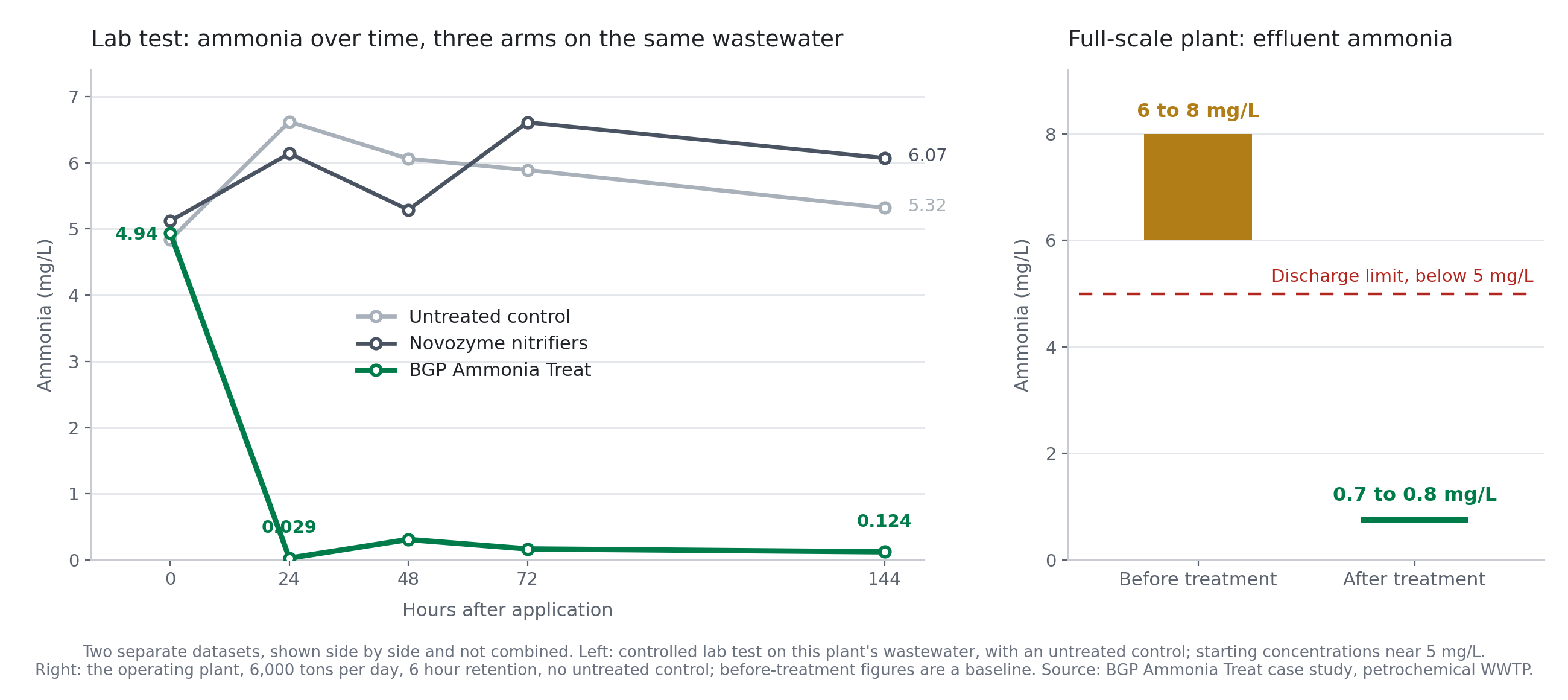
Two datasets shown side by side, not combined: a lab test with an untreated control, and the operating plant, where ammonia fell from 6-8 mg/L to 0.7-0.8 mg/L against its 5 mg/L discharge limit.
In the lab, ammonia in the Ammonia Treat sample fell from 4.94 mg/L to 0.029 mg/L in 24 hours, a 99% reduction. It stayed under 0.35 mg/L for the rest of the 144 hour run and finished at 0.124 mg/L.
Neither of the other two arms came down. The untreated control went from 4.84 mg/L to 6.62 mg/L over the same 24 hours and was still at 5.32 mg/L at 144 hours. The Novozyme nitrifier arm started at 5.12 mg/L, rose to 6.14 mg/L at 24 hours and finished at 6.07 mg/L. On this wastewater the nitrifier product tracked the untreated control.
The full scale plant is a separate dataset with a different starting point. There, effluent ammonia was 2 mg/L three days after the first application of Ammonia Treat and stayed below 1 mg/L after that. The plant's system record puts ammonia before treatment at 6 to 8 mg/L and after treatment at 0.7 to 0.8 mg/L. The lab arms started near 5 mg/L; the plant ran higher, at 6 to 8, so the two sets of numbers are not the same measurement and are not combined here.
The new standard required ammonia below 5 mg/L. This plant had been over it continuously and is now under it. That is what happened at this facility on this wastewater. It is not a compliance promise for another one.
The source also reports that COD came down, which is what you would expect from bacteria that consume carbon. It gives no COD figure before or after, so there is no number to put here and the claim stays qualitative.
One plant, one wastewater matrix, one lab test. The lab arms had a control; the full scale application did not. The application rate was set by that lab test on this plant's own wastewater, and the source does not record a rate that transfers to another facility. The nitrifier comparison is a single head to head on a single wastewater, and it says nothing about how that product performs anywhere else.
For the same product against a far heavier ammonia load, the Chengdu landfill leachate trial took ammonia from 850 mg/L to 4 mg/L in 26 hours.
The usual routes are biological nitrification, air stripping, breakpoint chlorination and ion exchange. Biological treatment is normally the cheapest per unit of ammonia removed and the one that fits inside an existing activated sludge plant without new hardware. Bioaugmentation means adding ammonia removing bacteria to a system that already has biology but is not hitting the removal its permit requires, which is the situation this plant was in.
Nitrifiers grow slowly and they are sensitive, so short retention times, temperature swings and inhibitory compounds in an industrial stream all work against them. This plant tried several nitrifying products from more than one supplier and none held. The source record does not diagnose the reason, and any specific cause offered here would be a guess. What it does record is that over 144 hours in the lab, the nitrifier arm ended higher than it started, at 6.07 mg/L against 5.12.
Autotrophic nitrifiers take their energy from oxidizing ammonia to nitrite and nitrate, and build cell mass from carbon dioxide. Heterotrophic bacteria consume organic carbon already present in the wastewater and take up ammonia nitrogen as they grow. Ammonia Treat is a heterotrophic blend, which is also why COD tends to come down alongside ammonia.
In the lab test on this wastewater, 24 hours took ammonia from 4.94 mg/L to 0.029 mg/L. At full scale the plant was at 2 mg/L on day three and below 1 mg/L after that. Speed depends on the starting concentration, retention time, temperature and how much of the system's biology has to be rebuilt, so read these as figures from one plant rather than as a schedule.
They solve different problems. Air stripping drives ammonia out of the water into the air. It handles high concentrations well, but it needs a tower, pH adjustment, energy, and usually an off gas treatment step, because the ammonia has to go somewhere. Biological removal converts the nitrogen inside the tanks you already have with no new hardware, but it responds more slowly to a shock load and it needs conditions the bacteria can live in. For a plant like this one, already biological and only a few mg/L over its limit, adding bacteria was the smaller intervention. For a stream running at hundreds of mg/L, stripping is often the right first stage.
The discharge permit sets it, and it varies by country, by receiving water and by season, so there is no single number. This plant's new standard was below 5 mg/L. In the United States, NPDES permits commonly set effluent ammonia in the low single digits and tighten in warm months, when ammonia is more toxic to fish. Read the permit rather than a benchmark.
Both, in two separate stages. The lab test carried a genuine untreated control alongside the treated sample and the nitrifier product. The full scale application on the operating plant had no control, so its before-treatment figure of 6 to 8 mg/L is a baseline. The two datasets also have different starting concentrations, which is why they are shown separately rather than merged into one number.
Heterotrophic bacteria consume organic carbon, so a COD reduction alongside ammonia removal is expected. The source for this case reports that COD was reduced but gives no before or after figure, so there is no number on this page. It stays a directional observation.
It is metered in on a daily schedule, usually at the head of the aeration basin so it mixes through and stays in contact with the wastewater. The rate for this plant was set by a lab test on its own wastewater before anything went into the live system. A rate taken from another plant is not transferable.
Bio-Green Planet supplies Ammonia Treat in bulk, wholesale, OEM and private label. Specifications, formats and application rates are on the ammonia reducing bacteria product page.
This is the product behind these results. Open its page for full specifications, packaging, and dosing rates.
Tell us your system size and current numbers. We will recommend a starting dose and send a quote.
Request a Quote


