
- Products
- Overview
- Product Forms / Packaging
- Plant Health
- Wastewater
- Livestock Waste
- Aquaculture & Ponds
- Petroleum & Grease
- Case Studies
- Buy
- About
- Contact

At a commercial shrimp farm in Colima, Mexico, a pond treated with Aquaculture Treat finished the cycle at 77% survival and a 1.37 feed conversion ratio, and harvested 17% more shrimp than the untreated control pond beside it.
| Metric | Without AQ (control) | With AQ (trial) |
|---|---|---|
| Total harvest, 7,000 m2 pond | 3,650 kg | 4,268 kg (+17%) |
| Feed conversion ratio (FCR) | 1.79 | 1.37 |
| Survival, larva to harvest | 69% | 77% |
| Size dispersion at harvest | 17% | 8% |
| Water exchanges per cycle | 8 to 10 | 0 |
| Pond bottom and odor | Black, anaerobic, sulfur | Firm, aerobic, no odor |
| Operating profit per cycle (operator estimate) | $4,344 | $6,822 |
The farm runs Pacific whiteleg shrimp (Litopenaeus vannamei) in semi-lined freshwater grow-out ponds on the coast of Colima, Mexico. Late in each cycle the same problem returned. Heavy organic load from feed and waste built up, the pond bottom turned black and anaerobic, and a sulfur smell told the operator the sediment had gone sour.
Water quality followed the bottom down. Ammonia climbed and growth turned uneven. To hold the pond together the crew ran frequent water exchanges, which raised pumping costs and made the pond harder to keep stable. The operator wanted one thing tested: could a shrimp pond probiotic hold water quality and the pond bottom through the whole cycle, on a working commercial pond, without changing the feeding and stocking the farm already ran.
The farm set up a side-by-side comparison on one crop. One 7,000 m2 grow-out pond, stocked with Pacific whiteleg postlarvae at about 70 per m3, was dosed with Aquaculture Treat (AQ) on a routine schedule through the 12-week cycle. A second pond of the same size and stocking was left untreated as the control. The feed, the aeration, the schedule, and the day-to-day management were kept the same across both ponds.
Across the cycle the operator tracked the numbers that decide a shrimp crop: survival from larva to harvest, feed conversion, total harvest weight, size uniformity, water exchanges, and the condition of the pond bottom. This was a single commercial operation with one treated pond and one control pond, not a replicated multi-pond study, so read it as one farm's result rather than a guaranteed outcome.

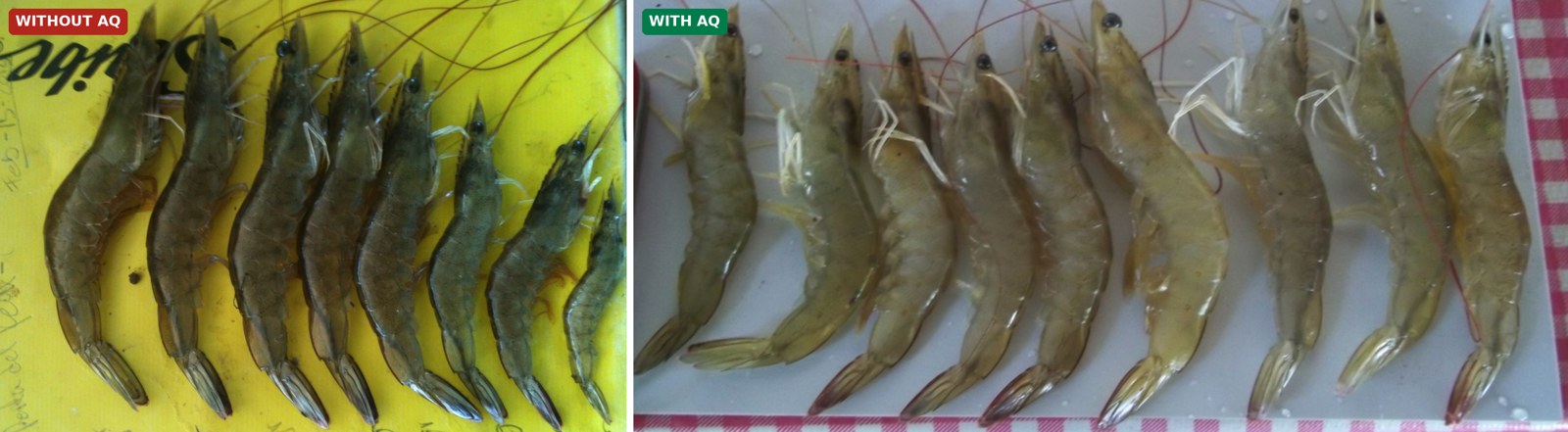
Harvest: the AQ pond (right) produced larger, cleaner shrimp than the untreated control (left), lifting total harvest to 4,268 kg.
The treated pond finished ahead on every measure the farm tracked. Total harvest came in at 4,268 kg against 3,650 kg in the control. That is about 618 kg more shrimp from the same 7,000 m2 of water, a 17% gain. Survival from larva to harvest rose from 69% to 77%, and feed conversion improved from 1.79 to 1.37, so the treated pond turned less feed into each kilogram of shrimp.
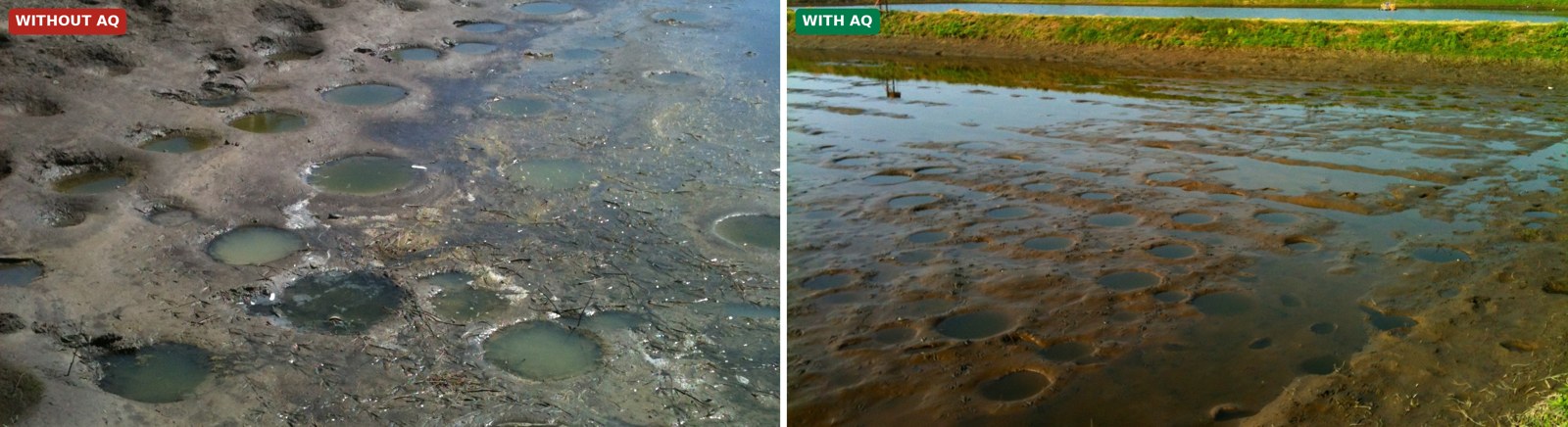
Size was more even too. Size dispersion at harvest fell from 17% to 8%, which means a tighter size grade and fewer undersized animals dragging down the average. The pond bottom stayed firm and aerobic with no sulfur odor through the cycle, and the AQ pond needed no water exchange at all, against the 8 to 10 exchanges the control pond required to manage ammonia.
On the economics, the operator put operating profit for the pond at about $6,822 for the treated cycle against $4,344 for the control. AQ cost $181 for the pond over the full cycle and added about $2,478 in profit, which the operator recorded as a return of roughly 1,270%. Those figures come from this one operation and depend on shrimp price and cost assumptions this page cannot verify, so treat them as an estimate from this operation, not a promise for the next one.
Aquaculture Treat is a pond and water-quality product. It is not an animal-health product, and we make no disease or treatment claims for it. On this farm, holding water quality and the pond bottom steady lined up with better survival, feed conversion, and harvest.
Most shrimp pond water quality problems trace back to organic load: uneaten feed, feces, and dead plankton that settle and decay, driving up ammonia and nitrite and pulling oxygen out of the pond bottom. Beneficial pond bacteria digest that waste before it turns anaerobic, which lowers BOD, clears the water, and steadies pH and dissolved oxygen. In this Colima trial the treated pond used a Bacillus-based product, Aquaculture Treat, dosed on a schedule through the cycle.
A black pond bottom and a sulfur or rotten-egg smell mean the sediment has gone anaerobic. Organic waste builds faster than the pond can break it down, oxygen runs out at the bottom, and the bacteria there start producing hydrogen sulfide. Digesting the settled waste and keeping the bottom aerobic is what prevents it. In the trial, the untreated control pond went black and anaerobic while the AQ-treated pond stayed firm and odor-free.
Ammonia and nitrite come mainly from the breakdown of feed and waste, so cutting the organic load and supporting microbial nitrogen uptake keeps them lower. A multi-strain Bacillus product helps two ways: it digests the waste that would otherwise release ammonia, and it supports the microbes that convert it. That reduces total ammonia nitrogen (TAN) and the toxic spikes that stress shrimp and force emergency water changes.
Cleaner, steadier water and a firm pond bottom let shrimp feed and grow with less stress. In this trial, survival from larva to harvest rose from 69% in the control pond to 77% in the AQ-treated pond, and feed conversion improved from 1.79 to 1.37, meaning less feed per kilogram of shrimp harvested.
Size dispersion is how much the shrimp vary in size at harvest. A lower number means a more uniform crop, which grades into higher-value size classes and leaves fewer undersized animals. In the Colima trial, size dispersion fell from 17% in the control pond to 8% in the treated pond.
When pond bacteria keep the organic load and ammonia in check, farms often need far fewer water changes to hold the pond stable, which lowers pumping costs and improves biosecurity. In this trial the AQ pond needed no water exchange over the cycle, against the 8 to 10 the control pond required. How far any farm can cut water exchange depends on stocking density, feeding, and pond conditions.
Yes. Aquaculture Treat was run in one 7,000 m2 grow-out pond against a second untreated pond of the same size and stocking that served as the control, with feed and management kept the same. It was a single operation with one treated pond and one control pond, not a replicated multi-pond study, so read the results as one farm's outcome rather than a statistical guarantee.
The trial was on Pacific whiteleg shrimp (Litopenaeus vannamei) in a 7,000 m2 semi-lined freshwater grow-out pond in Colima, Mexico, stocked at about 70 postlarvae per m3 and run over a 12-week cycle. Aquaculture Treat is also used with tiger shrimp (Penaeus monodon) and other farmed species.
The operator put operating profit for the pond at about $6,822 for the AQ-treated cycle against $4,344 for the control. AQ cost $181 for the pond over the cycle and added about $2,478 in profit, a return of roughly 1,270%. Those are the figures from this one operation and depend on shrimp price and input costs, so read them as what this farm recorded rather than a fixed return.
Dosing is set by pond volume and stocking density, starting during pond preparation before stocking and continuing on a regular schedule through grow-out. The Aquaculture Treat product page lists powder and liquid rates by farming intensity, and it is available in bulk, wholesale, and private label. Tell us your pond size, system, and stocking density and we will recommend a starting dose.
This is the product behind these results. Open its page for full specifications, packaging, and dosing rates.
Tell us your system size and current numbers. We will recommend a starting dose and send a quote.
Request a Quote


