
- Products
- Overview
- Product Forms / Packaging
- Plant Health
- Wastewater
- Livestock Waste
- Aquaculture & Ponds
- Petroleum & Grease
- Case Studies
- Buy
- About
- Contact

An independent Arizona laboratory grew green peppers in three systems, all on the same hydroponic nutrient solution and distilled water, with Multi-Tricho as the only added variable. Every treated transplant survived, 24 of 24 against 17 of 24 in the untreated control. Wet root mass reached 126.4 grams against 91.1 grams, roots ran 26 cm against 14 cm, and the drip lot set 42.6 pods per plant against 36.2. In the soil lot, where a leading commercial Trichoderma product was also grown, Multi-Tricho finished 7 cm taller than the competitor and 20 cm taller than the control.
| Measurement | Untreated control | Multi-Tricho |
|---|---|---|
| Transplant survival (Lot A, standing solution, 3 weeks) | 17 of 24 (70.8%) | 24 of 24 (100%) |
| Wet root mass (Lot A) | 91.1 g | 126.4 g, 39% more |
| Root length (Lot A) | 14 cm | 26 cm |
| Pods per plant (Lot B, drip, 2 months) | 36.2 | 42.6, 18% more |
| Plant height vs control (Lot B) | baseline | 35 cm taller on average |
| Plant height (Lot C, soil, 1 month) | baseline | 20 cm taller than control, 7 cm taller than a leading commercial Trichoderma product |
Independent laboratory trial, Arizona. All groups on the same hydroponic nutrient solution and distilled water, with Multi-Tricho as the only added variable. Lots A, B and C were separate tests in separate systems. The commercial benchmark was grown in Lot C only, and was measured on height and leaf area, not on survival, root mass or pod count.
A pepper crop is decided early. Transplant is the moment a seedling either takes hold or does not, and every plant lost in the first three weeks is a hole in the stand that produces nothing for the rest of the season. Root establishment sets the ceiling on everything after it: how much water and nutrient the plant can reach, how it handles a hot week, how many pods it can carry to maturity.
Under a standard nutrient program alone, that early window is where intensive pepper production leaks the most. Seedlings go into a root zone with very little biological activity, so the nutrients in solution are available but nothing is helping the root system expand fast enough to use them. Growers see it as uneven establishment, slow early growth, and a stand that never quite evens out.
This trial asked a narrow question with an obvious commercial answer attached: does adding Trichoderma to the root zone change transplant survival and root development when nothing else about the nutrient program changes. An independent laboratory in Arizona ran it across three growing systems, and in one of those systems added a third group treated with a leading commercial Trichoderma product, to see whether strain composition made a difference or whether any Trichoderma would do.
Multi-Tricho is an OMRI Listed multi-strain Trichoderma inoculant built from three species, Trichoderma harzianum, Trichoderma longibrachiatum, and Trichoderma asperellum. They colonize the rhizosphere and the root surfaces themselves, where they produce enzymes and metabolites that cycle nutrients and support root elongation and branching.
The lab ran three lots. Lot A grew in a standing hydroponic solution and was assessed three weeks after transplant, on root mass, root length, and survival. Lot B grew on drip and ran two months out to fruiting, measuring plant height and pods per plant. Lot C grew in soil for one month and carried the third group, a leading commercial Trichoderma product, alongside the untreated control and Multi-Tricho.
Every group in every lot received the same hydroponic nutrient solution made up with distilled water. The treated group got Multi-Tricho added to that base. The control got the base alone. Nothing else differed, which is what makes the comparison worth reading.
Two limits are worth stating plainly. The three lots are separate trials in separate systems at separate timepoints, not one experiment measured three ways, so the survival number and the pod number come from different plants. And the commercial benchmark was only grown in Lot C, where the measurements taken were height and leaf area. There is no benchmark figure for survival, root mass, or pod count, and we do not report one.

Untreated control: standard nutrient solution only, 91.1 grams of wet root mass and 14 cm roots, with 17 of 24 transplants surviving.
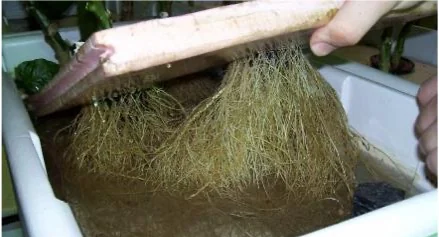
Multi-Tricho treated: the same nutrient base, 126.4 grams of wet root mass and 26 cm roots, with all 24 transplants surviving.
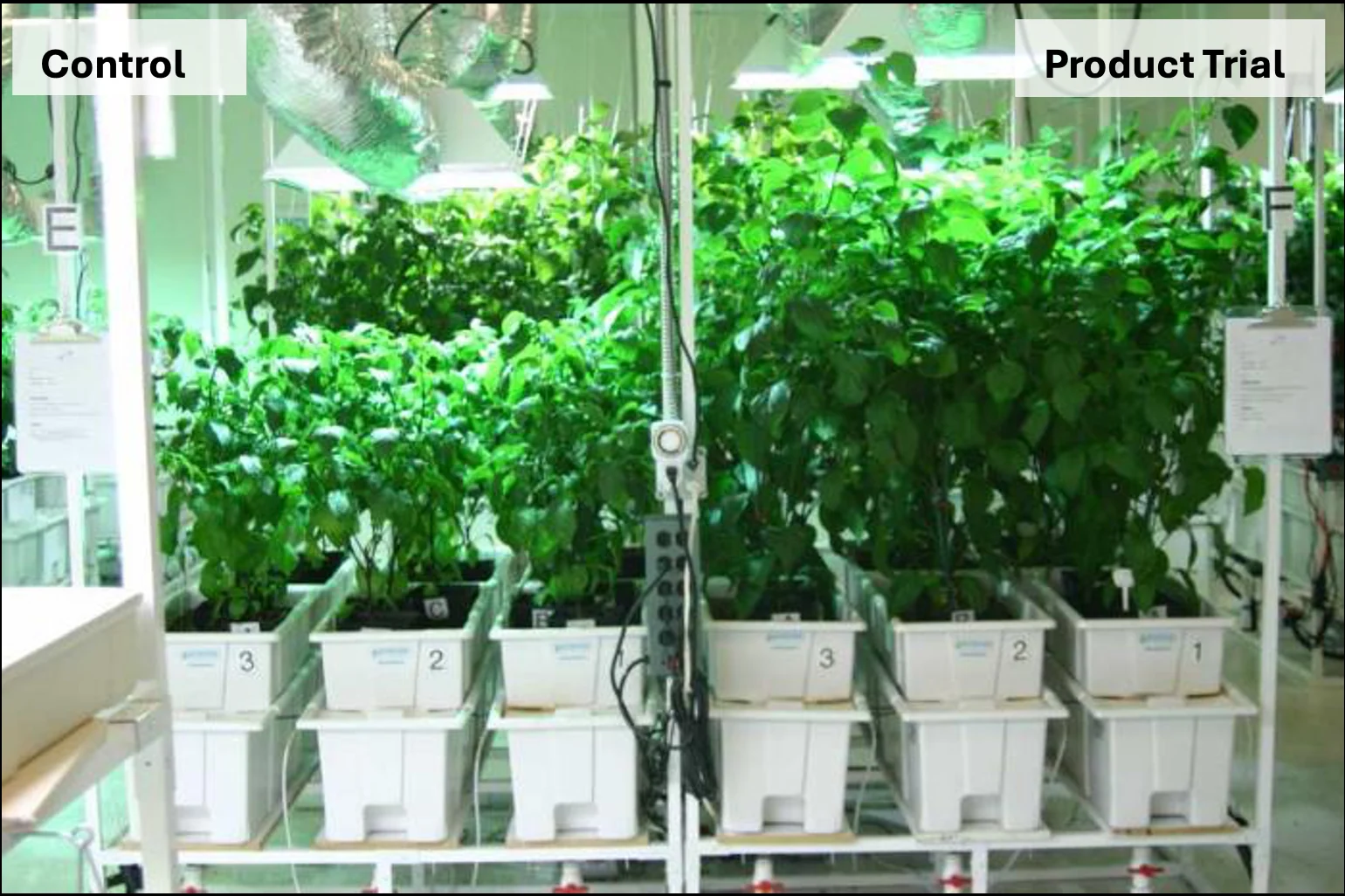
One frame, both groups: untreated control on the left, Multi-Tricho on the right, same bench, same lights, same nutrient solution.
Every treated transplant lived. Twenty-four of 24, against 17 of 24 in the untreated control, a 70.8% survival ratio. Roughly three in ten control seedlings never made it out of the establishment window. On a commercial stand that is the difference between a full planting and one that needs gapping up.
The root data explains why. Treated plants carried 126.4 grams of wet root mass against 91.1 grams in the control, 39% more, and root length nearly doubled, 26 cm against 14 cm. A root system twice as long three weeks after transplant is reaching water and nutrient the control cannot get to, which is exactly the margin that decides whether a stressed seedling holds on.
That early advantage carried through to harvest. In the drip lot at two months the treated plants stood about 35 cm taller than the control on average, with visibly more leaf and larger leaves, and they matured faster. At fruiting they set 42.6 pods per plant against 36.2, an 18% increase, on the same nutrient program.
The soil lot answers the question growers actually ask, which is whether one Trichoderma product is the same as another. It is not. Against a leading commercial Trichoderma product grown in the same soil on the same nutrient base, Multi-Tricho finished 7 cm taller, and 20 cm taller than the untreated control, with the largest leaf area and mass in the lot. The benchmark did beat the untreated control. It just did not match a three-species blend.
What the trial does not have is replication statistics or a named laboratory, and the three lots ran as separate tests rather than one design. Read it as three consistent results pointing the same direction rather than as a single statistically powered study.
In this trial it did, and by a wide margin. Every Multi-Tricho transplant survived, 24 of 24, against 17 of 24 in the untreated control on the same nutrient solution. The mechanism is root establishment rather than anything the plant does above ground: treated seedlings built 39% more root mass and nearly double the root length in the same three weeks, so they reached water and nutrient faster during the window when a transplant is most vulnerable.
No. The soil lot in this trial grew a leading commercial Trichoderma product alongside Multi-Tricho and an untreated control, on the same nutrient base. The commercial product did beat the untreated control, which is what you would expect from a working inoculant. Multi-Tricho finished 7 cm taller than it, with more leaf area and mass. The likely reason is strain composition: Multi-Tricho carries three Trichoderma species rather than one, which covers a wider range of root-zone conditions.
Here it was 126.4 grams of wet root mass against 91.1 grams, 39% more, with root length going from 14 cm to 26 cm, measured three weeks after transplant. Root length moved further than root mass, which is the useful detail: the treated plants were not just growing thicker roots in the same volume, they were exploring more of the root zone.
In the drip lot it did. Treated plants set 42.6 pods per plant against 36.2 in the control, 18% more, and stood about 35 cm taller on average with larger leaves and faster maturity. Worth noting that the pod count and the survival count came from different lots in this trial, so read them as two consistent results rather than one plant tracked start to finish.
This trial ran all three: a standing hydroponic solution, a drip system, and soil. Multi-Tricho outperformed the untreated control in every one. Trichoderma colonizes root surfaces rather than requiring soil structure to live in, which is why it holds up in soilless systems where a lot of soil biology does not.
Yes. Multi-Tricho is OMRI Listed for organic use. The three species in it, Trichoderma harzianum, Trichoderma longibrachiatum, and Trichoderma asperellum, are naturally occurring soil fungi, which is what makes them straightforward to fit into an organic or regenerative program.
It was run by an independent laboratory in Arizona, with the nutrient solution and water held constant across every group so that Multi-Tricho was the only variable that changed. Two honest limits. The three lots were separate tests in separate systems at separate timepoints, not one experiment measured three ways. And no replication statistics were reported, so this is a consistent set of results rather than a statistically powered study. We would rather say that than dress it up.
It points the same way from a different angle. The China green pepper trial tested Multi-Tricho on poor soil with no fertilizer at all and got 147% more yield, 156 grams per plant against 63. That one is about what soil biology can do when there is nothing else feeding the crop. This Arizona trial is the opposite setup, a full nutrient program in place, asking what Trichoderma adds on top. Both found the gain comes through the root system.
This is the product behind these results. Open its page for full specifications, packaging, and dosing rates.
Tell us your system size and current numbers. We will recommend a starting dose and send a quote.
Request a Quote


