
- Products
- Overview
- Product Forms / Packaging
- Plant Health
- Wastewater
- Livestock Waste
- Aquaculture & Ponds
- Petroleum & Grease
- Case Studies
- Buy
- About
- Contact

A cold-weather trial showed Low Temperature bacteria held 92% of biological activity at 4C, versus 1 to 5% for competitors, keeping BOD removal stable through winter.
| Metric | Conventional / competitor | Low Temperature (LT) |
|---|---|---|
| Biological activity at 4C | 1% to 5% | ~92% of 25C level |
| BOD reduction (cold) | Minimal | Measurable in 3 days |
| Winter sludge and odor | Rising | Controlled |
| Seasonal shutdown | Often needed | Not required |
Cold weather is hard on every biological wastewater system, from municipal and industrial plants to lagoons and ponds. As water cools, microbial metabolism slows and solids stop digesting, so treatment efficiency falls. Most conventional wastewater bacteria lose roughly half of their activity for every 10°C drop and slow sharply below 10°C (50°F), which is when BOD and COD creep up, sludge accumulates, and the nitrogen and phosphorus release behind odors and spring TSS spikes gets harder to hold in check.
That leaves operators exposed right when stability matters most. Near freezing, lagoons, ponds, and industrial systems risk process upsets, compliance misses, and a slow startup once temperatures recover in spring. The question this study set out to answer was whether a cold-weather-specific bacterial blend could hold biological activity near freezing, where standard bioaugmentation products fall away.
Low Temperature (LT) is a blend of cold-weather Bacillus strains selected to stay active when water drops below 15°C (60°F). To test it, wastewater was dosed and measured in the lab, so this is a controlled bench comparison rather than a full-scale field installation.
The work ran as two separate tests. In the first, a wastewater sample was treated with LT and with two competitor products, and biological activity was measured over three days at 4°C (39°F) and 25°C (77°F) to see how much of its warm-temperature activity each product held in the cold. In the second, dairy wastewater and pulp and paper wastewater were each treated with LT and compared against untreated samples, with BOD reduction measured at 4°C (39°F) and 20°C (68°F) over three days. The competitor products are kept unnamed, and every figure below is reported as measured in these tests.

Winter cold stalls standard wastewater biology. In this trial, competitor products retained just 1% to 5% of their biological activity at 4°C (39°F).
Low Temperature (LT) held about 92% of its 25°C activity at 4°C (39°F), keeping BOD removal working through the cold when conventional bacteria drop off.
In the activity test, LT held about 92% of its 25°C biological activity at 4°C. The two competitor products retained only 1% and 5% of their warm-temperature activity at the same 4°C, so LT stayed near full strength in the cold while the conventional products effectively stalled.
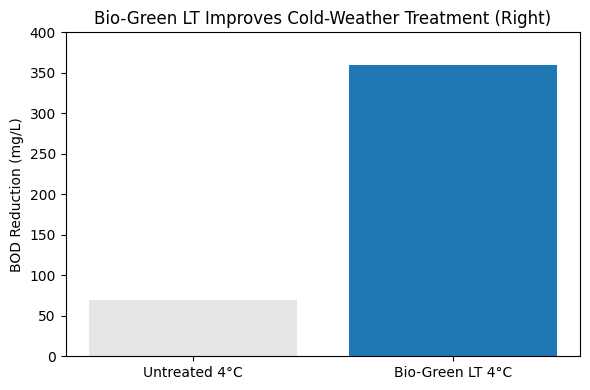
In the separate BOD tests, LT produced measurable BOD reduction in both the dairy and the pulp and paper wastewater within three days, at 4°C as well as at 20°C, while the untreated cold samples reduced BOD only minimally. The source reports these BOD results as charted trends rather than a published data table, so they are described here as directional cold-weather performance, not exact values.
Read together, the two tests point the same way. LT keeps biological treatment working near freezing, which helps control winter sludge and nutrient release and supports a cleaner handoff into spring startup. This was a controlled lab bench comparison on wastewater samples, not a full-scale plant installation, and the competitor comparison reflects what those specific products did in this test. What any operation sees depends on its wastewater, temperature, and loading.
Yes, with the right strains. In this cold-weather trial, Low Temperature (LT) held about 92% of its biological activity at 4°C (39°F) relative to 25°C, while two competitor products retained only 1% to 5%. LT is a blend of cold-weather Bacillus bacteria built to keep BOD, COD, TSS, and sludge reduction running through winter when standard bacteria slow down.
Microbial metabolism is temperature driven. Most conventional wastewater bacteria lose roughly half of their activity for every 10°C drop and slow sharply below 10°C (50°F), which is when facilities see BOD and COD climb, sludge build, and odor risk rise. Low Temperature (LT) uses cold-active strains selected to keep working near freezing instead of stalling.
Dosing a cold-active bacterial blend keeps the biology that removes BOD active when the water is cold. In this trial, Low Temperature (LT) delivered measurable BOD reduction in both dairy and pulp and paper wastewater within three days at 4°C (39°F), while untreated cold samples reduced BOD only minimally. Holding BOD removal through winter helps avoid compliance misses and spring process upsets.
Low-temperature bioaugmentation means adding bacteria that stay active in cold water so a treatment system stays stable through winter. Low Temperature (LT) supplies cold-weather Bacillus strains that maintain biological activity near freezing, so lagoons, ponds, and industrial systems keep digesting organics and controlling sludge when native biology slows.
Yes. Low Temperature (LT) stays active in cold lagoons and ponds, digesting the bottom sludge and organic muck that build up over winter and limiting the nutrient conditions that favor algae as the water warms. Keeping the biology working through the cold season supports clearer water and a smoother recovery in spring.
In this study it did. Low Temperature (LT) was tested against untreated samples of both dairy and pulp and paper wastewater and produced measurable BOD reduction at 4°C (39°F) and 20°C (68°F) within three days. These are two common industrial effluents where cold winter temperatures otherwise stall treatment.
That is one of the main reasons to dose through winter. By keeping the biomass active and limiting winter sludge and nutrient buildup, Low Temperature (LT) reduces the backlog a system carries into spring, so startup is faster and less prone to odor, TSS spikes, and process upsets once temperatures recover.
It was a controlled lab bench comparison. Wastewater samples were dosed and measured under set temperatures rather than installed in an operating plant, and the competitor products are reported unnamed as tested. The results show what Low Temperature (LT) did in these tests; performance on a given system will depend on its wastewater, temperature, and loading.
Dosing depends on your system type, volume, and winter low temperatures, and LT ships in powder, liquid, slow-release block, and tablet forms for plants, lagoons, and ponds. Tell us your system and your coldest operating temperatures and we will recommend a starting dose and send a quote.
This is the product behind these results. Open its page for full specifications, packaging, and dosing rates.
Tell us your system size and current numbers. We will recommend a starting dose and send a quote.
Request a Quote


