
- Products
- Overview
- Product Forms / Packaging
- Plant Health
- Wastewater
- Livestock Waste
- Aquaculture & Ponds
- Petroleum & Grease
- Case Studies
- Buy
- About
- Contact

At a high-volume restaurant in Mal Taman Anggrek, Jakarta, a Grease Treat program cleared hardened FOG from a waste line that was backing up 2 to 3 times a week, restoring flow in about 14 days and avoiding another pipe replacement.
| Metric | Before | During | After (14 days) |
|---|---|---|---|
| Pipe blockages | 2 to 3 per week | Softening | Cleared |
| Hardened FOG | Pipes nearly closed | Detaching | Removed |
| Flow capacity | Severely restricted | Expanding | Restored |
| Odor | Persistent | Diminishing | Reduced |
| Maintenance | Manual clearing, replacement | n/a | Preventive dosing |
A high-volume restaurant at Mal Taman Anggrek in Jakarta, Indonesia sent its kitchen waste through a grease line that fed the mall's central food court grease trap. Hardened fats, oils, and grease had built up along that line until the pipe was almost completely choked, leaving only a small opening for flow.
The line backed up 2 to 3 times a week and flooded the kitchen, forcing repeated shutdowns. Crews had to dismantle and scrape the pipes by hand every 4 months, and one section was so blocked it had to be replaced outright. Manual cleaning never held, because the hard grease re-formed within days. The result was constant downtime, sanitation risk, and recurring repair cost.
Grease Treat was dosed into the kitchen grease trap and at a distressed pipe access point, then kept running along the line over a two-week window. The blend uses facultative bacteria selected for high lipase activity, so it stays active in the low-pH, high-grease conditions inside a FOG-packed line and digests the hardened deposits in place instead of pushing them downstream.
To keep the comparison honest, the team left one leg on manual cleaning only and kept biological treatment on the second leg. Access points were photographed through the run so the change could be tracked day by day.

Day 0: hardened fats, oils, and grease have choked the restaurant waste pipe down to a pinhole, the blockage that flooded the kitchen 2 to 3 times a week.
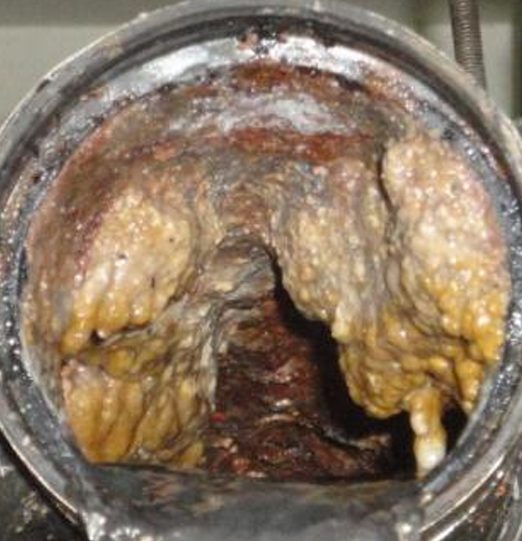
Day 9: after Grease Treat dosing, the FOG is softening and pulling off the pipe wall and the opening is visibly widening.

Day 14: the grease is soft and the bottom of the pipe runs clean again, with flow restored and no second pipe replacement.
Within a week, grease at the dosing point had started to soften and pull away from the pipe wall. By the second week the opening had visibly widened, and when the line was opened on a routine service about 14 days in, the grease was soft and the bottom of the pipe was clean. Side by side, the biologically treated pipe was well ahead of the manually cleaned leg in under two weeks.
Flow was restored without another full pipe replacement, the weekly backups stopped, and odor along the line dropped. The restaurant moved off reactive scraping and onto a steady preventive dose, turning a recurring emergency into routine maintenance.
It seeds the line with facultative bacteria that produce lipase and biosurfactants, which break down and emulsify the hardened fats, oils, and grease so the deposits soften, detach, and wash through. The grease is digested in place rather than pushed downstream to clog somewhere else.
In this restaurant line, grease at the dosing point began softening within the first week, and the pipe was clean and flowing again in about 14 days. Timing depends on how thick the buildup is, line temperature, and dosing, so heavily packed lines can take longer.
Yes. It is a biological product that works on the organic grease layer itself and is used routinely in kitchen grease traps, lift stations, and waste lines. It does not use caustic or acidic drain chemicals, so it will not attack your plumbing the way harsh cleaners can.
Usually, yes. Much of the smell around a FOG-choked line comes from grease and volatile fatty acids sitting and turning septic. As the bacteria digest that material, the food source for odor is reduced, which is why odor along this line dropped as flow was restored.
For many operators it shifts the work from reactive to preventive. This site had been scraping pipes by hand every 4 months and still flooding weekly, and a steady maintenance dose kept the line open so emergency clearing and another pipe replacement were no longer needed. A short knockdown dose is used first on a heavily blocked line, then a lower maintenance dose holds it.
Restaurants, mall and food court kitchens, commercial and institutional foodservice, and any facility running a grease trap or FOG-loaded waste line. It fits both a single kitchen and a shared line serving several tenants.
This is the product behind these results. Open its page for full specifications, packaging, and dosing rates.
Tell us your system size and current numbers. We will recommend a starting dose and send a quote.
Request a Quote


