
- Products
- Overview
- Product Forms / Packaging
- Plant Health
- Wastewater
- Livestock Waste
- Aquaculture & Ponds
- Petroleum & Grease
- Case Studies
- Buy
- About
- Contact

On some of the highest-salinity farmland in China, rice treated with Sunrise yielded 600 kg per 1,000 m2 against 212.5 kg in the adjacent control field, a 182% increase on soil holding at pH 9 to 10.
| Metric | Untreated control | Sunrise treated |
|---|---|---|
| Rice yield | 212.5 kg/1,000 m2 | 600 kg/1,000 m2, up 182% |
| Yield multiple | 1x | About 3x the control |
| Soil condition | pH 9 to 10, 0.5 to 0.6% salinity | Same soil, adjacent plots |
| Regional seedling emergence | Below 50% | Below 50% baseline for the area |
| Root system | Shorter, weaker | Longer and more robust |
| Shared inputs | EM pretreatment, one NPK pass | EM pretreatment, one NPK pass |
| Differentiating input | None | Sunrise, 14.4 g/1,000 m2 standard strength |
A rice grower in Jilin Province, northeastern China was farming some of the most salt-affected land in the country. Soil pH averaged 9 to 10 and salinity ran 0.5 to 0.6 percent, putting the fields squarely into saline-alkali, or sodic, territory. Across the region, seedling emergence on ground like this falls below 50 percent, and years of heavy NPK use with almost no rest between crop cycles had left the soil biologically depleted and chronically low yielding.
The question was whether a biological program could lift rice yield on land this marginal without adding more synthetic fertilizer and without pesticides. To keep the test honest, the grower deliberately selected the plots carrying the highest salt concentrations in the area rather than the easiest ground available.
The trial covered 3,500 m2 of rice transplanted in June 2015 and harvested in October 2015, run against an adjacent control field on the same land under the same management. Both fields were pretreated with EM bacteria to neutralize pH and reduce salinity, and both received a single mid-cycle NPK application. No base fertilizer, chemicals, or pesticides were used on either side. Sunrise Soil Probiotic, an OMRI Listed and CDFA registered multi-strain microbial inoculant of beneficial bacteria and fungi, was the only input that differed between the two plots, which is what makes the yield gap attributable to it.
Sunrise was mixed straight into the fields at transplanting. About 1,200 g of 2 billion CFU/g product went onto the trial area, a rate of 360 g per 1,000 m2, equal to 14.4 g per 1,000 m2 of the standard 50 billion CFU/g Sunrise microbial soil amendment. One application, no follow-up passes.
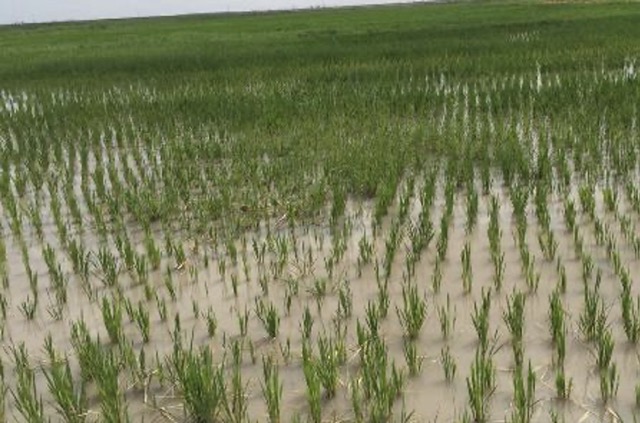
Untreated control field on the same saline-alkali land: sparse, stunted rice on soil at pH 9 to 10, where regional seedling emergence runs below 50%.
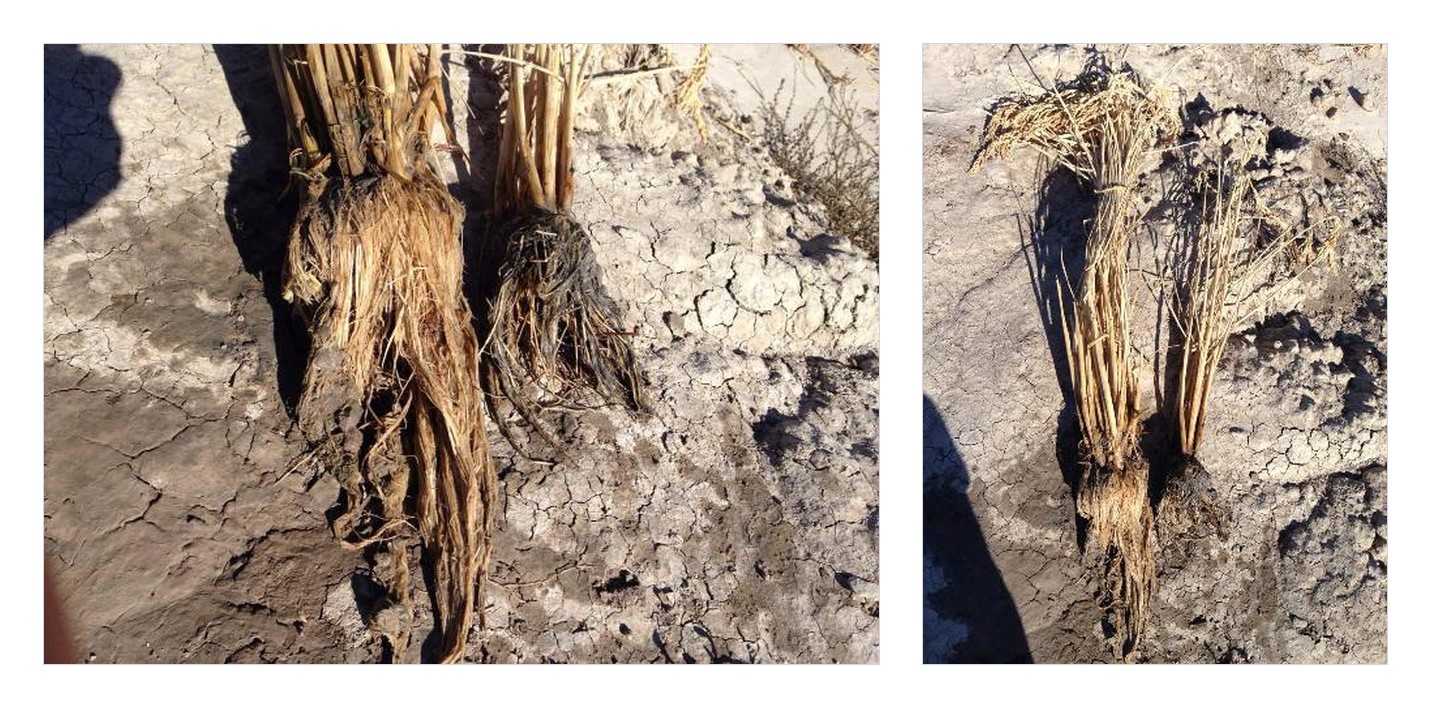
Root systems at harvest on the same saline-alkali soil: Sunrise-treated plants on the left grew longer, denser roots than the untreated control on the right, the root development behind the 182% yield gain.
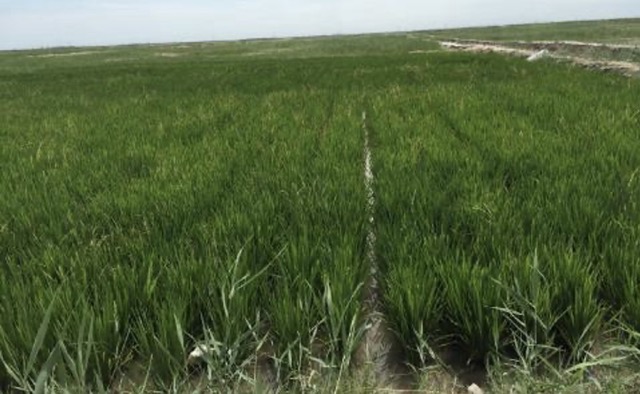
Treated trial field with Sunrise: thick green rice and longer, more robust roots on the same marginal soil, yielding 600 kg per 1,000 m2.
The Sunrise-treated fields yielded 600 kg per 1,000 m2 against 212.5 kg in the adjacent control, a 182.35 percent increase and roughly three times the control yield, on saline-alkali soil holding at pH 9 to 10. One month after transplanting the treated rice was already thick and deep green where the control stand was sparse and stunted, and at harvest the treated plants carried visibly longer, more robust root systems.
Because both plots received the same EM pretreatment and the same single NPK application, the gain tracks to the microbial inoculant rather than to reclamation of the soil itself. Sunrise is built to colonize the rhizosphere, solubilize bound phosphorus and micronutrients, cycle organic matter, and support root elongation, so the crop takes up more of what is already in the ground. On alkaline soil, where nutrient availability is the binding constraint, that is where the extra rice yield comes from.
Alkaline soil treatment covers anything that makes high-pH, salt-affected ground productive again, from gypsum and sulfur amendments to leaching and biological programs. In this Jilin trial the biological piece was Sunrise, an OMRI Listed multi-strain microbial inoculant, applied on top of an EM pretreatment that had already addressed pH and salinity. The microbes did not change the soil chemistry; they improved what the crop could pull out of it, and yield rose 182%.
Two things have to happen. The chemistry has to be brought into a workable range, usually with an amendment program and drainage, and the biology has to be rebuilt so nutrients that are locked up at high pH become available again. Sunrise handles the second half. On land running pH 9 to 10, a single mix-in application at transplanting lifted rice yield from 212.5 to 600 kg per 1,000 m2.
Fixing alkaline soil permanently means changing its chemistry, which is slow and expensive on a field scale. The faster commercial route is to farm it productively while that work goes on. Adding a microbial soil amendment restores nutrient cycling and root development in the root zone, so the crop performs even while the underlying pH stays high. That is exactly what this trial measured.
Saline-alkali soil, often called sodic soil, carries both a high salt load and a high pH. The Jilin trial fields ran pH 9 to 10 with salinity of 0.5 to 0.6 percent, among the highest-salinity growing areas in China. Salt stress limits water uptake and high pH locks up phosphorus, iron, and micronutrients, which is why regional seedling emergence sits below 50%.
Yes, though yields are usually poor. The control field in this trial produced 212.5 kg per 1,000 m2, which is representative of the region. The Sunrise-treated field on the same ground, with the same pretreatment and the same single NPK pass, produced 600 kg per 1,000 m2. Rice will grow on salt-affected land; the question is whether the yield clears the economics.
A microbial inoculant is a concentrated blend of beneficial soil organisms applied to the root zone. Sunrise combines spore-forming bacteria and fungi that colonize the rhizosphere, solubilize bound nutrients, break down organic matter, and support root growth. The soil probiotic framing is the same idea as gut probiotics: reintroduce the working biology that intensive cropping has stripped out.
Rhizosphere microbes release organic acids and enzymes that free up phosphorus and micronutrients bound in the soil, and they cycle organic matter into forms roots can take up. They also stimulate root elongation and branching, which enlarges the volume of soil a plant can draw from. In the Jilin trial, treated plants finished the season with visibly longer, more robust roots than the control.
NPK fertilizer supplies nutrients directly. A biofertilizer supplies biology that makes existing nutrients available and improves how efficiently the crop uses them. They are complements, not substitutes. Both fields in this trial received the same single NPK application; only the treated field also got Sunrise, and that field yielded 182% more rice.
OMRI Listed means the product has been reviewed and approved for use in certified organic production. Sunrise is OMRI Listed for use in organic production systems and CDFA registered for sale and distribution in California as a microbial soil amendment. Tell BioGP your crop, acreage, and soil conditions and we will recommend a starting rate for your program. See the full Sunrise Soil Probiotic specification for strains and packaging.
This is the product behind these results. Open its page for full specifications, packaging, and dosing rates.
Tell us your system size and current numbers. We will recommend a starting dose and send a quote.
Request a Quote


