
- Products
- Overview
- Product Forms / Packaging
- Plant Health
- Wastewater
- Livestock Waste
- Aquaculture & Ponds
- Petroleum & Grease
- Case Studies
- Buy
- About
- Contact

At a tequila vinaza distillery in Mexico, once-a-day bioaugmentation of the aeration tank eliminated odor within 7 days and, within 14, cleared the surface scum and digested more than a meter of bottom sludge, restoring oxygen transfer and treatment capacity with no new equipment.
| Metric | Before | After (14 days) |
|---|---|---|
| Bottom sludge | Heavy, over 1 m built up | Digested, level down 1+ m |
| Surface scum | Thick, blocked oxygen | Almost fully cleared |
| Odor | Persistent | Gone in 7 days |
| Oxygen transfer | Restricted | Restored |
| Aeration electricity | Rising | Reduced |
The plant treats raw vinaza, the high-strength wastewater left behind when agave is fermented and distilled into tequila. That organic load had overwhelmed the aeration tank. Heavy sludge had built up across the tank bottom, and a thick scum layer had formed on the surface, choking oxygen transfer and slowing the biology that does the actual treatment. Persistent odor signaled anaerobic pockets and incomplete breakdown of the waste. As treatment capacity fell, the aerators worked harder and electricity costs climbed. The operator needed to recover the tank without draining it, dredging the sludge, or adding new equipment.
The site ran a bioaugmentation program using Wastewater Treat (WT), a spore-based, high-CFU blend that stays active in both aerobic and anaerobic conditions. The powder was metered into the aeration tank inlet once per day, so the treatment rode the plant's existing flow. There was no capital work, no new tanks, and no change to the aeration hardware. The added bacteria colonized the sludge and scum and began digesting the accumulated organic load in place.

Day 0: a thick red-brown scum layer crusted the aeration tank at a tequila vinaza distillery in Mexico, sludge filled the tank bottom, and odor was constant.
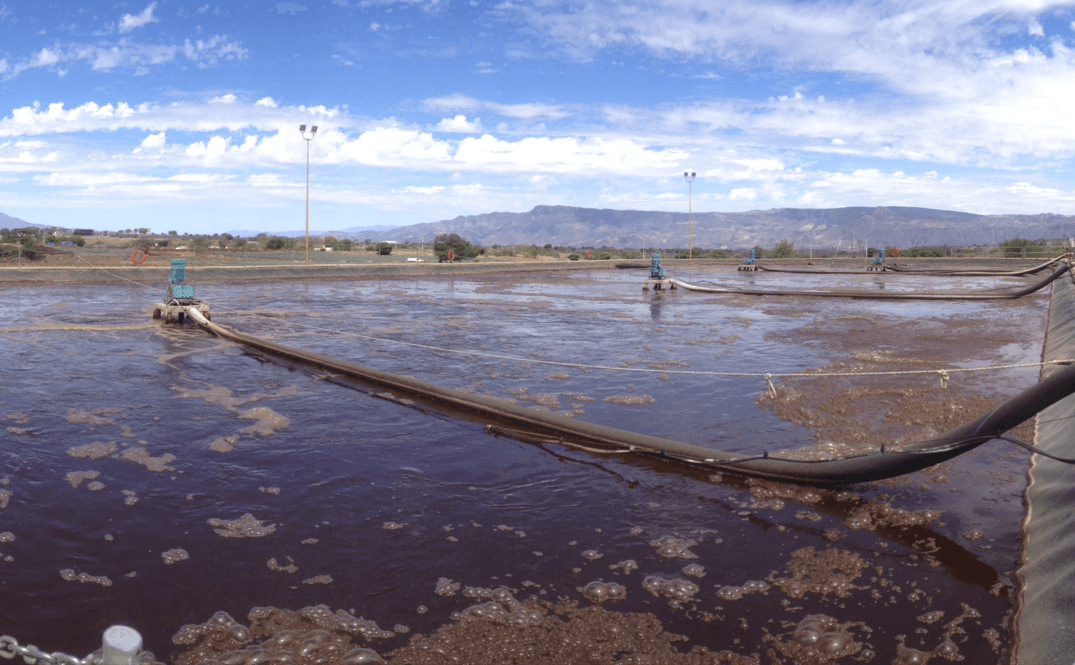
Day 14: scum almost gone and oxygen transfer restored, with the aeration tank level down over a meter as bottom sludge was digested.
Results came fast. Offensive odor was eliminated within 7 days as the bacteria broke down the sulfur and nitrogen compounds behind it. By day 14, the thick surface scum was almost entirely gone and oxygen transfer to the mixed liquor was restored. The clearest sign of digestion was at the bottom: the aeration tank water level dropped by more than a meter, which corresponds to more than a meter of accumulated sludge consumed in place. With that load gone, treatment capacity recovered and the aerators drew less power as organic loading and aeration demand eased. The same approach applies anywhere a high-strength fermentation stream overloads an aeration tank, including breweries, wineries, ethanol plants, food processing lines, and agave and distillery operations. It turned a failing tank around with a daily dose and no capital spend.
Vinasse, also called vinaza, is the high-strength liquid waste left over after fermenting and distilling a sugar crop into alcohol. In a tequila distillery it comes off agave; in other plants it comes off sugarcane molasses or grain. It carries a heavy organic load and acidity, which is why it is difficult to treat and tends to overload an aeration tank. Wastewater Treat (WT) is formulated to digest that load biologically.
Distillery wastewater is usually treated biologically, because its strength comes from dissolved and suspended organics rather than chemicals. Bacteria break down that organic load in aerobic and anaerobic stages, lowering BOD, COD, and solids before discharge. Bioaugmentation adds a concentrated, targeted culture to that process. Dosing WT into the aeration tank raises the working population of organic-degrading bacteria, which speeds digestion of sludge and scum without new infrastructure.
A scum layer forms when fats, oils, filamentous growth, and undigested organics float and mat together on the surface faster than the biology can break them down. On a high-strength stream like vinaza it can get thick enough to block oxygen transfer, which starves the treatment biology and makes the problem worse. Restoring an active, balanced microbial population, as WT does, digests the floating material and clears the surface.
You reduce it biologically, in place. Instead of draining and mechanically removing the sludge, a bioaugmentation dose builds up bacteria that digest the accumulated solids where they sit, converting them to gas and water. In this trial, once-a-day WT digested more than a meter of bottom sludge inside two weeks, shown by a matching drop of over a meter in the tank water level, with no dredging and no downtime.
Wastewater odor usually comes from anaerobic activity producing hydrogen sulfide, ammonia, mercaptans, and volatile fatty acids when organic load outpaces the available oxygen and biology. The durable fix is to restore aerobic digestion so those compounds are broken down instead of released. WT targets the organics that feed odor production, and in this case eliminated the odor within 7 days.
It can, indirectly. Aeration energy scales with how much organic load the blowers have to oxidize and how much sludge the system carries. As bioaugmentation digests accumulated sludge and stabilizes the organic load, aeration demand eases and the aerators do not have to work as hard. At this distillery, electricity use for aeration fell as the sludge volume and organic loading came down.
Sludge bulking is when activated sludge settles poorly, often because filamentous bacteria dominate under high organic load, low oxygen, or nutrient imbalance. It carries solids over and drags down effluent quality. Keeping a diverse, well-fed floc-forming population helps it settle. A high-CFU blend like WT supports healthy floc formation and settling while it works through the excess organic load.
It depends on tank volume, temperature, organic loading, and how long the buildup has accumulated, so timing varies from site to site. On this high-strength distillery stream the first result, odor removal, showed within 7 days, and the surface scum was almost gone by 14 days. Sludge digestion continues as long as dosing keeps the added bacteria active.
Yes. Breweries, wineries, ethanol plants, and food processing lines all produce high-strength fermentation and organic waste that overloads aeration tanks the same way vinaza does. The same WT bioaugmentation approach, dosing organic-degrading bacteria into the existing system, applies across those industries to cut sludge, control odor, and recover treatment capacity.
This is the product behind these results. Open its page for full specifications, packaging, and dosing rates.
Tell us your system size and current numbers. We will recommend a starting dose and send a quote.
Request a Quote


