
- Products
- Overview
- Product Forms / Packaging
- Plant Health
- Wastewater
- Livestock Waste
- Aquaculture & Ponds
- Petroleum & Grease
- Case Studies
- Buy
- About
- Contact

Lab analysis of a Wisconsin dairy lagoon before and after Pit Puck manure pit tablets showed plant-available nitrogen rise from 172.4 to 237.0 lbs per acre at a 20,000 gallon application rate, a gain of 64.6 lbs and a 37% increase, with potassium up 71.6 lbs per acre and phosphorus down 13.4 lbs per acre, which frees up application room under the farm's nutrient management plan. Sludge, surface scum, and odor all dropped over the same period.
| Per acre at 20,000 gal | Untreated baseline | After Pit Puck | Change |
|---|---|---|---|
| Plant-available nitrogen | 172.4 lbs | 237.0 lbs | +64.6 lbs (+37%) |
| Potassium (K2O) | 363.2 lbs | 434.8 lbs | +71.6 lbs (+20%) |
| Phosphorus (P2O5) | 230.0 lbs | 216.6 lbs | -13.4 lbs, more application room |
| Sludge, scum, odor | Heavy buildup | Substantially reduced | Easier agitation and pump-out |

Before treatment: heavy sludge on the lagoon floor and a scum layer across the surface, with 172.4 lbs of plant-available nitrogen per acre at 20,000 gallons.
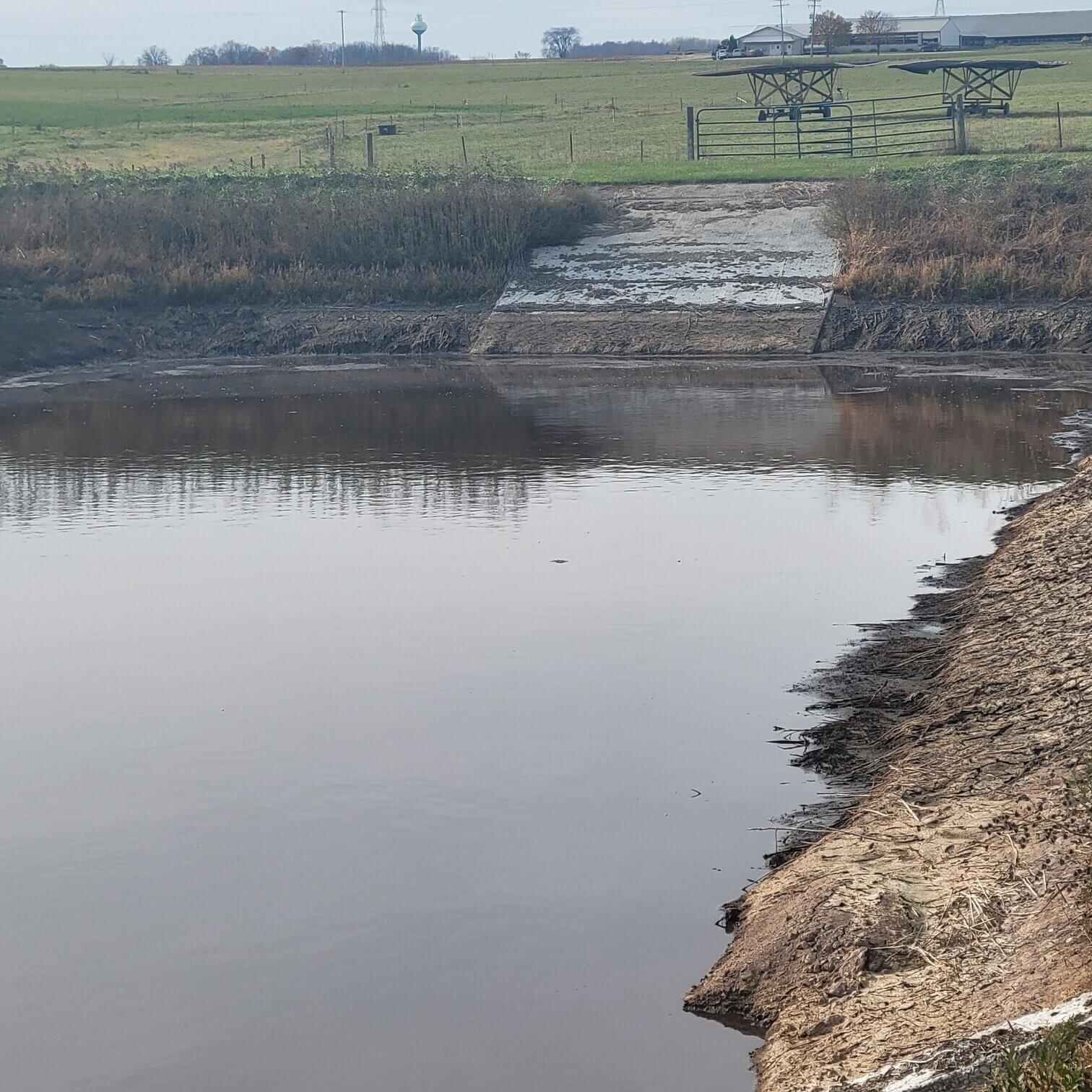
After Pit Puck: less sludge, less scum, lower odor, and 237.0 lbs of plant-available nitrogen per acre, a 37% gain in manure fertilizer value.
Liquid dairy manure is a real fertilizer, but its value swings widely with how the storage is managed. In this Wisconsin lagoon, the same manure carried 172.4 lbs of plant-available nitrogen per acre before treatment and 237.0 lbs after, at an identical 20,000 gallon rate. Same lagoon, same farm, 64.6 more pounds of nitrogen per acre.
It depends on the herd, the ration, dilution, and how well the storage is digesting. The useful figure is plant-available nitrogen at your actual application rate, not total nitrogen. This farm measured 11.85 units of nitrogen after treatment, which works out to 237.0 lbs per acre at 20,000 gallons, against 172.4 lbs from the untreated baseline sample.
Most of the gain comes from getting the storage biologically active so solids break down and the slurry going out the pump is more consistent. Adding a microbial tablet to this lagoon lifted plant-available nitrogen 37% and potassium 20% per acre, without changing the herd, the ration, or the spreading rate.
Nutrient management plans generally cap manure by the phosphorus a crop can take up, since excess phosphorus runs off into surface water. Nitrogen is usually the nutrient you want more of, so a high phosphorus concentration forces you to spread thin and cover more acres. Here phosphorus dropped 13.4 lbs per acre while nitrogen climbed, which moves the ratio in the direction a planner wants.
No, and the difference matters. A control is a second, untreated lagoon or parallel stream measured over the same period. A baseline is simply the same lagoon sampled before treatment started. This trial has a baseline, not a control, so changes from settling, temperature and loading over the treatment period cannot be separated from the treatment itself.
The honest test is whether anything measurable changes. On this farm two things did: the lab numbers on the manure moved substantially, and the physical condition of the lagoon improved, with less sludge, less surface scum, and lower odor during storage and agitation. Results vary with lagoon size, loading, and temperature.
Sludge and crust are undigested solids, so the fix is biological: give the storage enough of the right bacteria to keep breaking those solids down instead of letting them settle and mat. This lagoon carried noticeably less sludge and scum after treatment, which is what makes agitation and pump-out faster.
You drop it in. The tablets sink and dissolve on their own, delivering bacteria straight into the manure with no mixing, no dosing equipment, and no change to your handling routine. That is the practical reason producers use the tablet format instead of a liquid on pits and lagoons.
Test often enough that your spreading plan reflects what is actually in the storage, which for most operations means at least annually and again after any change in management. This trial is a good illustration of why: the same lagoon produced materially different nitrogen, potassium, and phosphorus numbers over the treatment period.
This is the product behind these results. Open its page for full specifications, packaging, and dosing rates.
Tell us your system size and current numbers. We will recommend a starting dose and send a quote.
Request a Quote


