- Products
- Overview
- Product Forms / Packaging
- Plant Health
- Wastewater
- Livestock Waste
- Aquaculture & Ponds
- Petroleum & Grease
- Case Studies
- Buy
- About
- Contact

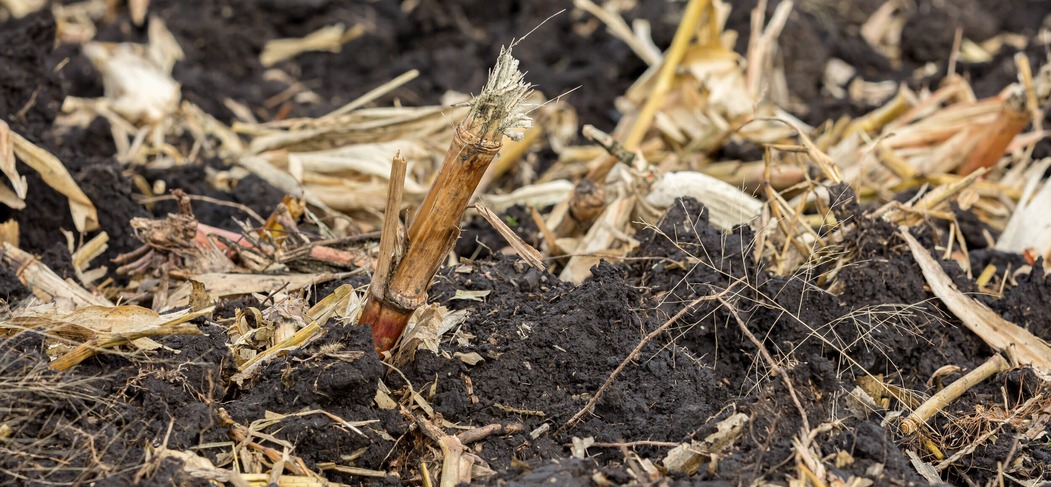
Corn stalks still lying on the field at planting usually point to slow soil biology. In Iowa State University trials, 34 to 49% of corn residue was still on the soil surface a full 12 months after harvest, and it made no difference whether the field was deep-tilled, strip-tilled or left in no-till [2]. What decides how fast stalks break down is soil temperature, moisture, and how many decomposer microbes are working on them.
Fall nitrogen and extra tillage, the two fixes growers reach for first, did not change breakdown in those trials either. What a grower can change is the size of the decomposer population on the residue, which is what a microbial product such as Crop Residue Decomposer (CRD) adds.
A corn crop leaves about as much stover per acre as it yields in grain, by weight, which works out to roughly 5.6 tons of stalks, leaves, cobs and husks behind a 200-bushel crop [3]. Most of that mass is cellulose, hemicellulose and lignin, the structural fibers that hold a corn plant upright. Lignin in particular is slow to digest. Only a narrow group of soil organisms, mostly fungi, can break it down at a useful rate.
After harvest, conditions work against those organisms. The residue is dry and sitting on top of the soil, out of contact with the microbes in it. Soil temperatures are dropping every week. And the residue carries far more carbon than nitrogen, so the microbes that do start on it run short of nitrogen and slow down. By the time conditions are good again in late spring, the planter is already in the field.
That is why the same field can look clean in one year and matted the next. A warm, wet fall gives the soil biology weeks of working time. An early freeze after a late harvest gives it almost none.
Soil microbes need food with a carbon-to-nitrogen (C:N) ratio around 24:1. Corn stover runs about 57:1 and wheat straw about 80:1 [1]. When microbes digest material above 24:1, they take nitrogen from the soil to make up the difference. USDA NRCS calls this a temporary nitrogen deficit, or nitrogen immobilization [1]. The nitrogen comes back later as those microbes die and decompose, but in the meantime breakdown is slow, and a crop planted into heavy residue can show it as pale, nitrogen-short seedlings in the first few weeks.
Temperature is the biggest single factor. Iowa State's lab work showed residue breaking down much faster at 90°F than at 32°F, and their field guidance puts the working threshold at soil above 50°F with moisture near field capacity [2]. Corn Belt soils cool quickly once harvest is done, so every week of delay between combine and treatment costs working time the microbes do not get back until spring.
Decomposer microbes need a moist surface to colonize. Stalks standing upright or lying loose on dry ground can sit for months with little activity. Residue that is chopped, in contact with soil, and wetted by rain breaks down far faster than the same residue left dry on top.
Every field has decomposers, but how many and which ones varies with organic matter, tillage history and management. A field short on the cellulose and lignin digesters that do the early work on stalks gets a slow start, and in fall a slow start means little gets done before soils turn cold.
Fall nitrogen is a common fix, and the data does not support it. Iowa State applied 0, 30 and 60 lb of nitrogen per acre as UAN right after harvest and found no difference in residue breakdown [2]. Temperature and moisture limited the microbes, and extra nitrogen did not change either one.
Extra tillage is the second common fix. In the same Iowa State work, deep tillage, strip-till and no-till all left a similar share of residue after a year [2]. Tillage passes still cost fuel and time, break down soil structure and leave the soil exposed to erosion over winter, so a pass made only to speed up decomposition is hard to justify.
Burning removes the residue but takes the carbon and much of the nutrient value with it, and it is restricted in many areas. Baling removes the nutrients along with the stalks. Waiting works in a warm fall and fails in a cold one.
A microbial decomposer adds the organisms the residue is short of, in large numbers, at the moment they are most useful. Instead of waiting for the native population to find the stalks and build up, the decomposers go on as a spray directly onto the residue.
Crop Residue Decomposer is a blend of nine strains: four bacteria (Bacillus pumilus, B. licheniformis, B. subtilis and B. amyloliquefaciens) and five fungi (Trichoderma harzianum, T. longibrachiatum, T. asperellum, Aspergillus oryzae and A. niger). The powder carries 100 billion CFU per gram of bacteria and 5 billion CFU per gram of fungi. The fungi and bacteria produce cellulase, xylanase and laccase, the enzymes that break cellulose, hemicellulose and lignin into compounds the rest of the soil biology can use.
The fungi matter most on corn stalks, because lignin is the slowest fraction to digest and fungi do most of that work. The Bacillus strains work on the softer fractions and keep going across a wide pH range. As the residue digests, the nitrogen, phosphorus and potassium held in it return to the soil, and what is left becomes organic matter.
A decomposer works under the same temperature and moisture limits as the native microbes. What it adds is a larger decomposer population on the residue when the fall window opens, and that is the part a grower controls.
For the science behind the strains themselves, ABI Microbes covers it in its guide to beneficial soil microbes.
Timing is the main decision. Apply as soon after harvest as possible, while soils are still warm. CRD works slowly from about 45°F (7°C), picks up speed once soils pass 60°F (15°C) and works fastest between 68 and 95°F (20 to 35°C). An early fall application gets several working weeks before winter. A spring application ahead of seedbed preparation also works, but it starts slowly and speeds up as the soil warms.
| Residue load | Rate per acre | Rate per hectare | Typical residue |
|---|---|---|---|
| Standard | 20 g | 50 g | Soybean, pulse, light small-grain residue |
| Heavy | 40 g | 100 g | Corn stover, wheat and rice straw, cotton stalks |
Corn stalks are a heavy load, so use 40 grams per acre (100 grams per hectare).
Shake the powder with a small amount of water in a closed container until it disperses, then add it to the spray tank and keep gentle agitation running. Use at least 10 gallons of spray volume per acre (95 liters per hectare) by ground, or 3 to 5 gallons per acre by air. A boom sprayer is the usual choice. Backpack sprayers, aerial application and irrigation or fertigation systems also work.
CRD is compatible with many liquid fertilizers, so it can ride along on a fall fertilizer pass you are already making. Dilute the fertilizer to its final spray concentration before adding CRD.
The label method is to spray right after the stalks are chopped with a stalk chopper, flail mower or combine chopper-spreader, then lightly incorporate with a disk or vertical tillage pass. Chopped residue exposes more surface for the microbes to colonize, and shallow incorporation puts residue, microbes and soil moisture together.
In no-till, spray onto evenly spread residue and time the application ahead of rain or irrigation, so water carries the microbes into contact with the stalks. Incorporation is faster but not required.
CRD contains live fungi, so do not tank-mix it with fungicides. Allow 7 days between a systemic fungicide and a CRD application, or 3 days for a contact fungicide. Herbicides pose much less risk to the microbes, but separate the two applications where practical.
No product turns a field of corn stalks into soil in a few weeks. Expect the change to show at planting.
In the first few weeks after a fall application, while soils are above 60°F, the microbes colonize the residue and start on the softer leaf and husk material. As soils cool through November, activity slows and in most northern fields stops over winter. It picks up again as soils warm in spring.
By planting, check the residue by hand. Stalks that snap cleanly at the nodes instead of bending, a thinner and darker mat, and less residue catching on row cleaners and openers are the signs that decomposition kept going over the off-season. Fields treated early in a warm fall will show more change than fields treated late after an early freeze.
We are working on field measurements with growers using CRD and will publish the numbers, with the method behind them, once they are in. Until then, leave an untreated strip in your own field and walk both at planting.
If you have corn stalks on the ground now, the useful window is the next few weeks. Tell us your acreage and residue load through the quote form and we will send a rate and pricing for Crop Residue Decomposer.
Corn stalks carry about 57 parts carbon to 1 part nitrogen, well above the 24:1 that soil microbes need, so decomposition stalls while the microbes hunt for nitrogen. Cold soil after harvest, dry residue sitting on top of the ground and a small native decomposer population slow it further. Iowa State found 34 to 49% of corn residue still on the surface a year after harvest.
Most are chopped or left standing and decompose in the field over the following year. Some growers bale them for bedding or feed, and in some areas residue is burned. Left alone, a large share is still there at planting, especially after a cold fall.
Not on its own. Iowa State applied 0, 30 and 60 lb of nitrogen per acre as UAN after harvest and saw no difference in breakdown. Temperature and moisture were the limits. A fall fertilizer pass is still a convenient way to carry a decomposer onto the field.
Not much. Deep tillage, strip-till and no-till left a similar share of residue after 12 months in Iowa State trials. A light incorporation pass helps a decomposer reach the residue, but tillage by itself is an expensive way to speed breakdown.
Right after harvest, while soils are still above 60°F. Crop Residue Decomposer works slowly from about 45°F and fastest between 68 and 95°F, so an early fall application gets several working weeks before winter. Spring application ahead of seedbed preparation also works.
40 grams per acre (100 grams per hectare), the heavy-residue rate. Lighter residue such as soybean stubble takes 20 grams per acre. Use at least 10 gallons of spray volume per acre by ground.
Yes. Spray onto evenly spread residue ahead of rain or irrigation so water carries the microbes into contact with the stalks. Incorporation speeds things up but is not required.
No. Crop Residue Decomposer is a microbial inoculant that speeds residue breakdown. It is not registered for pesticidal use and is not used to control pests or disease.