- Products
- Overview
- Product Forms / Packaging
- Plant Health
- Wastewater
- Livestock Waste
- Aquaculture & Ponds
- Petroleum & Grease
- Case Studies
- Buy
- About
- Contact

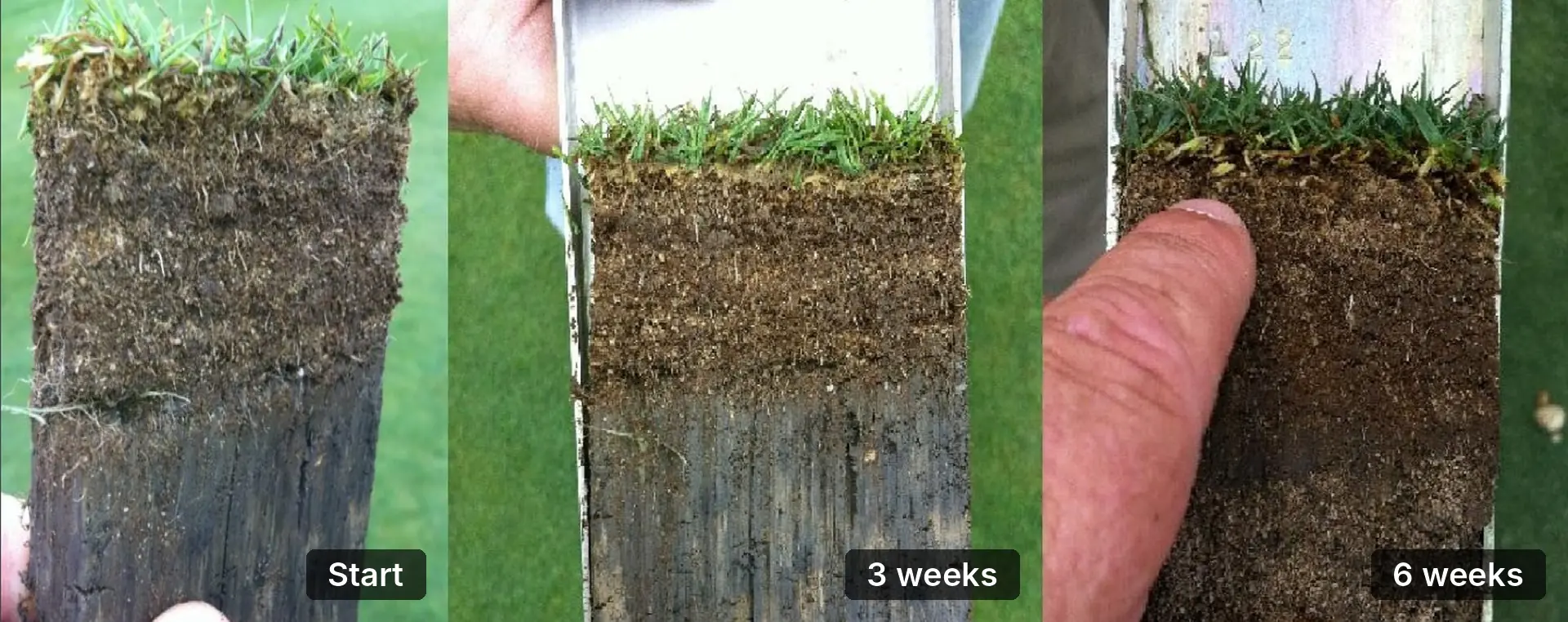
Verticutting is the standard way to pull thatch and organic matter out of golf greens, and it works. It also takes surfaces out of their best condition for days, leaves debris to clean up and has to be scheduled around play. A biological program goes after the same layer from the other side, by speeding up the microbes that break thatch down in place. On one American golf course, that approach took thatch from 3 inches to 0.5 inches in 40 days with no verticutting at all.
Thatch is the layer of living and dead stems, crowns, roots and leaf sheaths between the green canopy and the soil [1][2]. Some of it is useful. Penn State Extension notes that about half an inch on sports turf gives the surface resiliency and footing [2].
Past that, the problems are the ones turf managers already see in play:
Penn State puts the point where problems become likely at about one inch, and notes that at an inch or more, cultural practices alone will not bring the layer back down [2].
Pull profile samples with a cup cutter or soil probe from several greens or several areas of a field, and measure the brown, fibrous band between the base of the leaves and the top of the soil or sand [1]. Check the same spots each time so you can track the trend through the season. Thatch is rarely even. The greens with the most shade, the most irrigation or the heaviest fertility usually set the program.
Thatch builds when the turf produces stems and roots faster than soil organisms can break them down. Managed turf pushes both sides of that balance.
Growth runs high because of fertility and irrigation. Heavy nitrogen speeds stem and root production [1][2], and overwatering does the same [3]. Creeping bentgrass and Kentucky bluegrass are among the cool-season grasses that form the most thatch [2].
Breakdown runs low for several reasons:
That combination is why organic matter management never ends on a golf course or a sports field.
USGA describes verticutting as thicker blades, 1.4 to 3.0 mm, working from the surface down to 1.5 inches below the rollers, with the goal of removing organic matter and soil from the upper profile. It is typically done two or three times a season, and USGA calls it an aggressive and disruptive process that produces a large volume of debris [4].
Grooming and vertigrooming run shallower and more often, up to weekly on ultradwarf greens, with little disruption to play. Their main job is managing grain and lateral growth. USGA notes that grooming is not intended to remove large amounts of organic matter, and vertigrooming removes only trace amounts with each pass [4].
Light vertical mowing every one to two weeks in spring and fall thins puffy leaf growth and opens grooves for sand topdressing. Green speeds are typically slower for one to two days after each pass [5].
Core aeration pulls plugs of soil and thatch, relieves compaction and mixes some soil into the thatch, which helps microbes break it down [1][2]. Sand topdressing dilutes the organic layer and keeps surfaces firm. Purdue Extension notes that annual aeration plus better water and fertilizer management can take several years to bring thatch under half an inch on its own [3].
All of these physically remove or dilute the layer. Only aeration helps the decomposition side, and only by mixing soil into the thatch.
Thatch is mostly lignocellulose: cellulose, hemicellulose and lignin. Soil microbes break these fibers down with enzymes. Cellulase digests cellulose, xylanase digests hemicellulose and laccase works on lignin, the slowest fraction to break down.
Thatch Treat is a blend of Bacillus bacteria and beneficial fungi that produce all three enzymes, at 5 billion CFU per gram. The organisms colonize the thatch layer, so enzyme production keeps going after the spray dries instead of washing out after one application. Nothing is lifted out of the turf, so there is no debris and no recovery period.
The microbes have their own working range. Thatch Treat is active from 45 to 113°F (7 to 45°C), works best between 68 and 95°F (20 to 35°C) and tolerates soil pH from 4.5 to 9.5, with an optimum of 5.5 to 7.5.
On an American golf course with about 3 inches of thatch across its managed turf, a scheduled Thatch Treat program brought the layer down to 0.5 inches in 40 days, an 83% reduction. There was no verticutting, no coring and no mechanical dethatching, and the course stayed in play the whole time. By day 40, infiltration after irrigation and rain had recovered, the surface was firmer with more consistent ball roll and it no longer played spongy. The trial, with before and after photos, is in the golf course thatch case study.
That course started with a heavy layer. A sports field or a course with less buildup will see a different curve, and results depend on soil temperature, starting depth and the rest of the program.
| Step | Rate per acre | Rate per hectare | Spray volume |
|---|---|---|---|
| Initial application | 30 to 50 g | 75 to 125 g | 20 to 40 gal/acre (190 to 375 L/ha) |
| Follow-up, 4 to 8 weeks later | Same rate | Same rate | Same volume |
| Maintenance | Same rate | Same rate | Monthly, between topdressings |
Apply the follow-up dose when thatch is heavy or when herbicides, fungicides or other pesticides went down before decomposition was complete.
Shake the powder with a small amount of water in a closed container until it disperses, then add it to the tank and keep gentle agitation running. A boom sprayer is the usual choice on greens, fairways and fields. Backpack and hose-end sprayers work for small areas, and the product can also go through a light irrigation or fertigation cycle. The powder passes a 100 mesh screen, so it runs through standard turf equipment.
Follow with a light irrigation cycle of 1 to 3 minutes to move the microbes into the thatch layer. Avoid heavy irrigation right after, which can wash them below the thatch.
Apply during active growth, when soil is warm and microbial activity is high. Shoulder seasons work when conditions allow. Many programs start in spring and run monthly through the season between topdressings.
Thatch Treat contains live fungi and bacteria, so plan it around the fungicide and herbicide schedule. Avoid systemic herbicides and fungicides for at least 7 days before and during treatment. Contact products generally need a 3-day buffer. If a chemical application lands inside that window, reapply a follow-up dose.
A biological program does not replace every mechanical pass. Verticutting is still the right call when:
The two also work together. Applying Thatch Treat right after core aeration puts the microbes into fresh openings. After a verticutting pass, it keeps working on the thatch the blades left behind, and it slows how fast the layer rebuilds between passes. Many superintendents use it to stretch the interval between mechanical passes rather than drop them outright.
The same biology works on high-end lawns and landscape turf, at the same per-acre rate.
If you manage greens, fairways or sports fields with a thatch problem, send us your acreage and turf type through the order form and we will reply with a rate and pricing for Thatch Treat.
Verticutting runs vertical blades through the turf to cut out thatch, organic matter and some soil from the upper profile. USGA describes verticutting blades as 1.4 to 3.0 mm thick, working down to 1.5 inches below the rollers, and notes it is typically done two or three times a season.
Dethatching is the goal, removing the thatch layer. Verticutting is one way to do it, with vertical blades. Power raking, core aeration and biological thatch treatments are others. On greens, verticutting also cuts lateral growth and opens grooves for topdressing.
They do different jobs, and the same goes for dethatching vs aerating. Verticutting removes organic matter from the upper profile. Core aeration relieves compaction, improves air and water movement and removes some thatch. Most golf programs use both, and a biological treatment applied after aeration puts thatch-digesting microbes into the open holes.
USGA puts aggressive verticutting at two or three times a season, with lighter vertigrooming as often as weekly on ultradwarf greens. A biological program running monthly between topdressings can stretch the interval between the aggressive passes.
Yes. A biological program adds bacteria and fungi that digest thatch in place. On one golf course, Thatch Treat took thatch from 3 inches to 0.5 inches in 40 days with no verticutting, no coring and no downtime.
It depends on soil temperature and starting depth. In the golf course trial, thatch fell 83% in 40 days. A second application 4 to 8 weeks after the first helps on heavy thatch, and monthly applications between topdressings keep up with new growth.
Keep systemic fungicides and herbicides at least 7 days away from treatment, and contact products 3 days. If a chemical application lands inside that window, apply a follow-up dose.
No. Thatch Treat is a microbial inoculant that breaks down the thatch layer. It is not registered for pesticidal use and is not used to control pests or disease.
The full dataset behind this report is available as a CSV file for your own analysis. Please credit Bio-Green Planet when you use it.
Download the dataset (CSV)