- Products
- Overview
- Product Forms / Packaging
- Plant Health
- Wastewater
- Livestock Waste
- Aquaculture & Ponds
- Petroleum & Grease
- Case Studies
- Buy
- About
- Contact

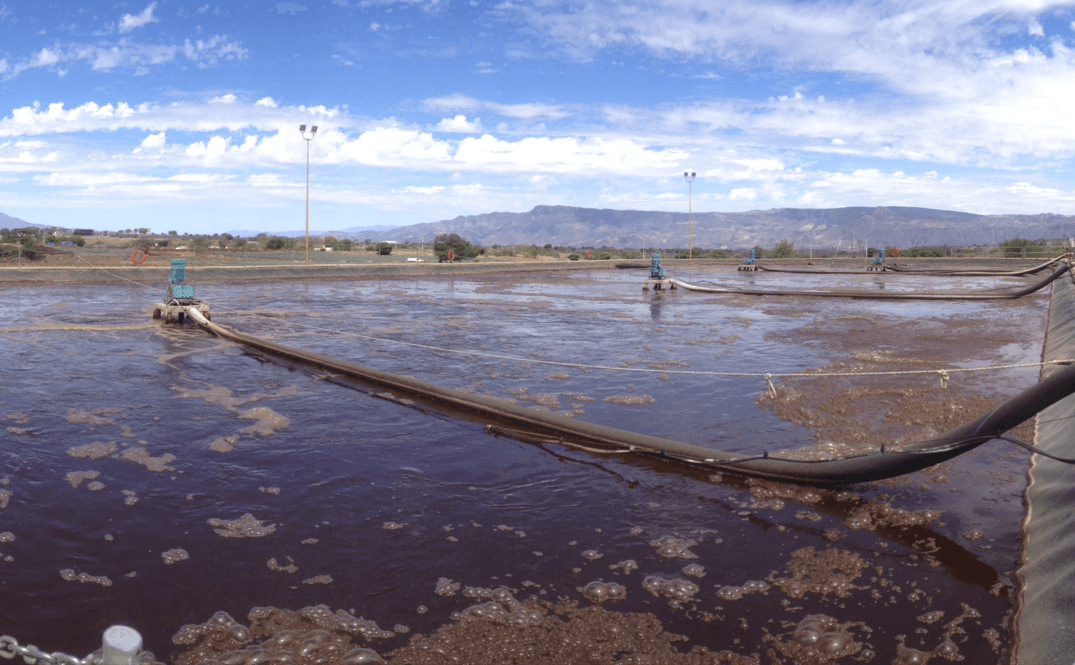
Wastewater Treat (WT) is a high-CFU blend of aerobic and facultative Bacillus bacteria built to cut BOD, COD, TSS, sludge, and odor in municipal and industrial systems. Its denitrifying strains work through the anaerobic zones and the sludge layer to move nitrate and total nitrogen out of the water, while its enzymes digest the fats, proteins, and organic solids that overload aeration tanks, lagoons, and digesters. The strains are facultative and hold up across wide pH, temperature, and load swings, so they keep working through seasonal and influent changes.
The numbers above are real field results, including the 86% BOD reduction WT delivered at a 90,000-bird poultry slaughterhouse in 90 days.
Key Benefits:
Wastewater Treat (WT) is a high-CFU blend of aerobic and facultative anaerobic Bacillus wastewater treatment bacteria for municipal, industrial, and agricultural systems. The spore-based strains digest BOD, COD, TSS, and organic solids, and their denitrifying members move nitrate and total nitrogen out of the water through the anaerobic zone and the sludge layer. Because the strains are facultative, they keep working across wide pH, temperature, and load swings, so a plant stays stable through seasonal and influent changes.
WT fits activated sludge, aeration basins, SBR, MBR, MBBR, clarifiers, anaerobic digesters, lagoons, lift stations, and septic infrastructure. It improves organic conversion, floc formation, and settling, and its enzymes, including proteases, lipases, and cellulases, break down the fats, proteins, and cellulose that overload aeration tanks and digesters. So effluent runs steadier while sludge, odor, and operating cost come down.
WT lowers organic and solids load so effluent holds inside permit under variable flow. In the field it cut effluent BOD from 860 to 121 mg/L, an 86% reduction, at a Brazil poultry slaughterhouse, and cut COD from 6,000 to 1,000 mg/L, an 83% reduction, at a Sao Paulo waste lagoon.
WT is a blend of denitrifying bacteria that convert nitrate and nitrite to nitrogen gas in the low-oxygen and anaerobic zones and inside the sludge layer, lowering total nitrogen so plants meet discharge limits. This supports biological nutrient removal (BNR) alongside phosphorus reduction, and eases the nutrient surcharges that come with high total nitrogen.
WT enzymes liquefy organic solids and speed digestion, so a plant produces less sludge and spends less on dredging, dewatering, and hauling. At a tequila vinaza plant, WT digested more than one meter of accumulated sludge in 14 days, and at a Southern California municipal plant it cut biosolids from its sequencing batch reactors by 50%, with sludge-hauling savings about 2.5 times the cost of treatment.
WT suppresses the compounds behind most plant odor at the microbial source, so operators usually notice the odor drop first, often within the first week. At the tequila vinaza plant, bad odors were gone in 7 days.
As an activated sludge bacteria blend, WT improves floc, settling, nutrient removal, and sludge reduction across the systems most plants run, in both municipal and industrial service.
As bacteria for sewage treatment, WT reduces solids, controls odor, and steadies biological activity in sewage plants, lift stations, septic tanks, and holding ponds, including low-maintenance and decentralized systems. Slow-release blocks and tablets keep dosing simple where daily addition is not practical.
WT handles high-strength industrial wastewater where complex organics and variable loads challenge standard blends. Its enzymes digest the fats, proteins, and sugars that overload these streams.
Every number here comes from a WT field trial, each with its own case study.
WT is an aerobic and facultative anaerobic Bacillus spore blend with denitrifying strains, manufactured at up to 100 billion CFU/g for viability and lower shipping cost. It produces broad-spectrum hydrolytic enzymes, works across wide pH, temperature, and loading ranges, and is all natural, non-toxic, and non-GMO. It ships as powder, liquid, slow-release block, and tablet, with a typical starting dose near 0.04 ppm stepped up after two weeks. Full concentrations, packaging, and dosing tables are in the Technical Data and Application Rates tabs.
As a US wastewater bacteria manufacturer, we supply WT in bulk and wholesale to WWTPs, engineering firms, and distributors, and for OEM and private label, with domestic and international shipping. WT also works as a microbial base for bio-based cleaning products, including drain openers, odor control sprays, and floor and carpet cleaners. Send us your flow and influent and we will size the dose and quote the order.
Concentration (CFU/g):
Custom concentrations available upon request
Packaging Options:
Smaller packaging available upon request
Shelf-life:
Storage Recommendations:
Application Guidelines:
| PPM | Grams per million liters/day |
Grams per million gallons/day |
Notes |
|---|---|---|---|
| 0.04 | 40 | 150 | Starting Dose |
| 0.08 | 80 | 300 | After 2 weeks |
| PPM | ml per million liters/day |
ml per million gallons/day |
Notes |
|---|---|---|---|
| 0.04 | 150 | 570 | Starting Dose |
| 0.08 | 300 | 1140 | After 2 weeks |
Blocks
One 900g (2lb) block treats ~1,500m3 (1.5 million liters) of water and slowly dissolves over ~30 days. Dissolve rate fluctuates with water temperature and flow rate.
Tabs
One 85g (3oz) tab treats ~150m3 (150,000 liters) of water and slowly dissolves over ~30 days. Dissolve rate fluctuates with water temperature and flow rate.
Fast-Dissolve Tabs
Fast-dissolve tablets dissolve within 1 hour. Available in multiple sizes (5g, 28g, 130g).
Bio-Based Cleaners
Usage rates vary. Reference dose:
Wastewater Treat (WT) is a high-CFU blend of aerobic and facultative Bacillus wastewater treatment bacteria for bioaugmentation of municipal and industrial systems. These microbes digest BOD, COD, TSS, and organic solids, and their denitrifying strains cut nitrate and total nitrogen in the anaerobic zone and sludge layer, while their enzymes reduce sludge and odor at the source.
These wastewater treatment bacteria fit most plants running aerobic, anaerobic, or variable-load conditions, and are a strong fit where high BOD or COD, seasonal swings, sludge buildup, or total nitrogen limits are the problem. WT works in activated sludge, SBR, MBR, MBBR, lagoons, digesters, and lift stations. Send us your flow and influent and we will recommend a starting dose.
In the field, WT cut effluent BOD from 860 to 121 mg/L, an 86% reduction, at a poultry slaughterhouse plant, and lifted treatment efficiency from 55% to 86% in 90 days. At a São Paulo waste lagoon it cut COD from 6,000 to 1,000 mg/L, an 83% reduction. Results vary with load and system, but WT reliably lowers BOD, COD, and TSS for permit compliance.
Yes. WT is a blend of denitrifying bacteria that convert nitrate and nitrite to nitrogen gas in the anaerobic zone and sludge layer, lowering total nitrogen so plants can meet discharge limits. It supports biological nutrient removal alongside phosphorus reduction.
Yes. These wastewater bacteria produce enzymes that liquefy organic solids and speed digestion, cutting sludge yield and lowering dredging, dewatering, and hauling costs. At a tequila vinaza plant, WT digested more than one meter of accumulated sludge in 14 days.
Yes. WT suppresses the hydrogen sulfide, ammonia, mercaptans, and volatile fatty acids behind most odor, cutting nuisance gases at the microbial source in lift stations, lagoons, digesters, and headworks. Operators usually notice the odor drop first, often within the first week.
By accelerating organic breakdown, biological wastewater treatment with WT lowers sludge yield, aeration energy, and chemical use such as polymers, flocculants, and odor additives, so plants save on hauling, electricity, and chemicals while holding effluent within permit.
Yes. WT is an activated sludge bacteria blend that improves floc formation, settling, nutrient removal, and sludge reduction across activated sludge, SBR, MBR, MBBR, clarifiers, anaerobic digesters, and lagoons, in both municipal and industrial plants.
Yes. As bacteria for sewage treatment, WT reduces solids, controls odor, and stabilizes biological activity in sewage plants, lift stations, septic tanks, and holding ponds, including low-maintenance and decentralized systems.
These wastewater treatment bacteria are used across municipal WWTPs and high-strength industrial effluent from food and beverage, pulp and paper, pharmaceutical, slaughterhouse, brewery, and juice processing. WT enzymes handle the fats, proteins, and complex organics that overload these streams.
A typical starting dose is about 0.04 ppm, roughly 40 g of 50-billion CFU/g powder per million liters per day, or 150 g per million gallons per day, stepped up after two weeks. Slow-release blocks and tablets are available for lagoons and hard-to-dose systems, and we tailor the dose to your flow and load.
WT ships as powder, liquid, slow-release block, and tablet, in sizes from pails to drums, with custom CFU concentrations on request. The powder runs up to 100 billion CFU/g for strong viability and lower shipping cost.
You can buy WT wastewater treatment bacteria directly from the manufacturer in bulk and wholesale quantities, with domestic and international shipping. Request a sample or a quote and we will size the order and dose to your system.
Yes. As a US-based wastewater bacteria manufacturer, we supply WT for private label, OEM, and distribution, including as a microbial base for bio-based drain, odor, and cleaning products, with custom formats and packaging.
Yes. WT uses all-natural, non-GMO Bacillus strains, is produced under quality control in the USA, and is safe for treatment infrastructure, operators, and downstream water when used as directed.