- Products
- Overview
- Product Forms / Packaging
- Plant Health
- Wastewater
- Livestock Waste
- Aquaculture & Ponds
- Petroleum & Grease
- Case Studies
- Buy
- About
- Contact

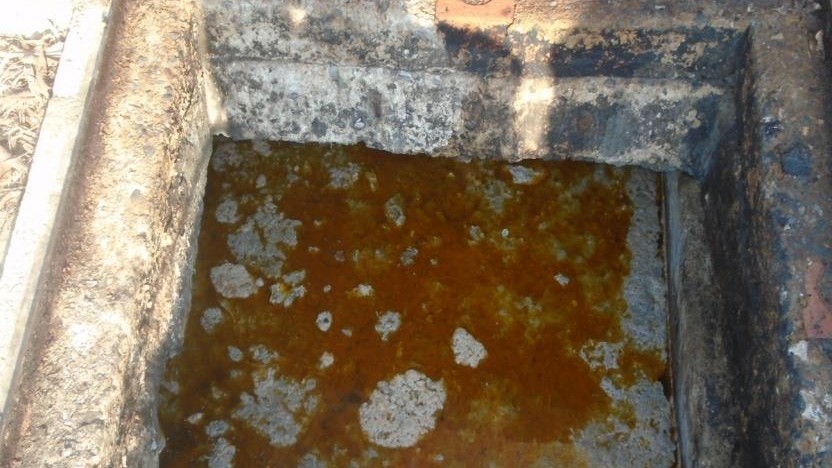
A commercial grease trap starts refilling the day it is pumped. Fats, oils and grease (FOG) and food solids build up until the next truck, and the trap smells worse the closer it gets. Your city sets the pumping schedule. A bacteria treatment changes how fast the trap fills and how much it smells in between. This guide covers grease trap maintenance from both sides: how often a trap needs pumping, what local rules say about additives, and where a biological program fits.
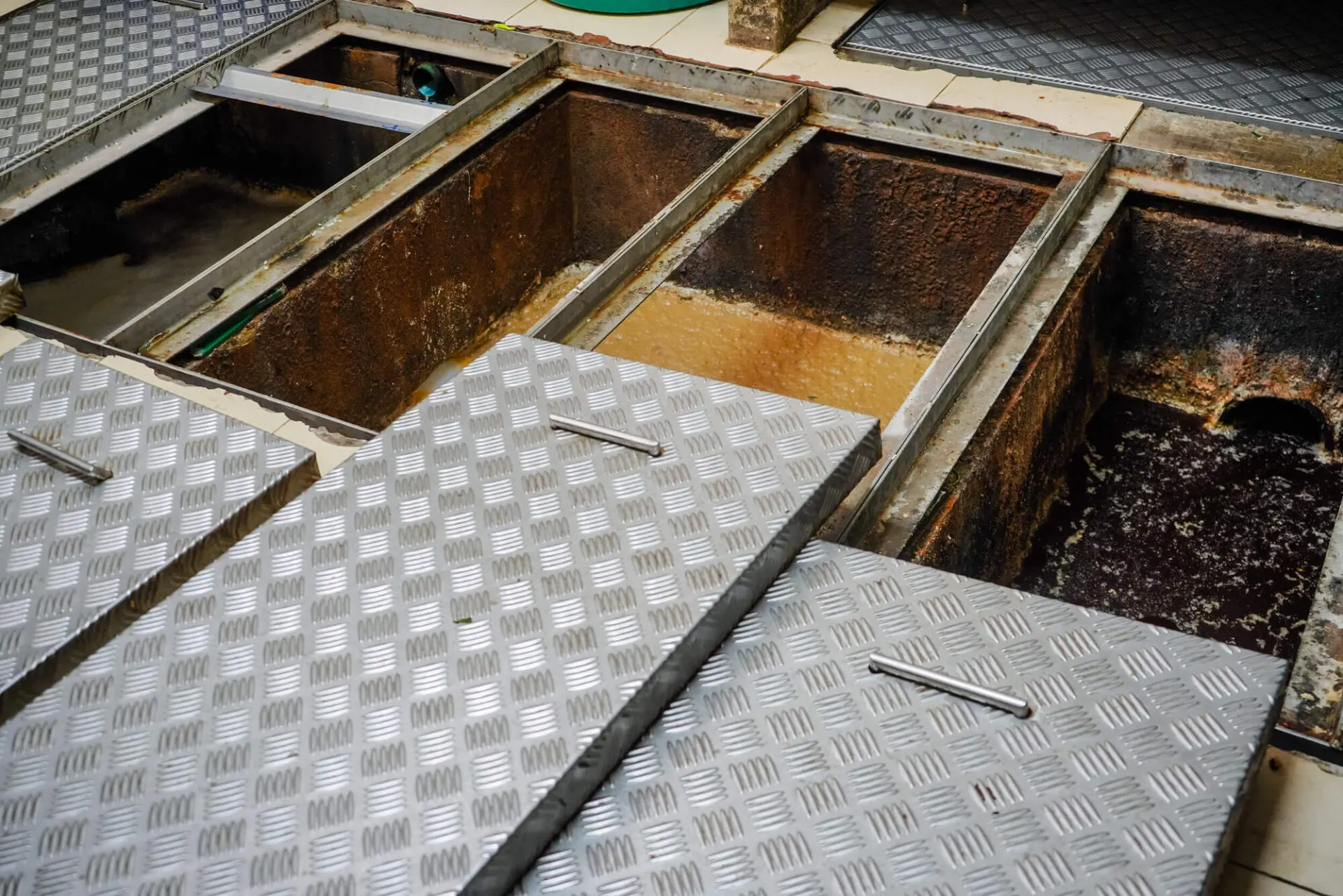
A grease trap slows kitchen wastewater down long enough for it to separate. FOG is lighter than water, so it floats to the top. Food solids sink to the bottom. The cleaner water in the middle flows out to the sewer. The whole design depends on that separation by gravity, and anything that keeps grease mixed into the water defeats it [2][5].
The small units under a sink or next to a dishwasher are usually called grease traps. The large tanks buried outside the building are usually called grease interceptors. They work the same way. Interceptors hold more and get pumped less often.
The most common standard is the 25% rule. A trap is due for cleaning when the floating grease and settled solids together take up 25% of its liquid depth [2][3]. Past that point, there is less clear water in the middle, wastewater moves through faster, and grease starts leaving with it.
Many utilities also set a fixed interval and enforce whichever comes first. Sioux City, Iowa, requires small grease traps to be pumped weekly and grease interceptors quarterly, or sooner if the 25% rule is met [3]. Scottsdale, Arizona, generally expects an outside interceptor at a full-service restaurant to be cleaned at least once every 90 days [4]. Portland, Oregon, sets the cleaning frequency by type of establishment [2].
The right schedule for your kitchen is the one your sewer utility sets, adjusted for how much grease you actually produce. A busy fryer kitchen hits 25% much sooner than a coffee shop, so measure the depth instead of guessing.
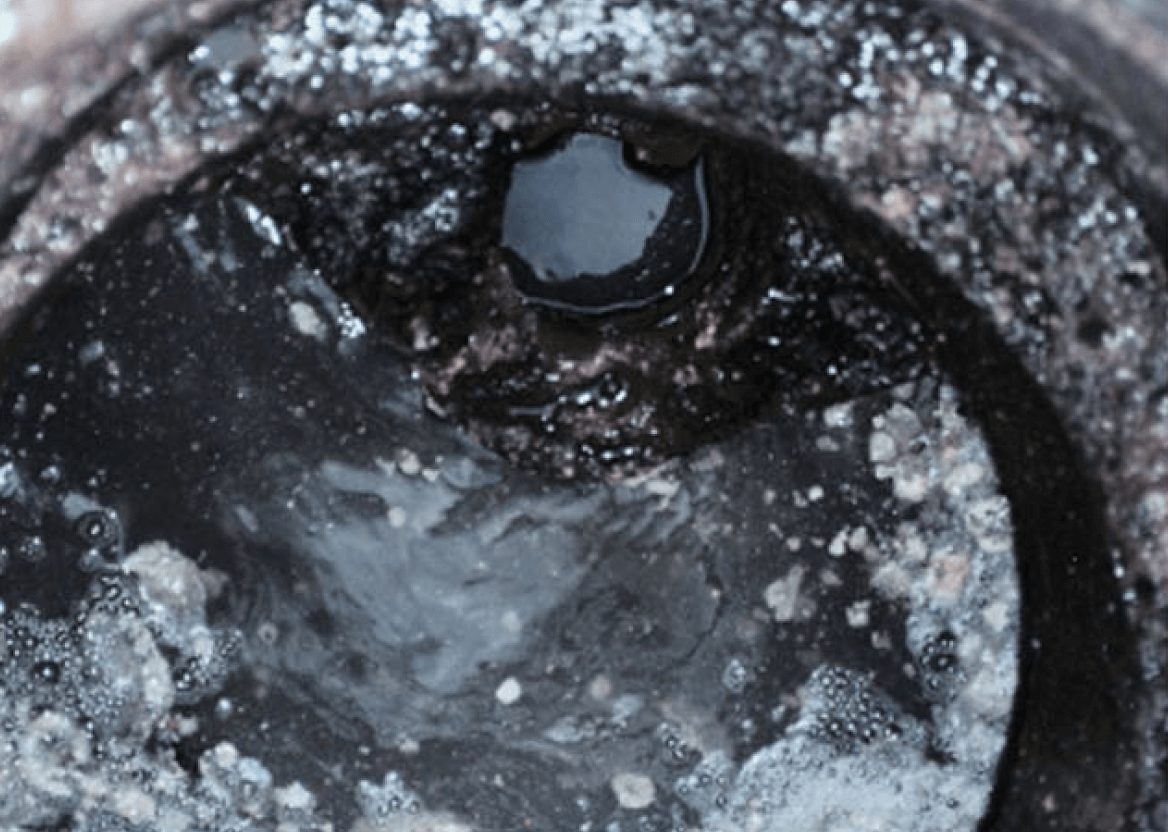
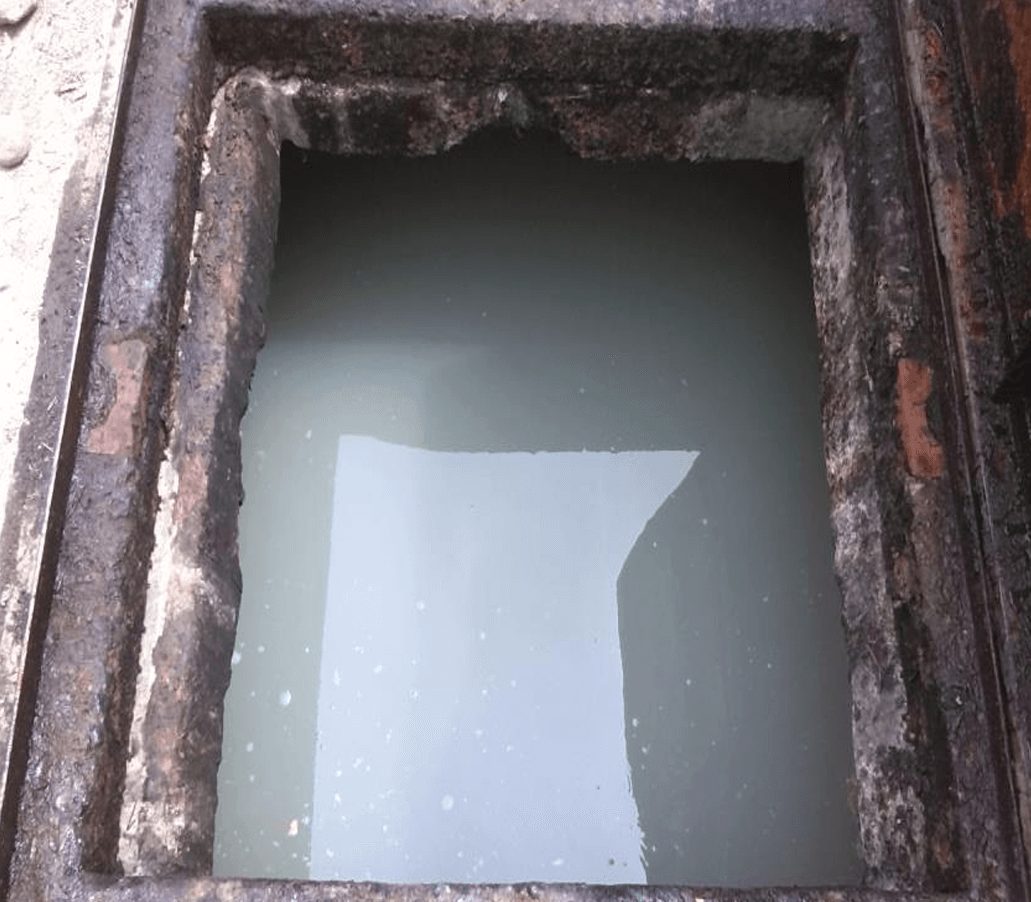
Grease from restaurants, homes and industry is the most common cause of reported sewer blockages, at 47% according to the EPA [1]. Between pump-outs, the same few problems build up:
Hot water, degreasers, caustic drain cleaners and enzyme products all make grease look like it went away. Most of it went downstream. Portland notes that cleaners, solvents and caustics do not eliminate FOG, and that enzymes only change its physical properties for a while [2]. Once the water cools further down the line, the grease separates again and sticks to the sewer pipe.
That is why many utilities ban these products outright. Sioux City prohibits enzymes, emulsifying chemicals, hot water or other agents as a grease abatement method [3]. Austin prohibits enzymes, chemicals or other agents used to make oil, grease or solids pass through the trap [5].
| Pumping | Bacteria treatment | |
|---|---|---|
| What it does | Removes the grease and solids already in the trap | Digests grease as it arrives, between pump-outs |
| How often | Set by your utility, or at 25% full | A small dose daily, or a slow-release tablet or block monthly |
| Odor | Short relief, then it returns as grease builds | Digests the fatty acids that cause it |
| Lines and lift stations | Not reached | Can treat lines upstream and downstream |
| Required by code | Yes | No, and restricted in some cities |
Bacteria treatment does not replace a required pump-out. Scottsdale's pretreatment program says additives will not eliminate the need for routine interceptor inspection and maintenance cleaning [4]. A biological program changes what the truck finds when it gets there, how long a trap takes to reach 25%, and how much odor and line buildup you deal with in between.
Rules on biological products vary by city. Austin prohibits adding any microbial agent directly to a grease trap [5]. Portland bans additives in interceptors regardless of composition [2]. Scottsdale prohibits additives in interceptors and traps but accepts products used to maintain floor drain traps and sewer lines and to control odor, as long as they do not interfere with the interceptor or let grease pass to the sewer [4].
Before you start, ask your utility's FOG or pretreatment program what it allows and get the answer in writing. Where in-trap dosing is not allowed, treating floor drains, branch lines and lift stations may still be. Where it is allowed, start right after a full pump-out so the program begins on a clean trap.
Emulsifiers and enzymes break grease into droplets that travel. Bacteria digest it, and digested grease does not come back together further down the pipe.
Grease Treat is a blend of spore-forming Bacillus strains selected for:
The same strains digest the volatile fatty acids that drive odor and limit the hydrogen sulfide behind corrosion. Grease Treat is active from pH 5 to 9.5, best at 6 to 8, and from 45 to 120°F (7 to 49°C), best at 59 to 104°F (15 to 40°C). Cold traps work slower, the same pattern we measured in cold wastewater.
A high-load commercial grease trap in Wisconsin was struggling to keep up with its FOG load. Solids rebuilt quickly between cleanouts, odor persisted and pumping was the trap's biggest recurring cost. The trap was put on a Grease Treat maintenance program and tracked for 300 days.
| Time | BOD (mg/L) | TSS (mg/L) | Pumping cost vs start |
|---|---|---|---|
| Start | 2,328 | 2,660 | Baseline |
| 30 days | 1,086 | 568 | 63% lower |
| 60 days | 651 | 289 | 81% lower |
| 150 days | 600 | 236 | 82% lower |
| 300 days | Under 200 | Under 230 | 98% lower |
BOD and TSS both fell about 91%, and pumping cost fell about 98%. The full data is in the Wisconsin grease trap case study. At a restaurant kitchen in Colombia, one Grease Treat tablet a month cut the volume of grease pumped out by about 40% within three months, with a clear drop in odor, and the site's own report recommended cutting manual cleanouts from twice a month to once because so little grease was building up (Colombia case study).
Results depend on grease load, water temperature, trap size and how much the trap was fouled at the start.
Rates below are for the 50 billion CFU/g powder. Use a higher dose for the first 3 days, then drop to the daily maintenance range.
| Grease trap volume | First 3 days | Daily maintenance |
|---|---|---|
| Up to 500 gal | 5 g/day | 1 to 2 g/day |
| 500 to 1,000 gal | 10 g/day | 2 to 4 g/day |
| 1,000 to 2,000 gal | 20 g/day | 4 to 9 g/day |
| 2,000 to 4,000 gal | 40 g/day | 9 to 15 g/day |
| 4,000 to 5,000 gal | 65 g/day | 15 to 22 g/day |
Kitchens that prefer not to dose daily can use slow-release forms. One 85 g (3 oz) tablet treats about 150,000 liters of water and dissolves over about 30 days. One 900 g (2 lb) block treats about 1.5 million liters over the same period. Dissolve rate changes with water temperature and flow.
Send us your trap size, how often it is pumped now and what your utility allows through the order form, and we will reply with a starting dose and pricing for Grease Treat.
When grease and solids reach 25% of the trap's liquid depth, or at the interval your sewer utility sets, whichever comes first. Some utilities require small traps to be pumped weekly and large interceptors quarterly. Scottsdale, for example, generally expects a full-service restaurant's outside interceptor to be cleaned at least every 90 days.
It is the point at which a trap needs pumping: when the floating grease layer and the settled solids together fill 25% of the trap's liquid depth. Past that, the trap holds wastewater for less time and lets more grease through to the sewer.
No. Pump-outs required by your utility still have to happen on schedule. Bacteria digest grease between pump-outs, so the trap fills more slowly, smells less and leaves less hardened grease in the lines. Where a utility uses the 25% rule, a trap that fills more slowly reaches it less often.
Grease and solids keep building until there is little clear water left, and the trap starts passing grease straight to the sewer. The lines between the sinks and the trap coat over and back up, the trap turns septic and smells, and the utility can cite the kitchen for the blockage downstream. Grease is the most common cause of reported sewer blockages, at 47% according to the EPA.
It depends on the city. Austin and Portland prohibit adding bacteria directly to traps or interceptors. Scottsdale prohibits additives in interceptors but accepts products used to maintain floor drains and sewer lines if they do not interfere with the interceptor. Ask your utility's FOG program before you start.
Keep the trap on schedule and reduce the grease sitting in it. The smell comes from grease turning septic and releasing volatile fatty acids and hydrogen sulfide. Grease-digesting bacteria break down those compounds, and a tight lid and working vent keep the rest out of the kitchen.
Both separate grease from wastewater by letting it float. A grease trap is usually a small unit inside the kitchen, under a sink or next to a dishwasher. A grease interceptor is a large tank, usually buried outside. Interceptors hold more and are pumped less often.
No. Hot water and degreasers only move the grease further down the line, where it cools and sticks to the sewer pipe. Many utilities prohibit them for that reason.