- Products
- Overview
- Product Forms / Packaging
- Plant Health
- Wastewater
- Livestock Waste
- Aquaculture & Ponds
- Petroleum & Grease
- Case Studies
- Buy
- About
- Contact

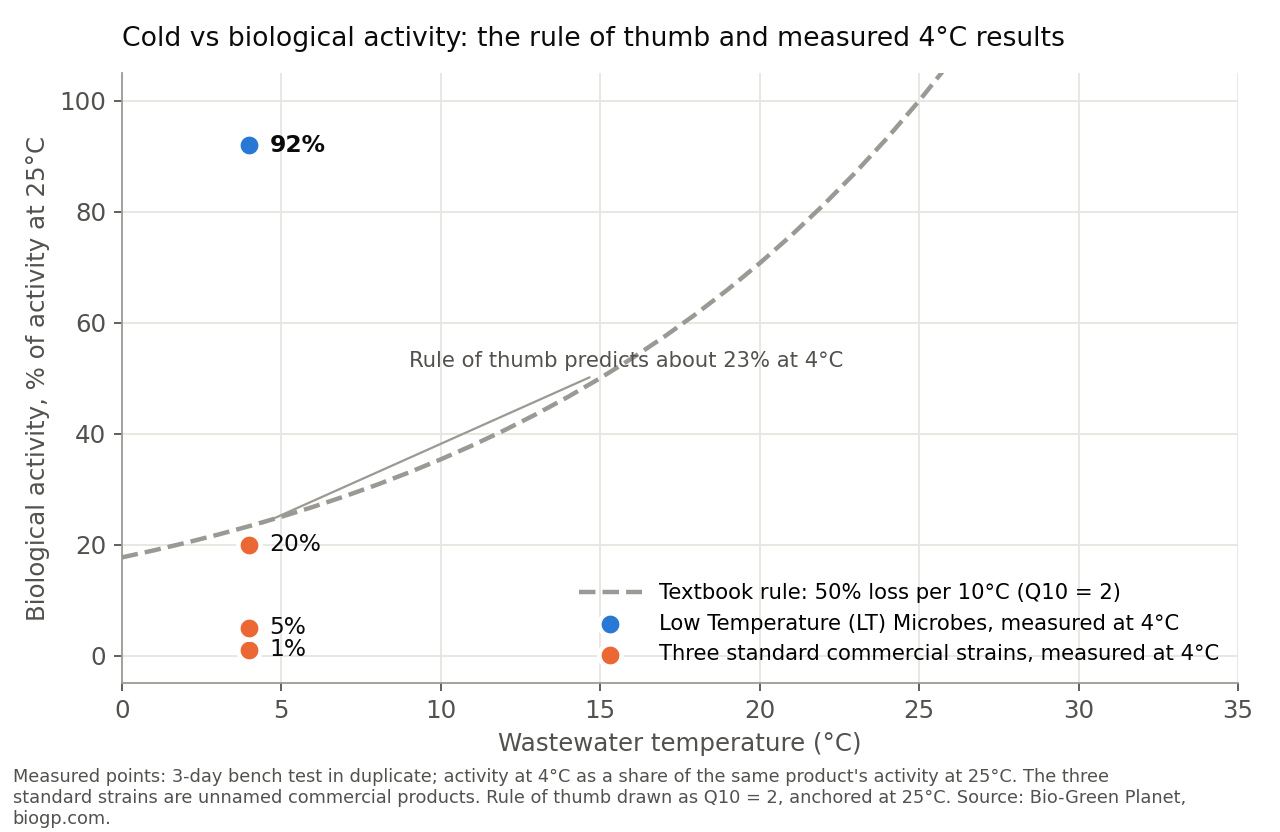
At 4°C, three standard commercial wastewater treatment bacteria kept 1%, 5% and 20% of the activity they showed at 25°C. Low Temperature (LT) Microbes, a Bacillus blend selected for cold, kept 92%. The test ran three days, in duplicate, on the same wastewater sample.
Treatment slows in winter. How much it slows is usually answered with a rule of thumb: for every 10°C the water drops, biological activity falls by about half. The rule is an average across organisms that behave very differently from one another. The bench data below shows how far a real product can sit on either side of it.
Bioaugmentation is the practice of adding selected, cultured bacteria to a wastewater system so the biological population can do more than the native community manages on its own: digest more BOD, hold nitrification through a shock load, keep sludge from building up. In summer a healthy plant often does not need it. In winter the native population slows and the added organisms carry a larger share of the work. So the question to ask about any bioaugmentation product is how much of its warm-water activity it keeps at 4°C. Whether it is alive at 4°C is a different question, and most products pass that one.
Biological reaction rates rise and fall with temperature in a roughly exponential way. Engineers write it as k(T) = k(20) × θ^(T − 20), where θ is a temperature coefficient. Typical θ values in wastewater design run from about 1.02 to 1.10 depending on the process; a common teaching value is 1.04 for decay and 1.07 for maximum growth rate [1]. A θ of 1.07 means the rate doubles or halves every 10°C, which is the same thing as saying Q10 = 2. That is the "50% per 10°C" rule in engineering form.
EPA's pond design manual gives the same idea as a pair of numbers: a first-order BOD removal coefficient of 0.12 per day at 20°C and 0.06 per day at 1°C for normal domestic wastewater, and it notes that BOD5 removals "are generally much lower during winter and early spring than in summer and early fall" [2]. EPA's lagoon troubleshooting manual puts nitrification's working range at 4 to 45°C with an optimum of 35 to 42°C, and warns that aerated lagoons in cold climates "may experience inhibited nitrification" [3].
Anchored at 25°C, the rule predicts about 50% activity at 15°C, 25% at 5°C and 23% at 4°C. The gray dashed line in the first chart is that curve.
The measured points come from a bench study of LT Microbes, the cold-selected blend Bio-Green Planet sells for cold-water wastewater treatment. Its strains are Bacillus subtilis, Bacillus pumilus, Bacillus licheniformis and Bacillus amyloliquefaciens, selected for growth at low temperature. It was tested alongside three commercially available wastewater bacteria products. The competitor products are not named here.
Test 1, activity at 4°C. A wastewater sample was split and treated with each product. Biological activity was measured over three days at 4°C (39°F) and at 25°C (77°F), each treatment in duplicate. The result for each product is its activity at 4°C expressed as a percentage of its own activity at 25°C, so every product is compared against itself, not against the others.
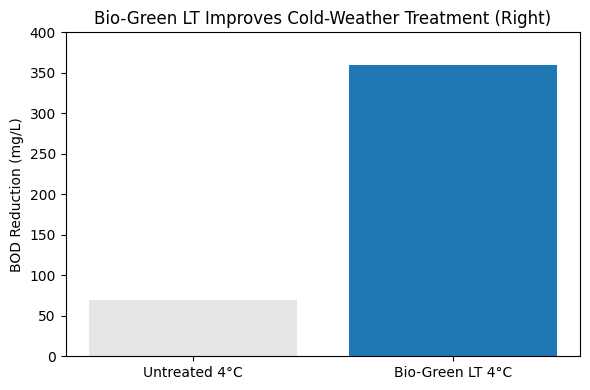
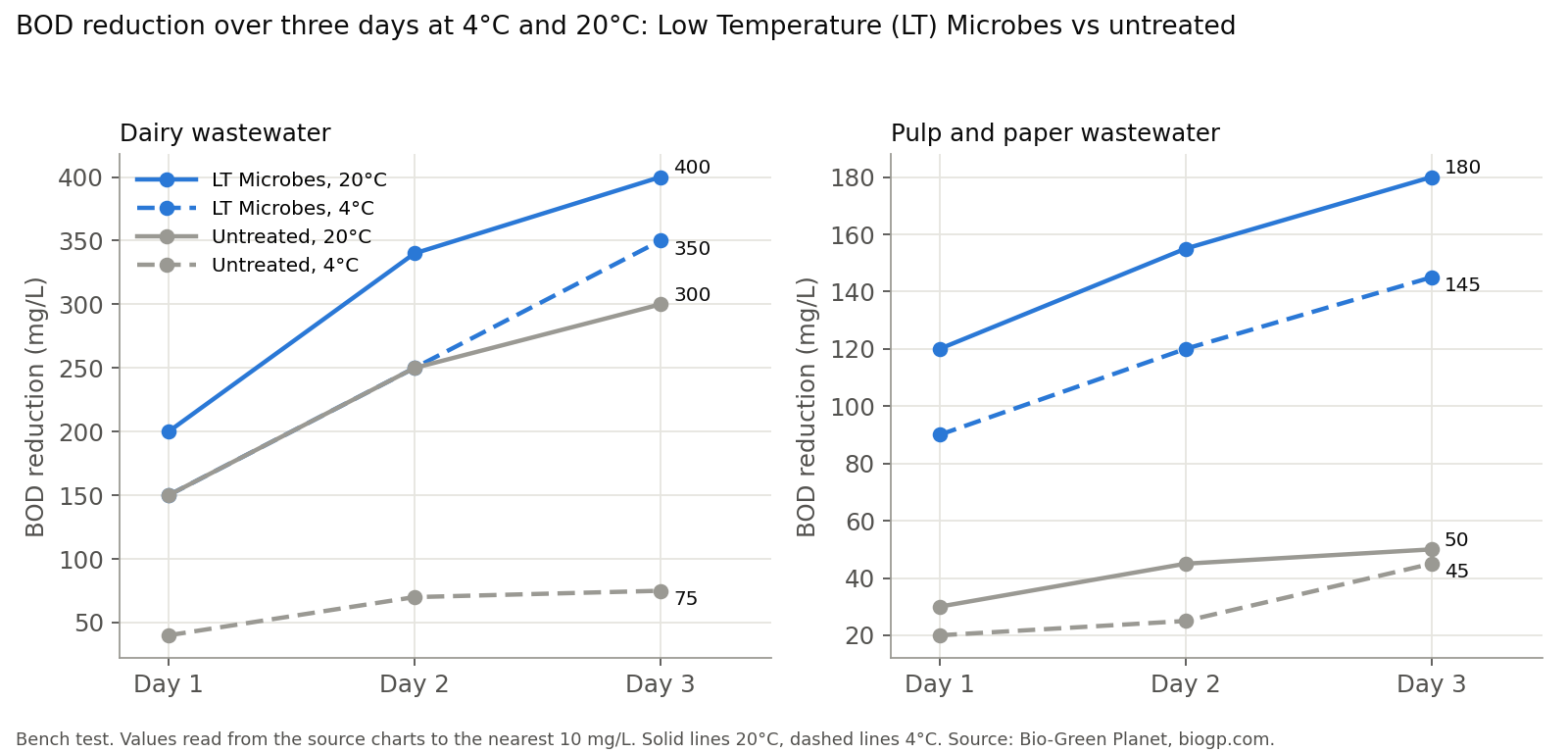
Test 2, BOD reduction in two industrial wastewaters. Dairy wastewater and pulp-and-paper wastewater were each held at 4°C (39°F) and 20°C (68°F), treated with LT Microbes or left untreated, and BOD reduction in mg/L was read on days 1, 2 and 3.
Test 3, growth in meat processing and pulp-and-paper wastewater. Continuous readings at 4°C and 20°C over roughly three days, treated versus control. These are summarized in the text below rather than charted, because the source readings are continuous traces rather than tabulated values.
Values in the tables are summary values rounded to the nearest 5 mg/L. The full set of values behind both charts is available on request; see the end of the post.
| Product | Activity at 4°C, as % of activity at 25°C | Rule of thumb prediction at 4°C |
|---|---|---|
| Standard commercial strain A | 1% | 23% |
| Standard commercial strain B | 5% | 23% |
| Standard commercial strain C | 20% | 23% |
| Low Temperature (LT) Microbes | 92% | 23% |
Two of the three standard products did far worse than the rule predicts. Only strain C landed close to it. LT Microbes held nearly all of its warm-water activity.
A plant that budgets for half the activity per 10°C and is dosing strain A is not getting a quarter of summer performance at 4°C. It is getting almost none. A plant dosing LT Microbes is getting more at 4°C than the rule promises at 15°C. The rule describes a typical mesophile, not any particular product, and the only way to know where a product sits is to measure it.
Dairy wastewater, BOD reduction in mg/L:
| Day 1 | Day 2 | Day 3 | |
|---|---|---|---|
| Untreated, 4°C | 40 | 70 | 75 |
| Treated, 4°C | 150 | 250 | 350 |
| Untreated, 20°C | 150 | 250 | 300 |
| Treated, 20°C | 200 | 340 | 400 |
Pulp-and-paper wastewater, BOD reduction in mg/L:
| Day 1 | Day 2 | Day 3 | |
|---|---|---|---|
| Untreated, 4°C | 20 | 25 | 45 |
| Treated, 4°C | 90 | 120 | 145 |
| Untreated, 20°C | 30 | 45 | 50 |
| Treated, 20°C | 120 | 155 | 180 |
Cold nearly stopped the untreated dairy sample. At 20°C the native population removed 300 mg/L of BOD in three days; at 4°C it removed 75. That is a 75% loss over a 16°C drop, close to what the rule predicts for an unselected population.
The treated sample at 4°C also beat the untreated sample at 20°C. In dairy wastewater, treated at 4°C reached 350 mg/L on day 3 against 300 mg/L for untreated at 20°C. In pulp and paper, treated at 4°C reached 145 against 50 for untreated at 20°C. Adding the cold-selected population did more for BOD removal than 16 degrees of warmth.
The gap between 4°C and 20°C for the LT Microbes sample was modest: 350 versus 400 in dairy, 145 versus 180 in pulp and paper, roughly 12 to 20% lower at 4°C. That is consistent with the 92% activity figure from test 1 and nowhere near the 75% loss the untreated sample showed.
The growth curves in meat processing and pulp-and-paper wastewater told the same story: the treated line rose steadily at 4°C and at 20°C, while the control at 4°C stayed close to flat for the first day and then climbed slowly.
If a supplier says their bacteria work from 4°C to 50°C, ask for activity at 4°C as a percentage of activity at 20 or 25°C. Two of the three standard products in this test were alive at 4°C and doing almost nothing, and the label claim would have been true for both.
The untreated population will lose most of its capacity below 10°C. In the dairy sample the native population dropped to a quarter of its warm-water BOD removal at 4°C. A plant relying on that population alone carries sludge and nutrients through the winter that would have been digested in summer, and they show up in spring as odor, algae and settling complaints.
Even LT Microbes lost 8% of activity and 12 to 20% of BOD removal between 20°C and 4°C. What it does is keep the plant in the range where retention time and aeration can cover the rest.
LT Microbes earns its cost below about 15°C water temperature. Above that a standard blend such as Wastewater Treat does the same work for less, so most northern plants run LT from roughly October to April and switch back. Water temperature, not the calendar, is the trigger.
The activity test used two temperatures, 4°C and 25°C. The rule-of-thumb line in chart 1 is drawn from the equation, not from measurements at intermediate points. A bench series at 8, 12 and 16°C would fill that in and is planned.
Bench BOD reduction over 72 hours compares treatments. It does not predict steady-state plant performance over a season.
These were laboratory samples treated in duplicate. Full-scale results vary with retention time, aeration, load and the existing population. The one field result to set beside this is a cold-climate plant that held 92% biological activity at 4°C, written up as a case study.
The BOD figures are summary values rounded to the nearest 5 mg/L. Differences under 10 mg/L are noise.
The three standard products are commercially available wastewater bacteria and are not identified. The comparison is between selection strategies, general purpose versus cold-selected, and not between brands.
The bench results line up with the peer-reviewed literature on psychrotrophic organisms. Xu and colleagues isolated cold-tolerant strains from domestic wastewater and reported roughly 80% COD removal at 4°C, against about 10% for single mesophilic strains under the same conditions; in a pilot reactor running across seasonal temperatures of 0 to 30°C, influent COD of 150 to 600 mg/L was brought down to about 40 mg/L at a 10-hour retention time [4]. That is the same pattern as chart 1. Organisms selected for cold keep working at temperatures where general-purpose organisms stall.
The field counterpart to these bench numbers is a cold-climate plant that held 92% biological activity at 4°C on LT Microbes, written up with its operating numbers in the cold climate wastewater bioaugmentation case study. If you want the bench values behind these charts as a CSV for your own analysis, contact us and say which comparison you are after.
Bioaugmentation is adding cultured bacteria, usually spore-forming Bacillus strains such as Bacillus subtilis, Bacillus licheniformis, Bacillus pumilus and Bacillus amyloliquefaciens, to a treatment system to raise its biological capacity. It differs from biostimulation, which feeds the existing population with nutrients rather than adding new organisms. Plants use it to recover from upsets, handle seasonal loads, and keep treatment going through cold months when the native population slows.
No. It describes a typical mesophilic population, the kind that dominates most plants in summer. Individual products ranged from 1% to 92% of warm-water activity at 4°C in this test, so the rule is an average and not a property of any particular product.
Around 15°C water temperature on the way down in fall, and back to a standard blend around 15 to 20°C on the way up in spring. Below 15°C most general-purpose strains lose a large share of their activity; above it, a standard blend does the same job for less money.
Yes, and often more, because a septic tank has no aeration or mixing to compensate. Septic tank bacteria slow with the same temperature curve, so solids accumulate over winter and the tank runs closer to its limit by spring. A cold-selected additive such as LT Microbes dosed monthly from fall through spring keeps digestion going; the switch point is the same 15°C water temperature.
Usually not. They are alive and dormant, which is why a supplier can truthfully say a product works from 4°C. Two of the three standard products here were alive and showed 5% or less of their 25°C activity at 4°C.
Sludge containing nitrogen and phosphorus builds up because the native population is too slow to digest it. When water warms in spring that material releases quickly, which is the usual cause of spring odor, algae and settling problems.
About 12 to 20% in the two industrial wastewaters tested (350 vs 400 mg/L in dairy, 145 vs 180 mg/L in pulp and paper over three days). The untreated samples lost 75% and 10% respectively over the same temperature drop.
No. The bench tests were run internally on the LT Microbes strain blend as part of its development, with the competitor products purchased commercially. The method, the numbers and their limitations are stated above so the results can be checked against other work.
The full dataset behind this report is available as a CSV file for your own analysis. Please credit Bio-Green Planet when you use it.
Download the dataset (CSV)