- Products
- Overview
- Product Forms / Packaging
- Plant Health
- Wastewater
- Livestock Waste
- Aquaculture & Ponds
- Petroleum & Grease
- Case Studies
- Buy
- About
- Contact


If the bottom of your pond is a soft black layer that smells when you stir it, that is pond muck, and in most ponds it is organic material rather than soil. A typical dredging job runs $7,000 to $30,000, according to Angi's 2025 cost data [4]. Organic muck can be broken down in place instead, by bacteria working with oxygen at the bottom. With Muck Fighter, that means one block per surface acre every 30 days while the water is above about 59°F (15°C).
The closest result we have is from a Wisconsin pond with floating scum, cloudy water and a strong bottom odor. After a program of Pond Treat powder, which uses the same bacteria as Muck Fighter in a different format, the water was visibly clearer and the odor was gone within about two weeks (Wisconsin pond case study). That was a single pond and a different product format, and muck depth was not measured.
Pond muck is the organic part of the sediment on a pond bottom: soft, dark and often smelling of rotten eggs when disturbed. Ponds accumulate organic matter from rotting plants, leaves and detritus [3].
Not every bottom layer is muck. Sand, silt and clay washed in from a bare bank, a construction site or a field can look similar in a photo. Bacteria cannot digest mineral sediment.
| Bottom layer | What it feels like | Where it comes from | What removes it |
|---|---|---|---|
| Organic muck | Soft, black, slippery, smells when stirred | Leaves, clippings, fish and goose waste, dead plants | Bacteria plus oxygen, over months |
| Mineral sediment | Gritty or firm, brown or gray | Eroding banks, runoff from fields and construction | Dredging, then fixing the erosion |
| Mixed (most older ponds) | Soft on top, firm below | Both | Digest the organic top first, then judge what is left |
A quick check: push a pole into the bottom at several spots. If it sinks easily through a soft, dark layer before it hits something firm, that soft layer is the organic part.
Muck builds when more organic material comes in than the pond's bacteria can break down. The usual inputs are fallen leaves, grass clippings, fish and goose waste, uneaten feed, and the plants and algae that die back each year.
Once the layer is thick:
When the bottom runs out of oxygen, decomposition there goes anaerobic, and the rotten-egg smell is hydrogen sulfide from that process.
Dredging removes sediment with an excavator or by pumping it out through a pipe [2]. Angi's 2025 cost data puts a typical pond dredging job at $7,000 to $30,000, or $20 to $60 per cubic yard of sediment removed, with pond size, sediment volume and site access driving the price [4]. Clemson Extension names the volume of sediment as a principal factor in dredging cost [2].
The spoil also has to go somewhere upland, be dewatered and be planted [2]. Dredging can need a federal permit for the dredged material [2], and some states add their own, so check with your state agency and the U.S. Army Corps of Engineers district before work starts. Texas A&M AgriLife advises against dredging in cold winter months, when it is hard on equipment and operators; in spring when water is below 70°F, because it is a danger to young fish; and above 95°F, when suspended silt can lower dissolved oxygen [5].
Dredging is the right call when a pond has filled in with mineral sediment, or when years of buildup have left too little depth for the pond's use. For an organic layer, it hauls away material that bacteria can break down in place.
Pond muck removal without a dredge comes down to four methods, and they work best in combination.
| Method | What it does | Best for | Limits |
|---|---|---|---|
| Rake or pond vacuum | Pulls muck out by hand or pump | Small ponds, beaches, koi ponds | Labor; stirs up the bottom; the sludge needs somewhere to go |
| Bottom aeration | Circulates oxygen through the full depth | Ponds that stratify in summer | Equipment and power; does not add bacteria |
| Beneficial bacteria | Adds muck-digesting bacteria to the bottom | Organic muck | Slows in cold water; works over months; no effect on sand or clay |
| Leaf and runoff control | Stops new organic material from coming in | Every pond | Prevents, does not remove |
Bacteria on the bottom need oxygen to do the job, and digesting muck uses oxygen too [1]. Subsurface diffusers circulate oxygen through a pond's entire depth and keep it from stratifying, which maintains oxygen in the bottom sediment [1]. In a pond that stratifies, plan on aeration alongside the bacteria. Leaf control cuts the load they have to digest the next year.
Muck-digesting bacteria release enzymes that break leaves, plant debris and fish waste into simpler compounds, and then they consume them. The organic layer thins from the top down instead of being moved somewhere else. Texas A&M AgriLife says beneficial pond bacteria decompose organic matter such as dead vegetation and cycle nutrients [5].
Digesting muck does not make its nutrients disappear; the bacteria cycle them. Keeping oxygen at the bottom with aeration helps keep phosphorus in the sediment instead of the water [1].
When you compare bacterial products, check these on the label:
Bacteria do not digest sand, silt or clay, and Muck Fighter is not an algaecide.
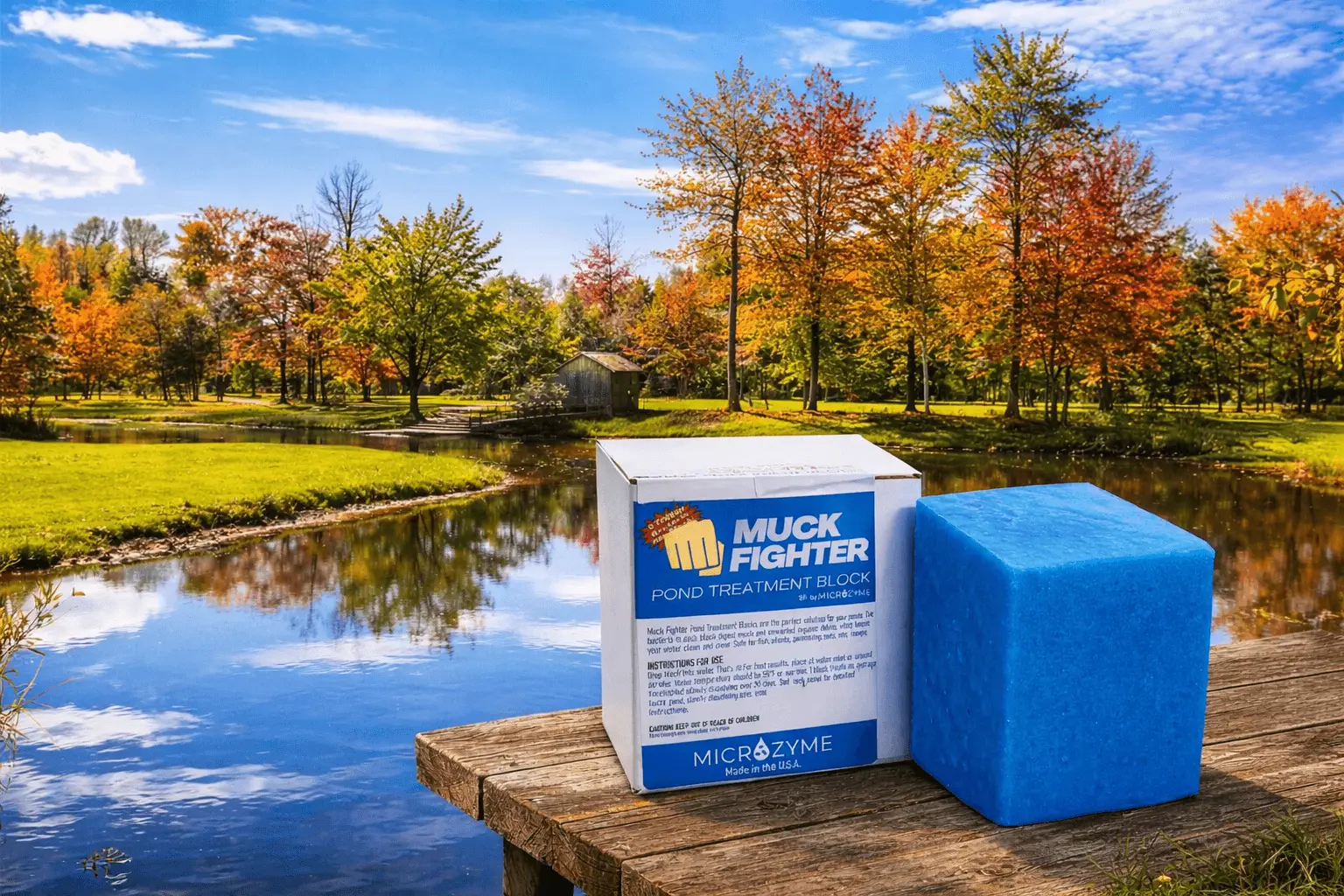
Muck Fighter is a slow-release block that sinks to the bottom and dissolves over about 30 days. The Muck Fighter product page rates one block for up to 1 acre of surface, about 2 million gallons at a 6-foot average depth, and says blocks can be divided for smaller ponds.
| Pond surface area | Blocks per 30 days |
|---|---|
| Under 1 acre or a water feature | Part of a block, divided in proportion to surface area |
| 1 acre | 1 block |
| Each additional acre | 1 more block |
| Lake swim area or dock | 1 per acre treated; treat the area you use, not the whole lake |
For water between 41 and 59°F (5 to 15°C), ask us about the Low Temperature Muck Fighter block. If you would rather broadcast across the surface, the same bacteria come as Pond Treat powder, at 40 g per acre to start and then 10 g per acre weekly for the 50 billion CFU/g grade.
Time the program by water temperature near the bottom of the pond, around 59°F (15°C), not by the calendar or the air temperature.
Track the bottom as well as the water, because clarity and odor can change long before muck depth does.
Results depend on water temperature, how much organic material comes in each year, circulation and how deep the muck was at the start.
Single blocks are on Amazon through the product page. For several acres, cases or a quote, send us your pond's surface area, average depth and water temperature through the order form, and we will reply with a block count and pricing for Muck Fighter.
Digest it in place. Add bacteria that break down organic sediment, keep oxygen at the bottom with aeration, and stop new leaves and clippings from going in. This works for organic muck. A pond that has filled with sand, silt or clay still needs dredging.
Muck-digesting pond products use bacteria that release enzymes to break down leaves, plant debris and fish waste, then consume what they break down. Before you buy, check the label for a live CFU count, whether the product sinks to the bottom, and the water temperature it works in.
They can, on organic muck in warm water with enough oxygen at the bottom, and they work slowly. Water clarity and odor usually change before the muck layer does. They do not remove sand or clay, and they slow down in cold water. Measure muck depth at marked spots so you can see whether yours is changing.
Angi's 2025 cost data puts a typical job at $7,000 to $30,000, or $20 to $60 per cubic yard of sediment removed. Pond size, sediment volume and site access drive the price, and permits and spoil disposal add to it.
Pond sludge and pond muck are the same thing. The natural route is bacteria, oxygen at the bottom and less organic material going in: skim leaves in fall, keep grass clippings out of the water, aerate in summer, and treat the bottom while the water is above about 59°F.
Rake or vacuum the shallow edges where muck is easy to reach, then treat the rest biologically. Bacteria blocks placed near aerators, inlets or wherever debris collects work on the bottom with the pond full.
Aeration on its own does not add bacteria, but it keeps oxygen in the bottom water and sediment, which bacteria need to break muck down. Subsurface diffusers circulate oxygen through the full depth and stop a pond from stratifying in summer. Most ponds with a thick layer do best with both.
When the water is warm. Start once the pond is above about 59°F (15°C) in spring and replace blocks every 30 days through the warm season. In fall, put your effort into keeping leaves out. For cool water between 41 and 59°F, ask about the low-temperature block.