
- Products
- Overview
- Product Forms / Packaging
- Plant Health
- Wastewater
- Livestock Waste
- Aquaculture & Ponds
- Petroleum & Grease
- Case Studies
- Buy
- About
- Contact

Three microbial products were run on the same petroleum contaminated soil for 15 days. Petroleum Treat cut the heavy C37-40 fraction 73%, against 55% and 39% for the two competing products, and it beat both on every fraction that could be quantified.
| TPH fraction | Before (ppm) | Petroleum Treat, day 15 | Competitor A, day 15 | Competitor B, day 15 |
|---|---|---|---|---|
| C10-14 | 110 | Below 50 (limit) | Below 50 (limit) | Below 50 (limit) |
| C15-28 | 16,800 | 7,420 (56% lower) | 10,500 (38% lower) | 11,000 (35% lower) |
| C29-36 | 15,300 | 6,260 (59% lower) | 9,640 (37% lower) | 11,700 (24% lower) |
| C37-40 | 1,470 | 390 (73% lower) | 660 (55% lower) | 890 (39% lower) |
| Three quantified fractions combined | 33,570 | 14,070 (58% lower) | 20,800 (38% lower) | 23,590 (30% lower) |
| Hydrocarbon odor | Strong | Gone by day 8 | Not recorded | Not recorded |
Soil taken from a petroleum contaminated site in China came into the lab with a strong hydrocarbon odor and 33,570 ppm of total petroleum hydrocarbons across the three fractions heavy enough to quantify: 16,800 ppm of C15-28, 15,300 ppm of C29-36 and 1,470 ppm of C37-40. A fourth fraction, C10-14, measured 110 ppm and sat close to the 50 ppm reporting limit.
Almost the entire load is mid chain and long chain, and that shape matters more than the total. Light fractions weather off and biodegrade quickly, so they rarely control a cleanup schedule. The heavy end does. Longer carbon chains are waxy, poorly soluble in water and less available to the bacteria that have to digest them, which is why C37-40 is the fraction that stalls at the tail of a remediation project and keeps a site out of compliance after the easy numbers have already come down.
The second problem has nothing to do with the soil. A site owner or remediation contractor comparing microbial products has almost nothing to go on. Every product sheet claims a high CFU count, a broad strain list and fast hydrocarbon degradation, and none of that predicts what happens in a specific soil. The only way to separate them is to run them on the same material at the same time.
Petroleum Treat (PT) and two competing oil eating bacteria products were applied to the same contaminated soil under matched conditions, and TPH was measured by carbon fraction on day 15.
Soil from the contaminated site was sampled and analyzed for total petroleum hydrocarbons by carbon fraction. Those are the day 0 numbers. The soil was then split and treated three ways: Petroleum Treat (PT), a high-CFU blend of petroleum degrading bacteria, and two competing microbial products, all under matched conditions. Odor was tracked through the run, and TPH was re-analyzed by fraction on day 15.
Petroleum Treat works by feeding on the hydrocarbons rather than moving them somewhere else. The blend produces biosurfactants and broad spectrum enzymes that make oil more available to the bacteria, which matters most on the heavy fractions, where low solubility is the thing holding degradation back.
Day 0 is a baseline, not an untreated control. No untreated soil was carried alongside the three treatments, so the trial shows which product moved the soil furthest in 15 days, not how much of the reduction would have happened without any product at all. The two competing products are the closest thing here to a reference point.
The source record also does not state the soil volume, the application rate, the temperature or the moisture content of the test. Those affect degradation rate in any soil program, and none of them are documented here, so the percentages should be read as a head to head ranking under one shared set of conditions rather than as a rate you can transfer to a different site.

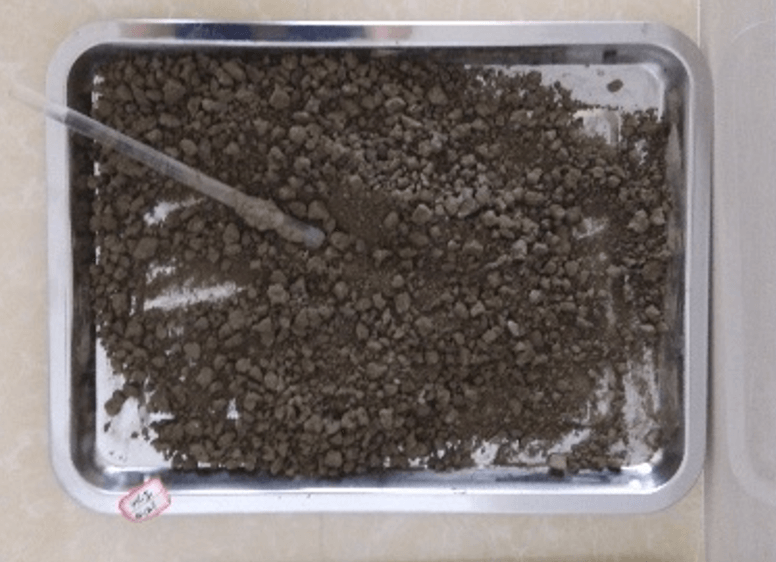
Before: soil from the contaminated site carried 33,570 ppm TPH across the quantified fractions, including 16,800 ppm of C15-28 and 15,300 ppm of C29-36, with a strong hydrocarbon odor.
Day 15: Petroleum Treat cut C37-40 by 73%, C29-36 by 59% and C15-28 by 56%, and the hydrocarbon odor was gone by day 8.
C37-40, the fraction that normally sets the length of a cleanup, fell from 1,470 ppm to 390 ppm under Petroleum Treat in 15 days, a 73% reduction. Competitor A brought the same fraction to 660 ppm, a 55% reduction. Competitor B reached 890 ppm, 39%.
The mid chain fractions followed the same order. C29-36 dropped from 15,300 ppm to 6,260 ppm with PT, 59% lower, against 9,640 ppm for Competitor A (37%) and 11,700 ppm for Competitor B (24%). C15-28 went from 16,800 ppm to 7,420 ppm, 56% lower, against 10,500 ppm (38%) and 11,000 ppm (35%). C10-14 started at 110 ppm and finished below the 50 ppm reporting limit under all three products, so no removal rate could be calculated for it.
Adding the three quantified fractions together, the soil went from 33,570 ppm TPH to 14,070 ppm under Petroleum Treat, a 58% reduction in 15 days. Competitor A finished at 20,800 ppm and Competitor B at 23,590 ppm, 38% and 30%. Those combined figures are summed from the per fraction lab results rather than reported directly.
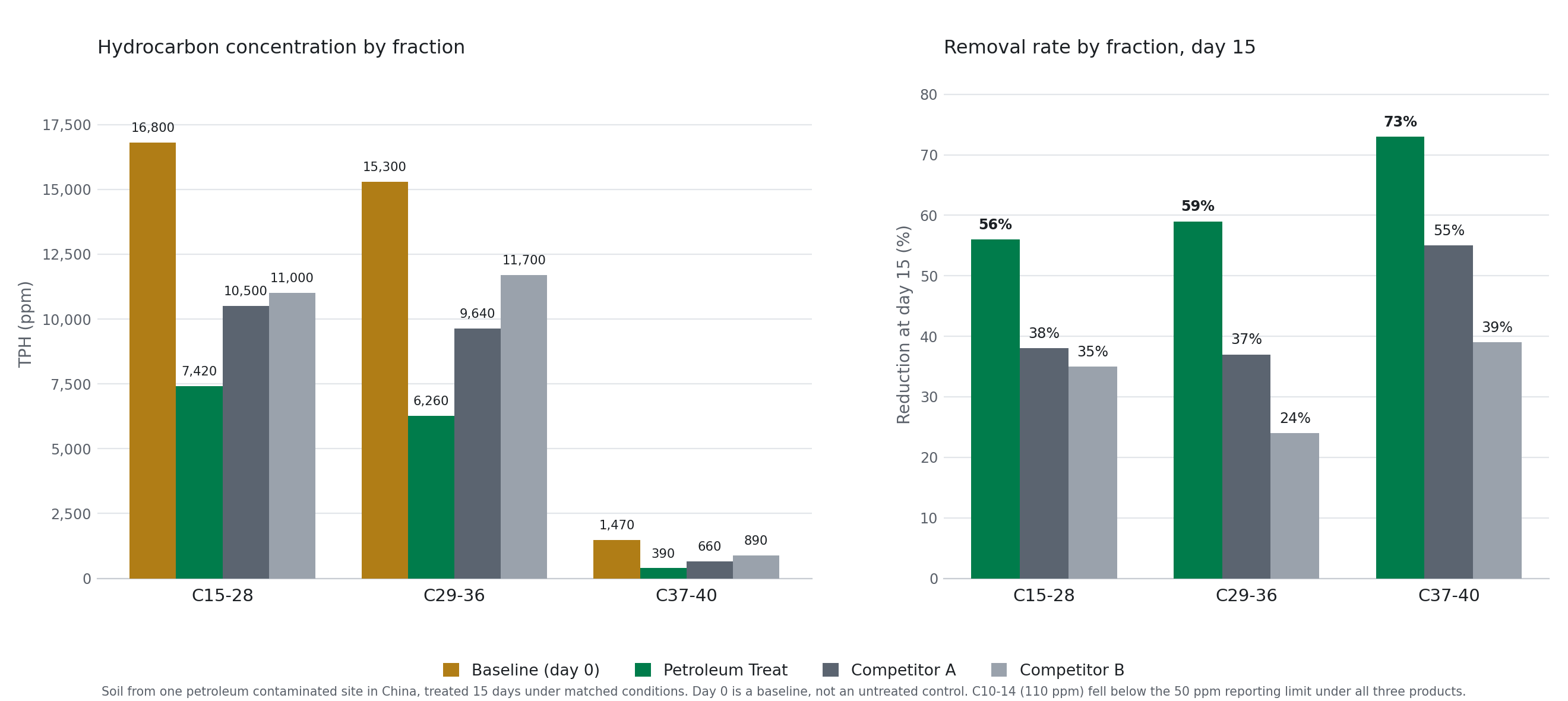
PT led on every fraction that could be quantified, and the gap widened as the chains got longer. On C29-36 it removed 59% where the better competitor removed 37%. On C37-40 it removed 73% against 55%. Products that look similar on a light or mid range hydrocarbon can separate sharply on the heavy fractions.
Eight days after Petroleum Treat was applied, the pungent hydrocarbon smell was gone. Odor is not a compliance metric and it was not tracked for the two competing products, so it belongs in the record as an observation about PT and nothing more.
What this trial does not establish is an endpoint. Fifteen days is a short window, the run stopped there, and 14,070 ppm of TPH is still a contaminated soil. What it does establish is comparative. On one batch of heavily contaminated soil, under one shared set of conditions, three microbial products separated clearly, and the separation was widest on the hydrocarbons that are hardest to degrade.
For what the same product does over a longer run, the on-site windrow program on 20,000 ppm soil cut TPH 97% and returned the treated soil to the site, and a municipal oil water separator went from 22,940 to 79 mg/L over 120 days.
They can, though heavy fractions degrade more slowly than light ones because long carbon chains are waxy and poorly soluble, which limits how available they are to bacteria. In this trial the heavy C37-40 fraction fell from 1,470 ppm to 390 ppm in 15 days under Petroleum Treat, a 73% reduction, while two competing microbial products reached 55% and 39% on the same soil.
C37-40 refers to petroleum compounds with 37 to 40 carbon atoms per molecule, the heavy end of a total petroleum hydrocarbon analysis. They are waxy, close to insoluble in water and far less bioavailable than diesel range compounds, so they tend to be the last thing left on a remediation site after the lighter fractions have come down.
In this trial, 15 days took the soil from 33,570 ppm TPH across the quantified fractions to 14,070 ppm, a 58% reduction. Rate depends on soil type, temperature, moisture, oxygen and how heavy the contamination profile is, and the run stopped at day 15 rather than at an endpoint.
The only way to answer that for a given soil is a side by side test. This one ran three microbial products on the same contaminated soil under matched conditions. Petroleum Treat led on every fraction that could be quantified: 56% on C15-28, 59% on C29-36 and 73% on C37-40, against 38/37/55% for one competitor and 35/24/39% for the other.
No. Day 0 is a baseline, not an untreated control. No untreated soil was carried through the 15 days, so the trial ranks three products against each other rather than measuring how much hydrocarbon would have degraded on its own. The two competing products are the reference points here.
Run them on the same material, at the same time, under the same conditions, and measure by carbon fraction rather than by total TPH alone. A total can be moved by the light fractions that would have weathered off anyway. Fraction by fraction data shows whether a product is reaching the heavy compounds that actually control the schedule.
The pungent hydrocarbon smell in this soil was gone eight days after Petroleum Treat was applied, before the day 15 lab analysis. Odor was not tracked for the two competing products, and it is an observation rather than a compliance measurement, so treat it as a field indicator that biological activity is under way and not as a substitute for TPH data.
On a real site it is typically mixed through the soil and kept moist and aerated, often in windrows that are turned on a schedule so the bacteria stay active. An industrial site running that approach with Petroleum Treat cut soil TPH from about 20,000 ppm to 650 ppm and returned the treated soil to the site. The source record for this comparison trial does not state the application rate or the mixing method used.
That is the usual reason to choose it. Treating soil in place or in on-site windrows avoids excavation, trucking, landfill tipping fees and clean fill replacement. Whether it is viable on a given site depends on the contamination profile, the schedule and the cleanup target.
Petroleum Treat is sold by Bio-Green Planet in powder, liquid, block and tablet formats, in bulk, wholesale, OEM and private label supply. Specifications, application rates and packaging sizes are on the Petroleum Treat product page.
This is the product behind these results. Open its page for full specifications, packaging, and dosing rates.
Tell us your system size and current numbers. We will recommend a starting dose and send a quote.
Request a Quote


